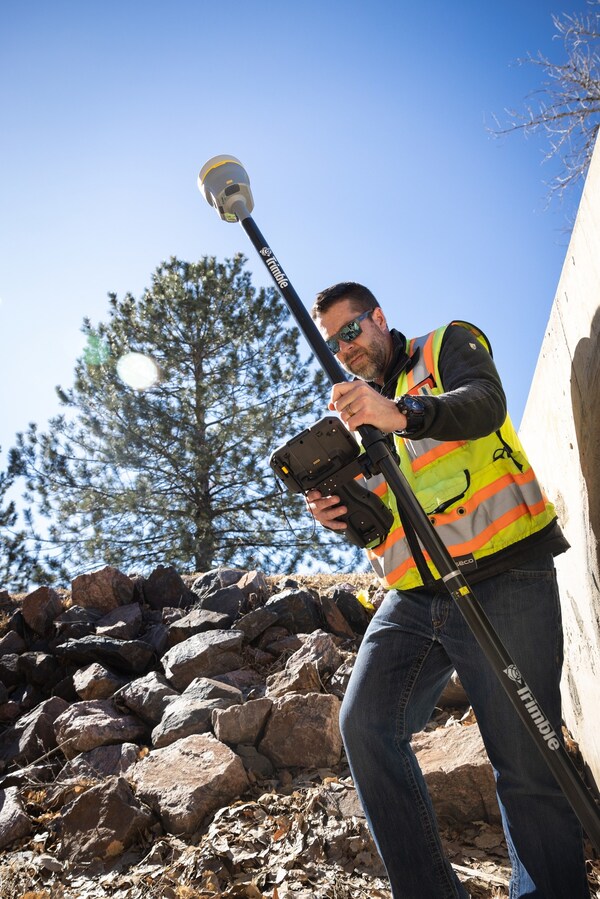

Category: Mobile

  • Mobile solutions: Higher accuracy blurs the lines between old product classes

    Mobile solutions: Higher accuracy blurs the lines between old product classes

    Photo: Leica Geosystems
    Photo: Leica Geosystems

    Do you remember the free-standing car navigation devices that were popular for a while, such as those made by Garmin and Magellan? Few people use them anymore because to find our way when driving, most of us use our smartphones instead.

    Smartphones now have a plethora of sensors, including inclinometers, accelerometers, magnetometers, barometers and light sensors. However, cost and size constraints (the insides of those small devices are so crowded!) limit the accuracy of smartphones’ GNSS receivers.

    Therefore, to accomplish professional mapping tasks, it is now increasingly common to pair a smartphone — which provides computing power, a display, motion sensors, a camera and Internet connectivity — with an external GNSS receiver and antenna.

    This and other changes in the industry make product categories long in use obsolete or, at least, less compelling. What is a mobile GNSS solution? Are the terms “mapping grade” and “resource grade” still useful? Who is using which devices for which tasks?

    I discussed these issues with Bernhard Richter, VP Geomatics at Leica Geosystems, which is part of Hexagon, and with Igor Vereninov, CEO of Emlid.

    — Matteo Luccio, Editor-in-Chief

    Leica Geosystems: Conversation with Bernhard Richter, VP Geomatics at Leica Geosystems, part of Hexagon

    We used to divide GNSS receivers into consumer grade, resource grade (for GIS data collection) and survey grade.

    Those lines don’t exist anymore to the same extent. Some of the lower-cost chipsets — which were originally built for mobile phones and Garmin devices and lower-accuracy stuff — can now provide higher accuracy. We call them industrial-grade chipsets. The need for UAVs, e-scooters, e-bikes, automotive applications, etc., triggered their development. They are coming closer to the premium boards — let’s call them the multi-frequency, multi-constellation receivers that were always built for real-time kinematic (RTK)-type applications.

    So, it’s the bottom that’s coming up.

    There is still a need for single frequency code-only chips on the one hand for the mass market and, on the other hand, for premium devices from companies such as NovAtel (part of Hexagon), Trimble, Hemisphere and Septentrio. There is a new tier, which we call industrial grade, from companies such as u-blox and Unicore, which come a bit closer to the premium segment.

    I’ve always thought of location-based services (LBS) as using consumers’ locations to connect them with retail and services. People use their smartphones to find the nearest coffeeshop, but what has not happened is coffeeshops saying, “Hey, I see that you are within 500 feet of our store. You should come in, because we’ll give you a discount.”

    In our field, we make money by providing decimeter- or centimeter-level solutions to our users for surveying, machine control, GIS, etc. When it comes to needing locations for other applications, such as retail, everything is already nicely integrated in smartphones, and consumers just utilize what is there.
    In order to get a better precision than the one provided by the cellphone, you need a small, extra GNSS device connected to the cell. Then, instead of using the position provided by the phone, the application will use that much better position. That trend will go on for quite a while. This is the change to what was standard in the last decade, when we built dedicated handheld controllers with fairly high-cost chipsets to enable GIS applications. These GIS devices seem to be disappearing. It’s either an Android or iOS-based phone or tablet, and now you add a hockey puck-type GNSS antenna. Then, you override or mock the position that is coming from the internal chipset on the phone, and the app uses that more precise position. That is the new standard for GIS, so to speak.

    Analogously, for a decade we had dedicated car navigation devices. They disappeared because our phones now do that.

    Exactly. Where we can really add is in providing that extra bit — not only hardware, but also software and services. Decades ago, we developed the HxGN SmartNet RTK service. Now, we also have HxGN SmartNetGlobal, which is both a terrestrial-based service and augmented by a satellite-based precise point positioning (PPP)-type service. Simple car navigation devices such as those by Garmin or dedicated GIS controllers have almost vanished. It’s always a smartphone or a tablet plus, if a centimeter-level solution is needed, an additional device.

    It does not make a lot of sense to fully integrate high-precision GNSS into these mobile devices, because the customer group who really needs a centimeter-type solution is too small, and it would put an extra burden on the engineering for the tablet or the smartphone. Nobody complains if you attach a device that weighs a few hundred grams. I also think that you shouldn’t integrate things that don’t belong together. The different components have different life cycles. A smartphone today is old when it’s 18 months old, right? But, with the volume that’s sold to customers needing high precision, we cannot renew the equipment every year.

    Are you talking about a smart antenna?

    Today, a GNSS chipset can be as small as a two-Euro coin. However, if you want to do high-precision GNSS, you still need a decent-sized antenna. So, you cannot go to a fingernail size with the antenna element. If you need a good amount of multi-pass mitigation in the analogue way, you need a beer coaster-sized ground plane. Now, typically, you also put in a MEMS-based inertial measurement unit (IMU), so that you do more than just the pure GNSS position — pitch, roll and yaw are important as well.

    Phones already have IMUs.

    It’s always a matter of what you want. Do you want five meters or one meter or sub-decimeter repeatable at high reliability? Then you need to add more, higher-value components, right? Also, if you just take what’s in an iPhone, it’s not so easy to calibrate those MEMS. Engineers could probably solve the problem, but precision is never the primary goal for a smartphone and would increase complexity.

    In addition, in an iPhone, you don’t really worry about aging of the components or whether they can survive a fall from 1.5 m. So, we look at the application and the environment in which the customers are using it, then we select the best components to really add value to, let’s say, the existing iPhone’s position.

    In September, we released a high-grade antenna about the size of an ice hockey puck with a very small and tightly integrated GNSS chipset and inertial measurement unit (IMU). Then, of course, we have our own processor to run our positioning engine. It brings in all the corrections that we can provide with our SmartNet service. So, we provide a centimeter solution and pitch, roll and yaw in the most compact form.

    Then the phone becomes just the interface.

    Yeah, the phone position gets mocked by the position, for example, from a FLX100 plus, and the app takes the better position.

    The app is the user’s interface with the puck.

    Yes, but the survey device — the “GNSS puck” together with the phone running the app — is only one element of what a typical GIS user needs. Most important are the data themselves and the cloud system that hosts them. The data are the key enablers. If you think of Esri, for example, their value is hosting the data, having the geospatial relationship between the data and enabling decision-making.

    The geospatial acquisition part became really easy and can even be done in a tilt-compensated way, so you don’t even need to level your survey pole. The surveyed points are typically automatically synchronized or uploaded to the cloud system. So, if you say that the phone is just the user interface, I kind of disagree.

    A utility technician using the Leica GS05 GNSS receiver for the surveying and utility industries, which Leica released in September. (Photo: Leica Geosystems)
    A utility technician using the Leica GS05 GNSS receiver for the surveying and utility industries, which Leica released in September. (Photo: Leica Geosystems)

    You’re collecting data and feeding them to the cloud, but they are also on the device to display.

    The data themselves are only stored inside the app or in the cloud and can be displayed. The GNSS device itself keeps streaming the position but nothing gets stored there.

    How much do you collaborate with ESRI, in terms of their application and the data?

    Jack Dangermond [Esri’s co-founder and president] once said, “portal to portal is key these days.” At Hexagon, we have our applications, our industries and our focus areas, and ESRI has its. To me, the way to be successful is to have systems that are compatible and portals that can talk to each other. So, to me, portal to portal is and will be key.

    You mean the portals in the cloud?

    Yes, they have an API interface and they can talk to each other. I’ll give you one concrete example. We have a product called the FLX100. It is a little puck, has a helix antenna, a receiver engine, but does not have a cellular phone integrated. We’re using the cellular connection of the user’s mobile phone. So, you connect the mobile phone to the FLX100.

    We have software called Zeno Mobile One that has an Esri interface. So, we can immediately synchronize everything we measure with ArcGIS Online and ArcEnterprise. This is how we developed our GIS asset collection software. We need an accurate position, of course, which we provide through the hardware that we sell with the FLX100 plus. It can also connect to any RTK service — but, ideally, we connect to our own SmartNet service. As soon as we collect an asset — such as a pipe, a fire hydrant or a manhole — the operator annotates it, “This is a manhole, this is a gas pipe, this is a water pipe,” whatever. Then, the data can be uploaded immediately, already in the right file structure, e.g. into an Esri environment.

    We can also run an Esri product, such as ArcGIS Field Maps, on the smartphone and still talk to our hardware. This is very interchangeable these days. If you’re not doing this, I think you limit yourself too much when it comes to data collection. We understand the whole workflow much better than in the past and can be open to certain services, such as Web Map Service (WMS) or Web Feature Services (WFS). You can download the map of your town, then download, let’s say, the entire public water system and load it into this map. Then you can make changes, add new pipes, etc. So, there are many services that enable you to add to an existing map.

    So, you’re using Esri’s APIs like anybody else.

    Theoretically, you’re right; we use those published interfaces. However, we are Esri Gold Partners, so we really work with Esri to make this happen. There are also open-source products, such as QGIS.

    What do you mean by “industrial-grade” receivers?

    UAVs doing high precision photogrammetry are one of the biggest market for RTK positioning. However, the highest-end boards from the likes of NovAtel (part of Hexagon) and Trimble are less often used in these applications nowadays. So, UAV manufacturers and operators switched to smaller, lower-cost chipsets. This is one area where this field developed. We are talking about hundreds of thousands of UAVs. So, it became a significant market.

    Also, today lawn mowers do not just follow random patterns on lawns. They start integrating those more high-precision chipsets. These days, they are more and more multi-frequency, multi-constellation.

    Who’s using something like the puck that you were describing earlier? It’s neither average consumers nor surveyors.

    It’s a very good question. We still need to differentiate between the high-precision geodetic market or the scientific market where highest reliability is needed and the GIS market where reliability is of lesser priority. In many cases, such as high multipath, foliage coverage and jamming — there are typically no anti-jamming tools on these lower-cost chipsets — there is a strong need for highest end GNSS cards and a significant difference. Nevertheless, the GIS market is still of significant market size.

    Every fiberoptic cable that’s being put underground these days in countries such as Germany, Austria and Italy must be mapped on the open trench. It would be quite costly for those companies who put the fiber optic cables into the ground to call a surveyor each time. So, they train their own technicians to do the job and need many handheld units. We have customers who need 100 crews equipped with the same GNSS equipment. That is the kind of customer group that needs this mid-tier of products.

    There are other markets for the mid-tier products, such as photogrammetry, which is coming back because of the improvements in digital cameras and the power of the processors in the field, and then everything with augmented reality. This customer group still needs some control points or RTK positions, but they typically don’t want to spend too much on highest precision equipment.

    What is new about the FLX100 plus?

    We integrate it into the world of mobile devices in a new way. It is a change from an integrated handheld controller to something that’s separated from the tablet or the smartphone. From an accuracy point of view — if we’re not talking about very challenging cases such as heavy foliage or multipath and 50 km baselines — the FLX100 plus is really good. I think we are at the level where we were with the highest-grade GNSS equipment in 2005 or 2010.

    At GPS World, we have used the term “mobile solutions” for a long time but, as the technology changes, it’s hard to use the same categories.

    The mid-tier and high-end premium will increasingly blur. So, there isn’t such a clear line anymore. The distinction will disappear, not the equipment itself, for those who want the highest reliability — such as surveyors, who typically earn their living by putting their stamp on a map or a plan and are liable for errors. These customers want the best possible also under very difficult conditions.

    Emlid: Conversation with Igor Vereninov, CEO at Emlid

    What does Emlid do? How large is it? Where is it based?

    We build high-precision RTK receivers and software for them. We are based in Budapest, Hungary, and we also have development offices in Belgrade, Serbia, as well as in Lisbon, Portugal. We are more than 100 people now. We are a diverse bunch, developing everything inhouse — including electronics, embedded software, mobile applications, cloud services and beautifully designed enclosures.

    Why did you start the company?

    I started the company with my co-founder out of my kitchen, 10 years ago. We started with the idea of making RTK more affordable. Back then, survey gear was very complicated, required a lot of training and was super expensive. We were maybe a bit arrogant, being just out of university, and we thought, “Yeah, we should definitely try to disrupt that.” We built super-affordable receivers, completely crowdfunded on Indiegogo, without any outside capital. Our personal money was very limited, so all the money we had in the company came from our future users.

    At that time, our receiver was just a board, but from there we saw so much interest and the orders started to flow. We realized, “Okay, this is going to be big, so we better build a fully recognized and waterproof device that surveyors can use in the field and is not just for DIY hackers and geeks.” That’s how it started.

    What came next?

    We first had the Reach receiver, which was the board, then the Reach RS, the Reach RS+, the Reach RS2 and the Reach RS2+. Now, we have our Reach RS3, which is super-popular worldwide. We’re now widely known, and our receivers are still very affordable, robust, easy to use and as accurate as any other receiver out there.

    To me, the term “mobile solutions” refers mostly to data collection for GIS, but these categories are very subjective. What are the key trends you see in the industry?

    A big industry trend is that more and more people inside companies are interacting with centimeter accuracy and with RTK. Previously, it was only surveyors, but now we are seeing that an increasing number of people in the field will have access to accuracy. We play a large part in this story because we democratized RTK and brought it to other professionals outside of surveying.

    Traditionally, we had RTK accuracy at one end of the spectrum, a GPS receiver inside your iPad or iPhone at the other end of the spectrum, and in between sub-meter devices, which traditionally occupied the GIS space. Now, customers and potential customers tell me that the sub-meter category is becoming less and less present and attractive. As the RTK technology becomes super accessible and affordable, all the consumers from the sub-meter space are shifting toward centimeter accuracy. Maybe they don’t really need it in the field, but they feel like …

    They might as well have it!

    Yes, why not just have it, right? It’s the same cost, so why not equip our field crews with centimeter accuracy? We now have easily accessible and affordable, or even free, correction networks. The devices themselves now cost less than $2,000 and are easy to use.

    That’s the kind of conversation we are having regularly with customers and potential customers. They’re saying, “Why not have it?” They want to upgrade the accuracy of their mobile mapping device — typically, an iPad. It’s not enough to be able to tell, for example, on which side of the pipeline the valve or junction box is. They really would be fine with 10 or 20 cm of accuracy, but then why not go to that 1 cm level?

    Another trend is using iPhones and high-precision GPS for site documentation. We now have deployments of hundreds of units in the field using a combination of an RTK GPS receiver with lidar and camera sensors inside consumer-grade devices, such as iPads or iPhone Pros, to document such things as accidents and construction progress — especially for large infrastructure projects, such as fiberoptic networks.

    Your Reach RX, for example, is an external device that talks to a tablet, right?

    Yes. We’re seeing the use of our receivers in combination with the sensors inside an iPhone to document objects with very high accuracy and with absolutely no training by the person doing the job. You really don’t need a trained person to do it. For example, an excavator operator — who is not typically doing any kind of mapping but is a professional in a different space — would be able to grab an iPhone with an external RTK receiver and map things with centimeter accuracy for reporting purposes.

    I find it very exciting that we’re able to use this mix of consumer-grade technology with RTK that is rapidly becoming very affordable. Together, they give us a platform that allows us to document things super-efficiently and bring it into the hands of more professionals. We are seeing more and more startups in that space as well.

    All your receivers are GNSS receivers, correct?

    Yes, everything that we make is all-constellation and multi-frequency GNSS.

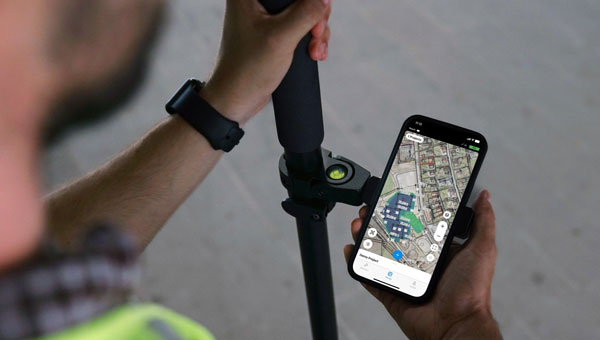
    A surveyor using an Emlid mobile RTK network rover, a Reach RX, in an urban environment. (Photo: Emlid)
    A surveyor using an Emlid mobile RTK network rover, a Reach RX, in an urban environment. (Photo: Emlid)

    What are the main end-user applications for your devices?

    We sell a lot to land surveyors and to drone pilots. Many drone pilots are increasingly becoming surveyors, and many surveyors are increasingly becoming drone pilots. So, those two groups of people are moving toward each other, and we are happy to serve both. Our devices are very popular and are the standard for drone workflows. This is a big market for us. Also, construction and mobile scanning.

    What about utility companies mapping their assets?

    Yes, we work with businesses that need to manage some kind of infrastructure or a large collection of assets. Water companies are very big users. They have many undocumented areas and a lot of people working in the field. For them, it’s crucial to have an affordable system that they can put in the hands of untrained people. Also, fiber optic networks, gas pipelines and agricultural companies have similar demands.

    Today, a traditional RTK GNSS receiver costs at least $20,000. Our Reach RX is $2,000; our Reach RS3 with tilt compensation is $3,000. This completely changes the game. So, we are opening this field for professionals, for architects, for landscape designers, for agricultural applications. We’re seeing archeologists use it. These guys would have never bought a system for $20,000 or $30,000. Now that it’s $2,000 or $3,000, it’s a different story.

    What do you make specifically for GIS?

    We recently introduced the Reach RX MFI, which is certified for use with Apple devices. This Reach RX integrates natively with Esri’s ArcGIS Field Maps, the most common platform for GIS data collection workflows. It required certain hardware modifications to connect to iPhones natively and some integration work with Esri. It is another way in which our Reach RX receiver can be used. Every one of our Reach RX is now a Reach RX MFI.

    Tell me about the Pix4D.

    We have a kit that consists of two parts. The hardware part is our Reach RX centimeter-grade, survey RTK receiver. The software part is the PIX4Dcatch mobile app on an iPhone Pro or Pro Max, which has a lidar sensor and a very good camera. As a part of the kit, you receive a bracket to mount everything together, forming a unique system that is easy to use, accurate and affordable. It uses the lidar for scanning.

    And the sensors in the phone to determine its attitude …

    Yes, and the huge photogrammetry experience that Pix4D has. They’re using their full photogrammetry engine to process the pictures, along with the lidar from the iPhone and highly accurate GNSS, which allows them to stitch together essentially survey-grade models just using this simple set of equipment.
    I’m very excited about this technology being so accessible and easy to use.
  • Calian releases full band smart choke antenna

    Calian releases full band smart choke antenna

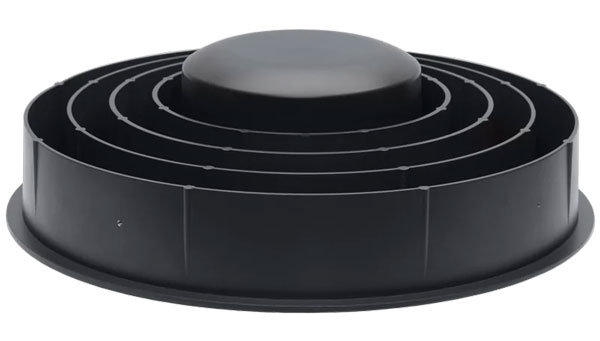
    Calian GNSS, formerly Tallysman Wireless, has introduced the VCS6000XF full band smart choke antenna, a new product designed for Continuously Operating Reference Station (CORS) applications. This antenna combines Tallysman Verachoke antenna elements with Septentrio’s Mosaic X5 full-band receiver to offer an integrated solution for OEM CORS systems.

    The VCS6000XF offers comprehensive GNSS signal reception, including GPS/QZSS L1/L2/L5, GLONASS G1/G2/G3, Galileo E1/E5a/E5b/E6/E5 AltBoc, BeiDou B1/B2/B2a/B3, NavIC L5, SBAS and L-Band correction services. It incorporates the advantages of the VC6050 Verachoke, such as low axial ratio, consistent frequency performance and excellent multi-path rejection.

    The antenna features a 0.5mm phase center variation and utilizes Calian’s eXtended filtering for near-band signal interference mitigation. The integrated Septentrio Mosaic X5 receiver provides capabilities such as anti-jamming, anti-spoofing, scintillation mitigation and receiver integrity by combining the antenna and receiver in the choke ring antenna. This design eliminates the need for expensive low-loss RF cables and ensures a clean RF signal for the GNSS receiver.

    By combining the antenna and receiver in the choke ring antenna, the VCS6000XF is engineered to address radio frequency (RF) signal degradation issues associated with long antenna cable runs. This design eliminates the need for expensive low-loss RF cables and can ensure a clean RF signal for the GNSS receiver.

    Calian Smart Antennas can be customized to meet specific customer requirements, offering compatibility with various GNSS receivers and correction services. The company has achieved integrations with receivers from ST, u-blox and Septentrio and GNSS corrections from providers such as PointOne, Swift Navigation and PointPerfect.

  • Harxon expands line of smart antennas for precise positioning

    Harxon expands line of smart antennas for precise positioning

    Smart antenna series

    Harxon has introduced a new line of smart antennas that seamlessly integrate advanced antenna technology with a comprehensive real-time kinematic (RTK) positioning module. These products offer high-precision positioning capabilities within a compact and easily integrable form factor, making them ideal for various applications.

    The smart antennas incorporate full-constellation, full-frequency RTK positioning modules, enabling a range of accuracy levels to suit different needs. Users can achieve single-point meter-level accuracy, DGPS sub-meter-level accuracy or RTK centimeter/millimeter-level accuracy depending on their requirements.

    The series includes both housed and embedded versions tailored for specific use cases. The HX-MR401A and HX-MR402A are housed versions, while the HX-ME403A and HX-ME404A are embedded versions designed for UAVs. These models leverage Harxon’s low-profile helix antenna technology. For robotic lawnmowers, Harxon offers the HX-ME401A and HX-ME402A, which are based on the cost-effective and high-performance OEM GNSS Antenna HX-CSX231A26.

    Photo:
    Photo: Harxon

    OEM GNSS antenna

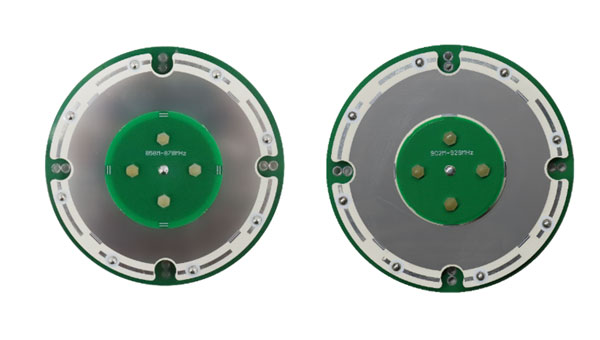
    Harxon has expanded its OEM GNSS antenna lineup with two combined antennas: the HX-SE402A and HX-SE403A. These full-band, full-frequency antennas integrate GNSS capabilities with a low-profile radio antenna that supports the 858-878MHz and 902-928MHz frequency bands. This addresses the growing need for devices requiring both navigation and communication functionalities.

    Unlike traditional whip-shaped radio antennas, which can extend up to 20 cm, Harxon’s new low-profile technology achieves the same functionality at 10 mm height, which allows for greater versatility in applications that demand precise positioning alongside wireless communication. Additionally, Harxon offers custom tuning services to optimize integration into OEM end-user modules for specific applications.

    Photo:
    Photo: Harxon

    Anti-jamming GNSS antenna

    Harxon has introduced its inaugural series of anti-jamming antennas, starting with two initial models: PT023 and PT024. These GNSS antennas are specifically engineered to operate in challenging environments characterized by complex electromagnetic interference, high-power signals and strong multipath effects.

    They are well-suited for scenarios involving low-elevation angle interference, high-power interference sources and radio communication system noise. The PT023 model utilizes multiple array elements combined with amplitude and phase manipulation to achieve spatial radiation shaping. This antenna also incorporates advanced multi-level filtering technology, effectively suppressing out-of-band noise power.

    In contrast, the PT024 model features vertical and horizontal two-dimensional polarization suppressors. This design effectively mitigates the reception of both odd and even LHCP and RHCP signals originating from the rear of the antenna, according to the company.  It can also suppress low-elevation multipath signals at the same frequency and out-of-band noise signals. These features collectively enhance the antenna’s performance in complex electromagnetic environments.

    Photo:
    Photo: Harxon
  • Topcon, u-blox to offer comprehensive GNSS positioning services

    Topcon, u-blox to offer comprehensive GNSS positioning services

    Photo: spainter_vfx / iStock / Getty Images Plus / Getty Images
    Photo: spainter_vfx / iStock / Getty Images Plus / Getty Images

    u-blox and Topcon Positioning Systems have formed a strategic partnership to develop a high-precision GNSS positioning service for the mass market.

    The partnership was formed in response to the increasing demand for GNSS precise positioning across various applications. According to a recent EUSPA report, services enabled by GNSS devices are projected to generate approximately 80% of total GNSS revenues by 2033.

    The comprehensive GNSS correction services will serve a wide range of applications requiring precise positioning, including automotive, industrial, robotics, construction, precision agriculture and mobility sectors. These services will integrate with u-blox’s current and future hardware products, as well as existing services such as PointPerfect.

  • Emlid enhances land surveying capabilities

    Emlid enhances land surveying capabilities

    Photo: Emlid
    Photo: Emlid

    Emlid has released updates to its Emlid Flow mobile and cloud app for land surveying. The app now includes a full range of tools for earthworks, topographic and as-built surveys and features such as Surfaces support.

    When used with Emlid’s survey-grade Reach GNSS receivers, the upgraded Emlid Flow app aims to improve efficiency for land surveying and construction workflows. Key features added to Emlid Flow include advanced linework capabilities, inverse and traverse tools, polygon support and an auto-collection mode. The recently released Surfaces support allows surveyors to incorporate digital terrain models (DTM) into projects and calculate cut and fill values during stakeout operations.

    In developing these updates, Emlid seeks to create an uncluttered, intuitive interface for surveyors while maintaining all necessary controls and functionality. The app offers streamlined navigation and instant cloud syncing, enabling surveying professionals to complete tasks efficiently on their preferred device, whether a rugged Android smartphone or iPad. Projects prepared in the cloud are instantly accessible in the mobile app for field use, streamlining the entire survey process.

  • u-blox introduces ultra-low-power asset tracking service for IoT

    u-blox introduces ultra-low-power asset tracking service for IoT

    Photo: u-blox
    Photo: u-blox

    u-blox has introduced CloudTrack, an end-to-end asset tracking service designed specifically for Internet of Things (IoT) applications. This comprehensive solution integrates ultra-low-power positioning, global connectivity and cloud integration into a single platform. CloudTrack aims to simplify IoT asset tracking by offering flexible, contractless per-location-request plans available worldwide, allowing users to manage their assets effortlessly.

    CloudTrack offers six times the energy savings compared to a standalone GNSS fix with a cold start while securely transmitting data over the internet. The system intelligently calculates position using a combination of data from GNSS, cellular, and Wi-Fi sources. This capability allows users to locate assets even in areas with poor or non-existent GNSS signal conditions and indoors, where obtaining a location fix can be challenging.

    With a single Thingstream SIM card operating globally, IoT devices can utilize one stock-keeping unit (SKU), eliminating the need for regional SKUs. The Thingstream cloud platform seeks to make it easy for businesses to transform and integrate their data with tracking dashboards, major cloud platforms and enterprise backend systems.

  • Launchpad: GNSS antennas and receivers,  UAV upgrades, defense solutions and more

    Launchpad: GNSS antennas and receivers, UAV upgrades, defense solutions and more

    A roundup of recent products in the GNSS and inertial positioning industry from the August 2024 issue of GPS World magazine.


    SURVEYING & MAPPING

    Upgraded RTK Rover
    Features MFi certification

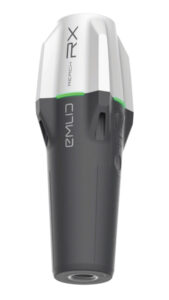
    The Reach RX Network real-time kinematics (RTK) rover has been upgraded to include new MFi (Made for iPhone/iPad) certification and is fully compatible with ArcGIS, QGIS and other GIS apps for both iOS and Android. Reach RX can be seamlessly integrated into GIS workflows to help industry professionals and teams collect accurate geodata at scale.

    The Reach RX offers precise positioning while receiving corrections through NTRIP and tracks GPS/QZSS, Galileo, GLONASS and BeiDou. It gets a fix in less than 5 seconds, delivering centimeter-level accuracy even in challenging conditions.

    It can be used for engineering, utility inspection, landscaping and other projects of any scale. According to the company, the rover will soon be compatible with QField, Blue Marble’s Global Mapper, Mergin Maps, Avenza Maps and more.

    The Reach RX weighs 250 grams; is IP68-rated, waterproof and dustproof; and withstands temperatures from -20° C to +65° C.Emlid, emlid.com

    Photogrammetric Software
    Upgraded coordinate system functionalities

    3Dsurvey 3.0 is an all-in-one photogrammetric software solution designed to unify lidar sensors, cameras on UAVs and various ground control points. Users can transition between orthophotos, point clouds and textured meshes.
    Version 3.0 features upgraded coordinate system functionalities to obtain georeferenced spatial data without local transformations.

    It includes improved coordinate system support, which handles transformations requiring special grid files and offers accurate GPS-to-local coordinate conversions. Additionally, the platform can automatically fetch missing geoid models.

    The revamped coordinate system selection process includes presets for users to find the correct system by entering their country name, with the appropriate settings applied automatically. It has PRJ file support to enhance compatibility with various GIS standards. 3Dsurvey, 3dsurvey.si

    RTK Evaluation Kit
    Includes L1+L2 RTK GNSS

    This real-time kinematics (RTK) evaluation kit (EVK) serves as a development platform for fixed or mobile high-precision positioning and navigation needs.

    The RTK EVK comes with a range of options for prototyping, including L1+L2 RTK GNSS, with L-Band correction built-in if needed, running on an agile processor.

    It features custom open-source software pre-loaded with RTK Everywhere firmware. Users can configure the EVK as an RTK base and push corrections to an NTRIP Caster or use corrections delivered through WiFi or Bluetooth.

    The integrated u-blox NEO-D9S offers L-Band reception and access to correction services such as PointPerfect. The u-blox LARA-R6001D provides global cellular connectivity, and Zero-Touch RTK offers users a simple way to receive corrections. Users can register the device and enable PointPerfect — no NTRIP credentials are required. Sparkfun Electronics, sparkfun.com

    GNSS Receiver
    With tilt compensation

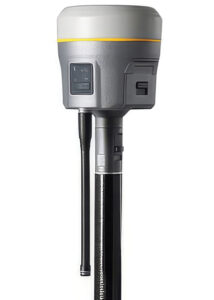
    The R980 features communication capabilities to support uninterrupted field operations. It can be used for land surveying, transportation infrastructure, construction, energy, oil and gas, utilities and mining projects.

    The system features Trimble’s ProPoint GNSS positioning engine and inertial measurement unit (IMU)-based tilt compensation, making it suitable for dense urban environments and under tree canopy, removing the need to level the pole when capturing data points.

    It includes a dual-band UHF radio and an integrated worldwide LTE modem for receiving corrections from a local base station or VRS network. It supports the Trimble Internet Base Station Service (IBSS) for streaming RTK corrections using Trimble Access field software and features Trimble IonoGuard technology, which mitigates ionospheric disturbances for RTK GNSS. Trimble Geospatial, geospatial.trimble.com

    Nautical Chart Production
    Generate charts in PDF/TIF from ENC data

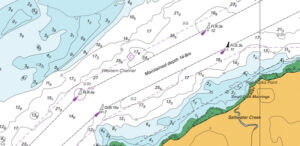
    CARIS AutoChart, a nautical chart production solution, is tailored to the needs of nautical chart producers. It can automatically generate charts in PDF/TIF from ENC data. Users can seamlessly import data from ENC files to create comprehensive nautical charts in PDF and/or TIF format. CARIS AutoChart can generate chart templates from existing chart portfolios maintained with CARIS paper chart composer or CARIS HPD paper chart editor.
    The software is designed to accommodate the unique needs of chart production facilities of all sizes. It can be used by hydrographic offices, port or waterways authorities.Teledyne Geospatial, teledyneimaging.com

    Upgraded GIS Platform
    Featuring native database integrations

    Felt 3.0 includes new features and native database integrations to improve the capabilities of geographic information systems (GIS). It provides modern GIS tools for teams to visualize, analyze and present important insights and map data relevant to their operations.
    Operators can directly connect Postgres/PostGIS and Snowflake databases for automated live data updates. The API allows users to create and style elements and listen to map updates via webhooks, while providing a Python SDK for professionals to continue to work in their preferred tools. Felt, felt.com


    UAV

    Gimbaled Camera
    For UAV missions

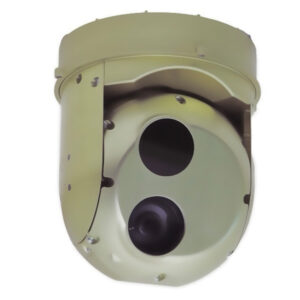
    The Gimbal 155 is a gimbaled camera designed for the UAV Survey Mission program. The GOS-155 meets UAV requirements for surveillance and rescue missions. Its optimized size, weight and power (SwaP) profile, advanced day and night ISR imaging, and embedded video processor make it ideal for any mid-sized UAV — whether VTOL or winged. With its low weight of 1.8 kg, and 155 mm, UAV platforms can increase endurance without sacrificing optical performance.

    The GOS-155 two-axial gimbal is an EO/IR system, comprising a 30x optical zoom HD (1280 x 720) visible camera paired with a fixed focal length uncooled thermal LWIR (1280 x 1024) camera. This allows users to collect intricate visuals across visible and infrared spectrums.

    It includes embedded video processing with electronic stabilization and object tracking and can be integrated with external GPS/INS with real-time target location at 20 m across multiple environments, and around 5 m using UAVOS’ Ground Control Station software. UAVOS, uavos.com

    Tactical Grade INS
    Tailored to unmanned systems

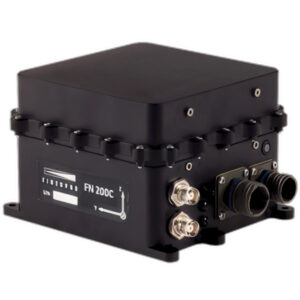
    The FN 200C combines multiple functions into a single integrated platform. It features a three-in-one strapdown system compromising motion reference unit (MRU), attitude and heading reference system (AHRS) and inertial navigation system (INS) capabilities for precise positioning, velocity and orientation data in both static and dynamic movements.

    It is equipped with fiber optic gyroscopes (FOG) and MEMS accelerometers. The FN 200C’s inertial measurement unit (IMU) offers accurate and reliable navigation data even in challenging conditions. The system supports various correction methods such as SBAS, DGPS, RTK, and PPP for real-time navigation and positioning in a wide range of applications.

    The FN 200C utilizes NovAtel OEM7, u-blox ZED-F9P or Septentrio mosaic-H GNSS receivers to provide precise positioning information across multiple GNSS constellations. With embedded anti-jamming and spoofing features, the FN 200C offers reliable operation in environments where signal interference may be present.

    The FN 200C is ideal for unmanned systems applications, including land-based surveying, aerial mapping, maritime navigation and more, delivering precise and reliable navigation data to meet the most demanding requirements. According to FIBERPRO, the system’s advanced technology, robust design and comprehensive feature set ensure that it will revolutionize navigation and operation in today’s dynamic and challenging environments. FIBERPRO, fiberpro.com

    Upgraded UAV
    With a modifiable flight controller

    The RDSX Pelican extended-range hybrid vertical take-off and landing (VTOL) delivery UAV is now offered with an easily modifiable flight controller, designed for users to more readily integrate customized flight systems and companion software.
    The RDSX Pelican combines the reliability and flight stability of a multirotor craft with the extended range of a fixed-wing airframe. Its customizable payload bay can be factory-integrated with the A2Z Drone Delivery RDS2 commercial delivery winch to support a variety of logistics operations.

    Engineered to operate within the FAA’s 55-pound max takeoff weight for Part 107 compliance, the Pelican is rated to carry payloads up to 5 kg on operations up to 40 km roundtrip. The flexibility of the Pelican’s cargo bay makes it ideal for logistics missions or deployment with payloads customized for aerial mapping, UAV inspection, forestry services, search and rescue operations, water sample collection, offshore deliveries, mining and more.

    With the RDSX Pelican now operating on the Cube flight controller (CUAV X7+), users can integrate their preferred systems — including ground control software, radio beacons and other companion software systems. A2Z Drone Delivery, a2zdronedelivery.com

    GNSS Positioning Modules
    Compatible with UAVs and robotics

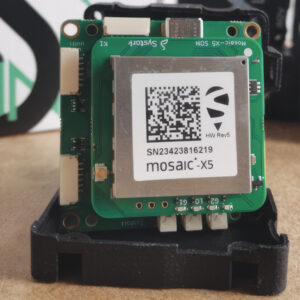
    The Linnet ZED-F9P is built around u-blox’s ZED-F9P RTK module. It offers multiband signal reception including GPS L1 and L2 for precise positioning, even in areas with low satellite coverage. In addition to USB-C connectivity, it features UART, SPI and I2C interfaces for easy integration into a variety of UAV and robotics platforms.

    Linnet Mosaic X5 RTK-GNSS module is based on Septentrio’s mosaic-X5 module, with multifrequency signal tracking including GPS L5. The module features an onboard CPU that runs a full internal web-based user interface for configuration and monitoring, as well as integrated NTRIP corrections. Other capabilities include built-in anti-jamming and anti-spoofing protection and a spectrum analyzer. Systork, systork.io


    MOBILE

    “Patch-In-A-Patch” Antenna
    Maintains dual-band L1/L5 performance

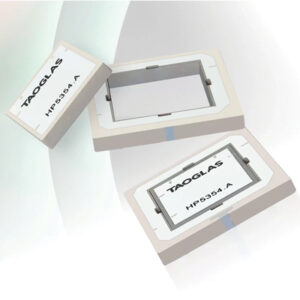
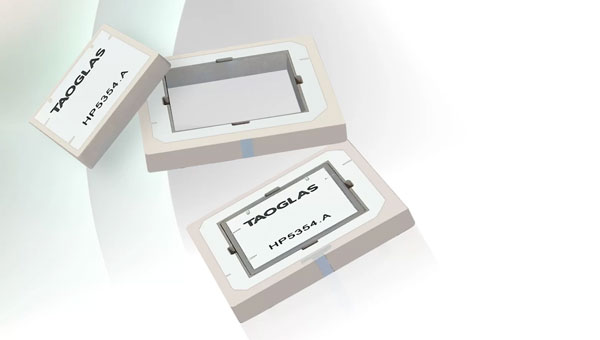
    Inception is a new GNSS L1/L5 ultra-low-profile “patch-in-a-patch” antenna. The HP5354.A offers dual-band stacked patch performance in a single 35 mm x 35 mm x 4 mm form factor. This design integrates the second antenna within the first, eliminating the need for stacking parts and reducing the antenna height by 50%.
    The HP5354.A antenna features a passive, dual-feed surface mount design (SMD) to decrease weight and conserve horizontal space. This makes it suitable for GNSS applications requiring high precision and limited space. The antenna improves positioning accuracy from 3 m to 1.5 m while maintaining dual-band L1/L5 performance.

    With a passive peak gain of 2.61 dBi, the HP5354.A can be used for GPS L1/L5, BeiDou B1, Galileo E1, and GLONASS G1 operations. Its dual-feed design maintains circular polarization gain even when the antenna is de-tuned or requires in-situ tuning.

    It is ideal for applications such as asset tracking, smart agriculture, industrial tracking, commercial UAVs and autonomous vehicles. The HP5354.A uses Taoglas’ custom electro-ceramics formula, ensuring high-quality performance and seamless integration into devices requiring high-precision GNSS.

    The Taoglas HC125A hybrid coupler can combine the dual feeds for the L1 patch, offering high RHCP gain and optimal axial ratio for upper constellations including GPS L1, BeiDou B1, Galileo E1 and GLONASS G1. The Taoglas TFM.100B L1/L5 front-end module can be incorporated into the device PCB, aiming to save valuable real estate and up to two years of complex design work, according to the company. Taoglas, taoglas.com

    Waterproof GNSS Antenna
    Built-in LNA

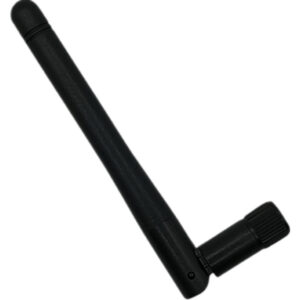
    The external antenna features an adhesive mount and sealed IP67-rated waterproof protection. It is an active GPS/GNSS antenna that includes a built-in low noise amplifier (LNA) for enhanced performance, making it ideal for applications where the receiver is close to the antenna and in environments where signal strength is strong, such as open areas with a clear line of sight.

    This type of antenna can amplify weak signals received from satellites by improving signal quality and reducing noise. It requires an external power source to operate the built-in LNA and is less sensitive to signal loss due to longer cable lengths. It is connected to an SMA connector at the end of a 3 m pigtail. The antennas can be used in navigation, location-based services and fleet management applications. Amphenol RF, amphenolrf.com


    DEFENSE

    AI and Quantum-Powered Navigation System
    When GPS signals are compromised

    AQNav is designed for navigation across air, land and sea when GPS signals are jammed or unavailable.

    AQNav is a geomagnetic navigation system that uses proprietary artificial intelligence (AI) algorithms, powerful quantum sensors and the Earth’s crustal magnetic field. The system seeks to provide an un-jammable, all-weather, terrain-agnostic, real-time navigation solution in situations where GPS signals are unavailable, denied or spoofed.

    The system uses extremely sensitive quantum magnetometers to acquire data from Earth’s crustal magnetic field, which exhibits geographically unique patterns. It uses AI algorithms to compare this data against known magnetic maps, allowing the system to quickly and accurately find its position.

    It is available globally, does not rely on visual ground features or satellite transmissions to function and is not affected by weather conditions. AQNav can be integrated into a wide variety of platforms. Its passive technology emits no electronic signals, which reduces the aircraft’s detectability. SandboxAQ, sandboxaq.com

    PNT Solution
    Operates with or without GNSS signals

    TRNAV is a terrestrial navigation solution designed to operate with or without GNSS signals.
    It establishes a mesh network of ground stations capable of operating independently from GNSS by using precise pre-established locations or connecting to GNSS when available. TRNAV’s synchronized timing system ensures a minimal drift of 10 ns during a week without GNSS.

    The system features a re-synchronization capability that allows the entire network to be updated instantly when just one station reconnects to a GNSS satellite, maintaining high precision across all platforms. Users can integrate mobile stations to enhance network flexibility and range, with the potential to cover distances up to 250 km.

    TRNAV also offers a high-bandwidth communication channel for communication capabilities within the established network. The system employs AES-256 encryption and advanced waveform technologies, including DSSS/FHSS for robust and secure operations in challenging environments. TUALCOM, tualcom.com

    Software-Defined Radio
    Designed for mission-critical systems

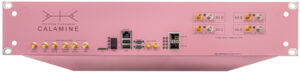
    Calamine is a four-channel wide tuning range software-defined radio (SDR) that can be integrated into mission-critical systems for the defense, GNSS, communications and test and measurement markets.
    The SDR offers a tuning range from near DC to 40 GHz with four independent receiver radio chains, each offering 300 MSPS sampling bandwidth. It is tailored to government, defense and intelligence communities and civil users with direct applications for radar systems, signal intelligence, spectrum monitoring and satellite communications systems. Per Vices, pervices.com

    C-UAS Solution
    For electronic warfare

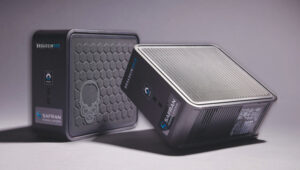
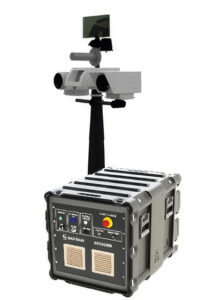
    The Skyjacker is a multi-domain electronic warfare counter unmanned aerial system (C-UAS), suitable against swarms and high-speed threats. It is designed as a response to threats posed by UAVs in the battlespace and at sensitive installations.

    Skyjacker alters the trajectory of a UAS by simulating the GNSS signals that guide it toward its target.

    Skyjacker is particularly well suited to countering saturation attacks, such as swarming UAVs. The system also can defeat isolated drones piloted remotely by an operator and deliver effects at ranges from 1 km to 10 km (6 mi).

    It can be integrated with an array of sensors, such as optronic sights, radars, radiofrequency detectors, lasers, communication jammers and other effectors. Skyjacker can be deployed as a mobile version or interconnected with existing surveillance and fire control systems on land vehicles or naval vessels. Safran Electronics & Defense, safran-group.com

  • Launchpad: Tactical-grade IMUs, Spirent simulator upgrades, atomic clocks and more

    Launchpad: Tactical-grade IMUs, Spirent simulator upgrades, atomic clocks and more

    A roundup of recent products in the GNSS and inertial positioning industry from the July 2024 issue of GPS World magazine.


    MAPPING

    Photo:

    Mobile Mapping System
    With integrated inertial labs INS/lidar

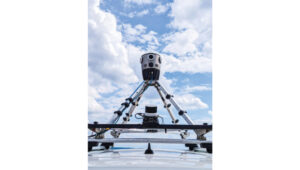
    The Meridian mobile mapping system integrates the Mosaic X camera with Inertial Labs inertial navigation system (INS) and lidar to improve mapping accuracy.

    The Meridian system offers panoramas with a 74 MP native resolution and 13.5 K resolution using precisely synchronized camera modules. The design minimizes image overlap to offer clearer and more consistent panoramas. The integrated INS system has a vertical accuracy of 2 cm to 3 cm and a precision of 2 cm to 4 cm.

    It features seamless, out-of-the-box operations with fully integrated and calibrated components. The Meridian system is designed for ease of use and requires only minutes of training. In addition, it features a rugged design to ensure performance in challenging environments.

    Mosaic, mosaic51.com


    OEM

    Photo:

    INS
    Combines a GPS master clock with an INS

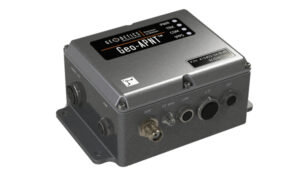
    The Geo-APNT serves applications requiring precise navigation data and an accurate time reference. The Geo-APNT combines a versatile GPS master clock with an INS to
    offer assured positioning, navigation and timing (PNT) under all circumstances, including temporary loss of GPS signal. It minimizes size, weight and power (SWaP) due to the integration of positioning and timing that are typically achieved by two independent subsystems.

    It can be easily integrated into existing systems and supports RTK and PPK positioning and offers support for MEMS, fiber optic gyro and ring laser gyro inertial measurement units (IMUs). The system also includes GPS antenna and cables.

    AEVEX Aerospace, aevex.com

    Photo:

    Tactical-Grade IMUs

    For unmanned applications

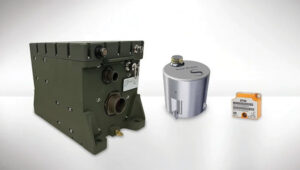
    This line of tactical-grade IMUs is engineered to address the evolving needs of unmanned applications and 2 space-based operations.

    The IMUs include Iconyx, a high-performance HRG-based IMU that significantly outperforms legacy technologies, the company says. It offers improved accuracy and reliability for demanding navigation needs. It also features a small tactical IMU (STIM) ideal for applications requiring lower size, weight and power (SWaP).

    The company is upgrading its Geonyx inertial navigation system (INS), which is based on HRG technology, to incorporate M-Code capability. The fully integrated solution can perform in GPS- denied or spoofing environments, offering reliable navigation in challenging environments.

    Safran Federal Systems, safranfederalsystems.com

    Photo:

    GPS-Aided INS
    For land, marine and aerial applications

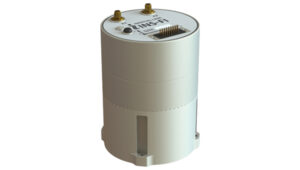
    The INS-FI, a GPS-INS, is designed for enhanced performance and reliability across various platforms including land, marine and aerial applications.

    The INS-FI is built with tactical-grade fiber optic gyroscope (FOG) technology and an IP67 rating, indicating its robustness and resistance to electromagnetic and environmental interference. This system integrates an IMU that combines fiber optic gyroscopes and MEMS accelerometers, along with an all-constellations GNSS receiver supporting multiple bands.

    It offers horizontal and vertical positioning with approximately 0.1% error of distance traveled for land applications and a drift of five nautical miles per hour for aerospace applications without GNSS signal. INS-FI is fully compatible with Inertial Labs’ Air Data Computer (ADC), visual inertial navigation systems (VINS) and a stand-alone magnetic compass (SAMC).

    INS-FI incorporates sensor fusion filter technology, navigation and guidance algorithms and calibration software to ensure optimal performance and reliability. The system aims to provide precise horizontal and vertical positions, velocity, and absolute orientation (heading, pitch and roll) for any mounted device, maintaining high accuracy for both stationary and dynamic applications.

    Inertial Labs, inertiallabs.com


    TRANSPORTATION

    Photo:

    GNSS Receiver

    Rated IP67 for water and dust resistance

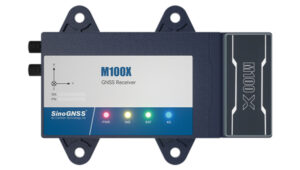
    The M100X GNSS receiver is built with the Quantum-III SoC Chip, designed to provide full-constellation and multi-frequency capabilities, specifically engineered for high-accuracy vehicular positioning and heading.

    The M100X features GNSS/INS integrated technology to provide real-time high- precision positioning, velocity and heading data, even in challenging environments.

    The receiver provides accurate positioning and heading information across various applications, including autonomous mining trucks, intelligent ports, mapping and autonomous buses. It is designed to safeguard vehicles as they pass through areas with poor signal reception, even in obstructed environments such as urban canyons, city overpasses, underground garages, tunnels and parks.

    The M100X has a data update rate of up to 100Hz, allowing it to perform well in
    very dynamic environments, such as vehicles traveling at high speeds. This rapid update capability enables continuous and real-time tracking of vehicle positions for reliable computation and instant updating of navigation information. It also facilitates quick responses to changes in vehicle dynamics during travel. These features are essential for maintaining seamless operation in high- speed environments and ensuring high levels of safety and performance.

    Constructed with aluminum alloy and rated IP67 for water and dust resistance, the receiver is built to withstand harsh operational environments. It also features a shock-resistant design, capable of surviving a drop from 1 m without damage. It can connect to 4G, LAN, Bluetooth and multiple I/O ports for seamless integration with various systems and networks.
    The M100X can be used with the Navigation Master software, an Android app for quick device configuration and effective remote management. Using Bluetooth connectivity, users can configure their M100X devices for optimal performance. Additionally, its cloud platform, NaviCloud, offers instant access to projects and data from any location.

    ComNav Technology, comnavtech.com


    SIMULATORS

    Photo:

    Spirent Simulator Upgrades

    Now implementing PULSAR

    Spirent has implemented Xona Space Systems’ PULSAR production signals for seamless integration into the existing SimXona product line. The PULSAR X1 production signal implementation has passed Xona certification and the PULSAR X5 signal verification process is currently underway. It is expected to pass certification during the summer of 2024. Spirent is now accepting orders for SimXona with production signals capability.

    Xona is developing PULSAR, a high-performance PNT service built on a backbone of low-Earth orbit (LEO) small satellites. Xona’s smallsat signals will improve PNT resilience and accuracy by augmenting GNSS while operating with an independent navigation and timing system architecture. Xona is fully funded to launch its production class satellite, the In-Orbit Validation mission, in 2025.

    Spirent is the leading provider of PNT test solutions and recently launched a sixth-generation simulation system, PNT X. Designed for navigation warfare (NAVWAR) testing, PNT X is an all-in-one solution with native implementation of SimXona.

    Spirent, spirent.com

    Photo:

    GNSS Simulator 

    Compatible with Satgen simulation software

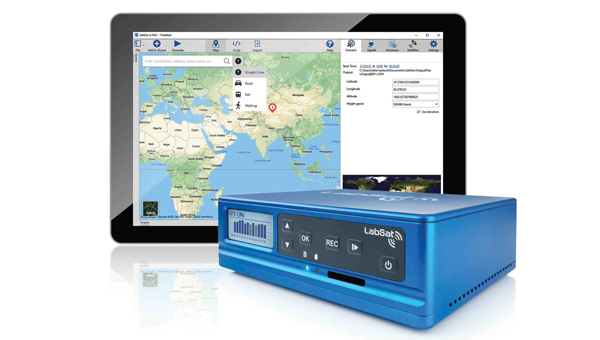
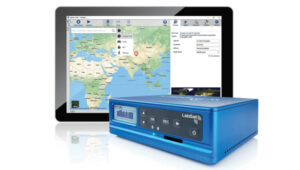
    The LabSat 4 GNSS simulator is designed to meet the demands of modern GNSS signal testing. It is equipped with three radio frequency channels, each of which can be configured with up to 12-bit I&Q quantization and a bandwidth of up to 60 MHz. This allows users to precisely control recording parameters and optimize file sizes based on their specific testing requirements. Additionally, synchronized record and replay of external data sources such as CAN, CAN-FD, RS232 and digital event capture are designed to further enhance complex test scenarios.

    Users can save custom record settings for efficient setup and repeatability. Additionally, a user-friendly, web-based interface allows for easy configuration and management of the simulation environment.

    LabSat 4 offers file management capabilities with 7.6 TB internal storage and robust data transfer options via Gigabit Ethernet and USB 3.0. This technology accommodates the high- volume data needs of modern GNSS testing without sacrificing speed or performance.

    It is small, portable and cost-effective, making it suitable for use both in the field and in the laboratory. LabSat 4 is fully compatible with SatGen Simulation Software, which allows users to create GNSS RF I&Q scenario files based on custom trajectories. This integration enables the simulation of scenarios involving multi-stop routes, time zone transitions, leap seconds and more, using any specified time, date and location.

    LabSat, labsat.co.uk

    Photo:

    Warfare Simulator

    Tests military receivers

    BroadSim Duo is a dual-frequency GNSS simulator designed specifically for testing military receivers in an unclassified environment.

    BriadSim Duo integrates dual-frequency capabilities within a single compact GPS military signal testing unit. The simulator has dual-frequency capability, which is essential for testing P-Code and AES-M-Code. It features a new software-defined radio in an M.2 form factor, offering robust and reliable performance. It also seamlessly integrates with the Skydel simulation environment for improved versatility and functionality.

    Safran Federal Systems, safranfederalsystems.com


    TIMING

    Photo:

    Atomic Clocks

    For PNT services

    Adtran has released two optical cesium atomic clocks, the OSA 3300 Super High-Performance (OSA 3300 SHP) and the OSA 3350 Super Enhanced Primary Reference Clock+ (OSA 3350 SePRC+). The devices use optical pumping technology to meet evolving demands across applications from scientific research to critical PNT infrastructure.

    The OSA 3300 SHP offers stability and accuracy, making it a valuable tool for metrology institutes and scientific research facilities. The OSA 3350 SePRC+ is specifically designed to enhance holdover capabilities for PNT services.

    It maintains 100 days of 100-nanosecond precision, providing continuous and accurate timing even in environments where GNSS is compromised or unavailable. This makes it a crucial

    component for ensuring the integrity of mission-critical networks and supporting vital infrastructure and defense operations with reliable backup timing.

    Adtran, adtran.com


    MOBILE

    Photo:

    Smart Atenna

    For surveyors and construction professionals

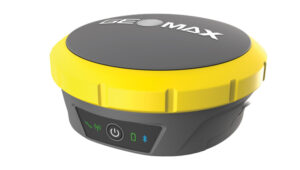
    The Zenith60 Pro GNSS smart antenna is designed for surveyors and construction professionals. It is a real-time kinematics (RTK) rover that features calibrated free tilt compensation to measure otherwise inaccessible points. The antenna is suited for harsh climates, urban areas, dense canopy coverage or other challenging terrains.

    This multi-constellation, multi-frequency GNSS receiver features a GNSS board with more than 800 channels and IP68 protection against dust and water. It also connects with GeoMax total stations and X-PAD field software to create an efficient and flexible workflow.

    GeoMax Positioning, geomax-positioning.com

    Photo:

    Helical Atenna

    House or embedded

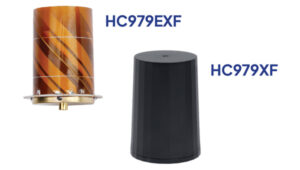
    The HC979XF antenna is designed to provide optimal support for the entire GNSS band, including GPS/QZSS L1/L2/L5 (QZSS L6), GLONASS G1/G2/G3, Galileo E1/E5a/b/E6, BeiDou B1/B2a/b/B3, NavIC L5 and L-Band corrections services.

    The key new feature of the HC979XF and HC979EXF antennas is the support for Galileo’s Global High Accuracy Service (HAS) and QZSS’s regional Centimeter Level Augmentation Service (CLAS). Both correction services are broadcast in the E6/L6 band (1258- 1300 MHz).
    The radio frequency spectrum has become congested worldwide due to the activation of many new LTE bands. Their signals or harmonic frequencies can affect GNSS antennas and receivers.

    In North America, the planned Ligado service, which will broadcast in the frequency range of 1526 to 1536 MHz, can affect GNSS antennas that receive space-based L-band correction service signals (1539 – 1559 MHz). New LTE signals in Europe [Band 32 (1452 – 1496 MHz)] and Japan [Bands 11 and 21 (1476 – 1511 MHz)] have also affected GNSS signals. Calian’s XF models are designed to mitigate the effects of these new signals.

    The Calian HC979XF housed helical antenna weighs 42 g and is enclosed in a military-grade IP69K plastic enclosure. The embedded HC979EXF helical antenna weighs 8 g. It is easily mounted with an optional embedded helical mounting ring, which traps the outer edge of the antenna circuit board to the host circuit board or any flat surface. An MCX connector is installed in the base of the antenna.

    Calian, calian.com


    UAV

    Photo:

    Mapping software

    Designed for UAVS

    WingtraCLOUD software is designed to simplify data collection and streamline the onboarding of surveyors and pilots.

    WingtraCLOUD offers a user-friendly flight planning experience, plus time-saving features including site-based file organization, advanced 3D planning, coordinate system by sites and improved connectivity via cloud syncing in a single environment.
    It aims to simplify and streamline site setup and team collaboration. WingtraCLOUD’s features accelerate planning and introduce anew level of transparency among stakeholders with enhanced wireless functionality. Users can now provide insights to regional and global site managers across projects.

    WingtraCLOUD allows users to maximize Wingtra aerial data and services, offering UAV program scaling and business advantages across a variety of industries.

    Wingtra, wingtra.com

    Photo:

    AI Computer

    For unmanned systems

    FLYC-300 is designed 2 for advanced applications in UAVs, unmanned ground vehicles (UGVs) and autonomous mobile robots. Weighing 297 g, the FLYC-300 features a low size,
    weight and power (SWaP) form factor and delivers 100 TOPS AI performance. It supports autonomous navigation, object detection, real-time inference, and SLAM capabilities.

    The FLYC-300 is suitable for industries such as inspection, logistics, rescue operations, security, agriculture and environmental monitoring. It supports a variety of sensors and cameras, accommodating RGB, infrared, hyperspectral, HDR and high-resolution cameras. It can seamlessly integrate with flight controllers, vehicles or robots.

    The computer can operate with a wide voltage input range from 4S to 14S battery packs or 12 V to 60 V DC input via the XT30 DC-IN connector, making it versatile for different unmanned systems. It also supports 5G or 4G modules for real-time transmission of images, videos and data. The computer is available in two configurations, with or without an enclosure, to meet varying application needs.

    Neousys Technology, neousys-tech.com

    Photo:

    VOTL UAV

    ‘Drone-in-a-box” solution

    The VTOL hangar drone combines the JOUAV JOS-C800 hangar with its new VTOL fixed-wing UAV, CW-15V.

    This “drone-in-a-box” solution isdesigned to offer amore efficient and versatile solution for businesses looking to optimize their routine operations through automated aerial technology.

    The JOS-C800 hangar system is composed of an automated hangar, a newly developed VTOL fixed-wing drone CW-15V, and the Jocloud management platform. This system enables complete management and monitoring of automated aerial missions through cloud-based remote operations.

    Its key features include autonomous takeoff and landing, intelligent flight planning, automatic charging, data management, intelligent data analysis and report generation, enabling fully automated drone operations without the need for on-site personnel.

    The JOS-C800 uses AI and AR algorithm integration to classify and identify potential hazards in the collected data, supporting the display and management of these hazards on Jocloud, and generating detailed hazard classification reports. The upgraded algorithms allow for real-time stitching and comparison of video data comparative analysis to identify new or changed hazards.

    It supports multi-UAV, multi-hangar operations with staggered takeoffs, allowing for hop-and-fly operations. The CW-15V UAVs can be paired with various payloads such as gimbal cameras, lidar and oblique cameras.

    JOUAV, jouav.com

    Air Traffic Surveillance Solution

    Supports BVOLS UAV operations

    INVOLI, a specialist in cooperative air traffic surveillance solutions, has partnered with MatrixSpace to create a comprehensive air traffic awareness solution through a unified platform.

    The partnership combines INVOLI’s cooperative detection technology with MatrixSpace’s advanced non-cooperative detection capabilities, facilitated by miniaturized primary radar technology. This integration allows for complete surveillance of both airborne and ground-based traffic, significantly enhancing UAV detection, counter unmanned aircraft system (CUAS) capabilities and safety for beyond visual line of sight (BVLOS) operations.

    The integrated solution is designed to be low in size, weight, power and cost (SWaP-C), and can be deployed quickly without the need for additional infrastructure or specialist training. This makes it suitable for a variety of applications, including surveillance of sensitive sites such as prisons and energy infrastructure, as well as supporting safe and efficient BVLOS UAV operations.

    INVOLI, involi.com


    DEFENSE

    Photo:

    Anti-Jamming Receiver

    Meets tight SWaP-C requirements

    NavStorm-M is a gun-hardened integrated anti-jamming GPS receiver for artillery, bombs, missiles and unmanned systems.

    It features a layered protection approach using beamforming, anti-spoofing, resiliency and software assurance. It is an assured positioning, navigation and timing (A-PNT) device featuring M-Code GPS technology. It offers GNSS protection of two bands (L1/E1+L2 or L1 + G1 or L1/E1 + L5) from up to three directions of jamming simultaneously.

    NavStorm-M is designed to meet the tight size, weight, power and cost (SWaP-C) requirements of unmanned aircraft systems, loitering munitions, hypersonic platforms and other weapons — especially in gun-hardened applications. NavStorm-M offers precise GPS navigation as a stand-alone system or integrated with an INS.

    BAE Systems, baesystems.com

    Photo:

    GNSS Receiver

    For manned and unmanned group vehicles 

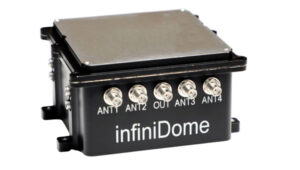
    GPSdome2 is a high-end anti-jamming and fully retrofit solution tailored for defending manned and unmanned ground vehicles and UAVs from jamming attacks. It can be integrated with various GNSS off-the-shelf receivers. Using up to four off-the-shelf active antennas, with dual-band protection — GPS L1+L2 or GPS L1+Glonass G1 — it protects from up to three jamming directions simultaneously in each band. With optional mil-spec compliance, it can serve smaller and lighter platforms.

    infiniDome, infinidome.com

    Photo:

    Loitering Munition

    For air, land and sea

    Atlas is a Group II loitering munition with robust capabilities in air, land and sea tactical scenarios. With a flight duration of more than two hours and a striking distance comparable to larger Group III aircraft, Atlas delivers mission flexibility and performance.

    Designed for high-impact scenarios, it supports a range of operations such as intelligence, surveillance, and reconnaissance (ISR)/detect, identify, locate and report (DILR), electronic warfare and direct-action engagements. The munition’s payload includes options for fragmentation or penetration effects, further enhanced by optional ISR capabilities.

    AEVEX Aerospace, aevex.com

    Photo:

    Portable UAV 

    Serves ISR applications

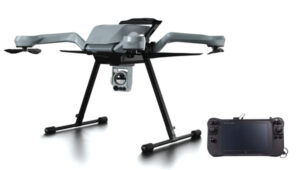
    Zoe M4 is a portable and foldable quadcopter platform designed to rapidly deploy an overwatch capability for military personnel and units. It is easy to transport and set up, making it ideal for security, ISR (intelligence, surveillance, and reconnaissance), and emergency response applications.

    It is equipped with the NextVision Raptor X80, a military-grade EO/IR gimbal that offers stabilized daytime and night-time imagery with 80x zoom and thermal imaging in high resolution. The NDAA-compliant quadcopter features the same rugged capabilities as the base Acecore Zoe model, including a robust carbon fiber construction, an all-weather waterproof design and the ability to survive winds of up to 29 knots.

    The Zoe M4 is paired with Acecore’s Signav Ultra ground control station (GCS), a lightweight handheld device based upon the Panasonic FZ-M1 tablet and rated to MIL-STD-810G. It can be factory-configured for compatibility with existing military networks or frequency bands between 1625 to 2510 MHz.

    Acecore, acecoretechnologies.com

  • Taoglas launches “patch-in-a-patch” antenna

    Taoglas launches “patch-in-a-patch” antenna

    Photo: Taoglas
    Photo: Taoglas

    Taoglas has unveiled Inception, a new GNSS L1/L5 ultra-low-profile “patch-in-a-patch” antenna. The HP5354.A offers dual-band stacked patch performance in a single 35 x 35 x 4mm form factor. This design integrates the second antenna within the first, eliminating the need for stacking parts and reducing the antenna height by 50%.

    The HP5354.A antenna features a passive, dual-feed surface mount design (SMD) designed to decrease weight and conserve horizontal space. This makes it suitable for GNSS applications requiring high precision and limited space. The antenna improves positioning accuracy from 3 m to 1.5 m while maintaining dual-band L1/L5 performance.

    With a passive peak gain of 2.61 dBi, the HP5354.A can be used for GPS L1/L5, BeiDou B1, Galileo E1, and GLONASS G1 operations. Its dual-feed design maintains circular polarization gain even when the antenna is de-tuned or requires in-situ tuning.

    It is ideal for applications such as asset tracking, smart agriculture, industrial tracking, commercial UAVs and autonomous vehicles. The HP5354.A uses Taoglas’ custom electro-ceramics formula, ensuring high-quality performance and seamless integration into devices requiring high-precision GNSS.

    Emerging GNSS bands such as L2, L5, L6, and L-band offer pathways to cleaner signals, improved gain and centimeter-level accuracy. This trend is crucial for global GNSS technologies, including GPS, GLONASS, Galileo, BeiDou, QZSS, IRNSS, and SBAS.

    With an ultra-low profile SMD, the antenna offers stack patch L1/L5 performance within a single-patch solution. It also maintains circular polarization gain with a dual-feed design.

    The Taoglas HC125A hybrid coupler can combine the dual feeds for the L1 patch, offering high RHCP gain and optimal axial ratio for upper constellations including GPS L1, BeiDou B1, Galileo E1 and GLONASS G1. The Taoglas TFM.100B L1/L5 front-end module can be incorporated into the device PCB, aiming to save valuable real estate and up to two years of complex design work, according to the company.

  • Emlid upgrades RTK rover

    Emlid upgrades RTK rover

    Photo: Emlid
    Photo: Emlid

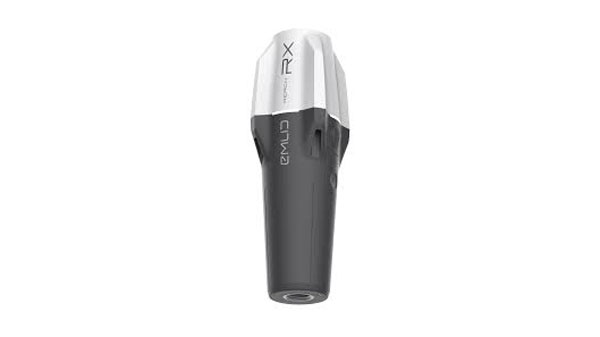
    Emlid has released upgrades for its ultralight Reach RX Network real-time kinematics (RTK) rover. It features MFi (Made for iPhone/iPad) certification and is fully compatible with ArcGIS, QGIS and other GIS apps for both iOS and Android. Reach RX can be seamlessly integrated into GIS workflows to help industry professionals and teams collect accurate geodata at scale. 

    Reach RX offers precise positioning while receiving corrections through NTRIP. The device tracks GPS/QZSS, Galileo, GLONASS and BeiDou. It gets a fix in less than 5 seconds, delivering centimeter-level accuracy even in challenging conditions. 

    The rover does not require configuration or additional training— surveyors only need to add NTRIP credentials. With its intuitive and straightforward workflow, Reach RX allows users to achieve high precision for engineering, utility inspection, landscaping and other projects of any scale. 

    According to the company, the rover will soon be compatible with QField, Blue Marble’s Global Mapper, Mergin Maps, Avenza Maps and more. 

    The Reach RX rover weighs 250 grams. The battery provides 16 hours of operation on a single charge and can be recharged from a power bank. The receiver works in a variety of survival environments. The IP68-rated rover is waterproof, dustproof, and withstands temperatures from -20 to +65°C (-4 to 149°F).  

  • Swift Navigation, Calian advance precise positioning integration

    Swift Navigation, Calian advance precise positioning integration

    Photo: Swift Navigation
    Photo: Swift Navigation

    Swift Navigation and Calian, formerly Tallysman, have partnered to integrate precise positioning into location-based products across a variety of industries.

    Autonomous vehicles and robots are complex and costly to build. Developers must integrate advanced hardware and software, do extensive testing and validation, maintain complex infrastructure, and calibrate diverse components and systems to ensure seamless compatibility. To address these challenges, Calian’s fully integrated GNSS hardware is now compatible with Swift’s Skylark Precise Positioning Service.

    Calian’s smart antennas are available in a ceramic patch design, based on its Tallysman Accutenna technology, ideal for stationary or vehicle-mounted applications, such as precise navigation, enhanced driver safety and robotics. It is also offered in a helical form factor, designed for portable and lightweight devices where size, weight and durability are critical, such as UAVs and wearables.

    When paired with Skylark’s GNSS corrections, the antennas offer centimeter-level accuracy, uniform performance and fast convergence. Skylark’s subscription model removes the need to maintain ground reference stations or the risk of relying on unreliable public ones. It leverages observations from its extensive network to model corrections for entire countries, which are then delivered directly to receivers via the internet.

    Calian offers development kits that include the smart antenna, an RS-232, RS-422 or USB digital interface and the TruPrecision evaluation software, allowing developers to quickly evaluate Skylark with the many compatible Calian antennas.

  • Trimble releases new GNSS receiver

    Trimble releases new GNSS receiver

    Photo: Trimble
    Photo: Trimble

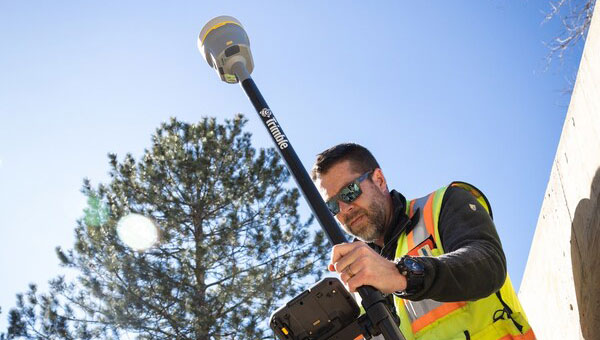
    Trimble has introduced the Trimble R980 GNSS system, the newest addition to its GNSS receiver portfolio. The R980 features communication capabilities to support uninterrupted field operations.

    The Trimble R980 can be used for land surveying, transportation infrastructure, construction, energy, oil and gas, utilities and mining projects. It features Trimble’s ProPoint GNSS positioning engine and inertial measurement unit (IMU)-based tilt compensation using Trimble TIP  technology. These features make it suitable for dense urban environments and under tree canopy, removing the need to level the pole when capturing data points.

    The R980’s communication capabilities include a dual-band UHF radio and an integrated worldwide LTE modem for receiving corrections from a local base station or VRS network. Able to operate on 450 MHz, 900 MHz or LTE bands, users have flexibility in how they receive and transmit RTK corrections. It operates in both 450 MHz and 900 MHz bands, allowing for interoperability with a range of existing industry solutions.

    The R980 also supports the Trimble Internet Base Station Service (IBSS) for streaming RTK corrections using Trimble Access field software for connected workflows.

    A 12-month subscription to Trimble CenterPoint RTX real-time corrections, delivered via satellite or internet, is included on new R980 receivers. This provides reliability without the need for a local base station or VRS network, the company says. The service provides centimeter-level corrections and is complemented by the Trimble xFill correction service that extends RTK positioning during signal interruptions.

    The receiver includes Trimble IonoGuard technology, which mitigates ionospheric disturbances for RTK GNSS and Trimble Everest Plus for multipath mitigation performance. IonoGuard technology improves positioning availability in periods of increased solar activity, such as the recent G5 geomagnetic storms that occurred around the world.