Category: Uncategorized

  • Seen & Heard: A rise in GPS jamming

    Seen & Heard: A rise in GPS jamming

    “Seen & Heard” is a monthly feature of GPS World magazine, traveling the world to capture interesting and unusual news stories involving the GNSS/PNT industry.


    Photo: deepblue4you / iStock / Getty Images Plus / Getty Images
    Photo: deepblue4you / iStock / Getty Images Plus / Getty Images

    Rise in GPS Jammers

    The Finnish government’s Transport and Communications Agency (Traficom) has seen an increase in GNSS jamming devices. In 2024, the agency already has detected 106 GNSS disturbances caused by signal-jamming devices in vehicles. When activated, the devices interfere with GPS signals in a radius that measures from a few dozen to several hundred meters. Authorities have found people have used the jammers in company cars tracked by their employers to disrupt tachographs that track where and when they are driving.


    Photo: kertu_ee / iStock / Getty Images Plus / Getty Images
    Photo: kertu_ee / iStock / Getty Images Plus / Getty Images

    Confirmed Decline in Emperor Penguin Colonies

    A multinational research exercise has confirmed emperor penguins are in decline in Antarctica. However, the cause is still unknown. The assessment of emperor penguin colonies found a 10% decline in the adult population, now estimated at 228,000.  The study used aerial and satellite imagery of all known colonies in Antarctica to collect data for a series of models analyzing emperor penguin population processes across the continent. “Remote sensing has given us the context that, sometimes, these birds hop up on ice shelves or glaciers – we didn’t know they did that prior to seeing them doing that on satellite imagery,” said Michelle LaRue, the wildlife ecologist from the University of Canterbury and Minnesota University, who led the study.


    Image: Phillip Silverman / iStock / Getty Images Plus / Getty Images / Getty Images
    Photo: Phillip Silverman / iStock / Getty Images Plus / Getty Images / Getty Images

    UK Defense Minister’s Plane Jammed Near Russia

    A plane carrying British Defense Secretary Grant Shapps had its satellite signal jammed as it flew near Russian territory, the government reported on March 14. The government said the Royal Air Force jet carrying Shapps, officials and journalists “temporarily experienced GPS jamming when they flew close to Kaliningrad” on a flight from Poland to the UK. The Times of London, whose reporter was onboard, said that for about 30 minutes, mobile phones could not connect to the internet and the aircraft was forced to use alternative methods to determine its location. Kaliningrad is a Russian enclave bordered by Poland and Lithuania, home to the Russian Navy’s Baltic Fleet.
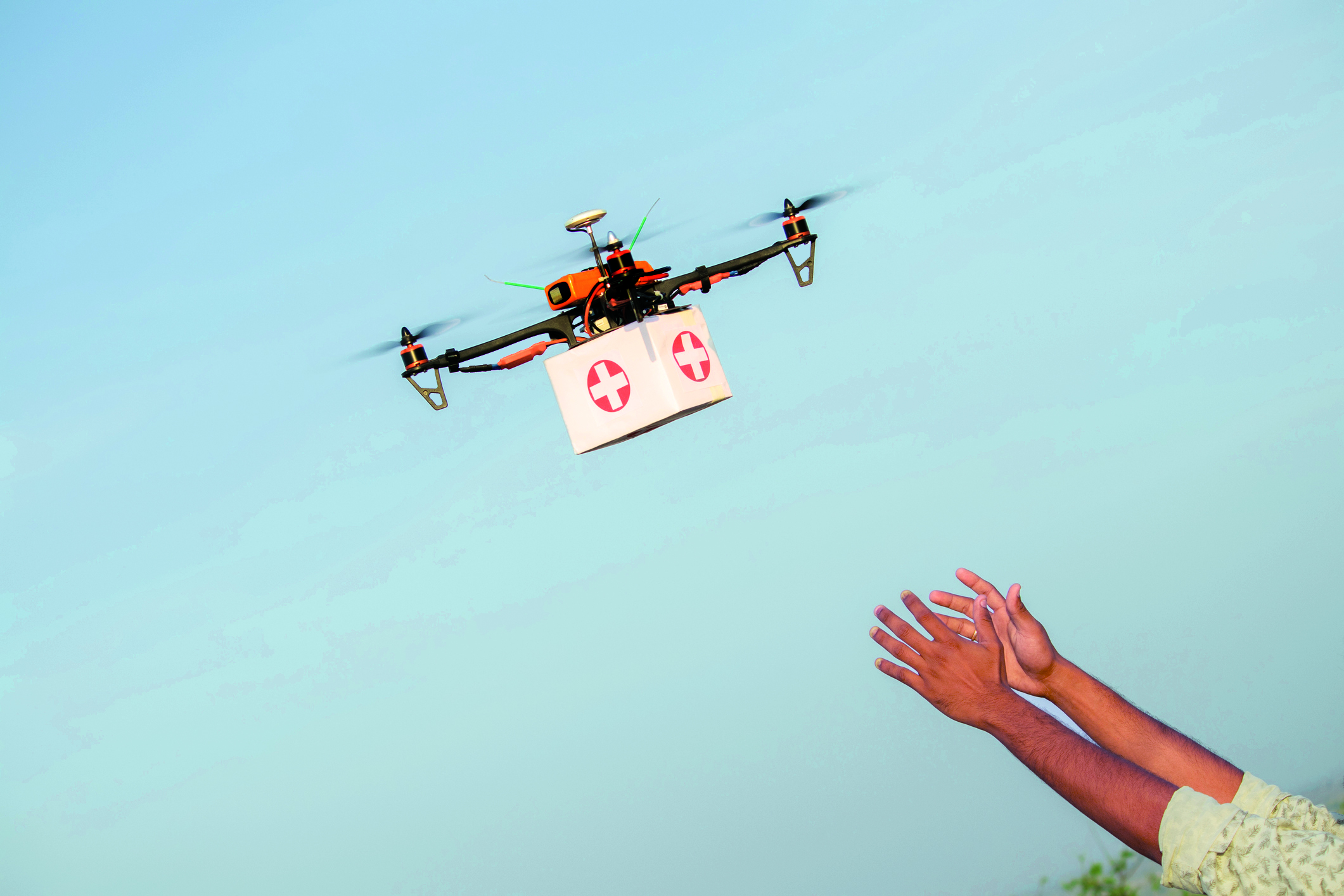

    Photo: lakshmiprasad S /  iStock / Getty Images Plus / Getty Images
    Photo: lakshmiprasad S / iStock / Getty Images Plus / Getty Images

    Medicine from the Sky

    In the remote village of Oren, Kisumu County, Kenya, healthcare providers are now getting supplies and medicine delivered from the sky using UAV technology from Zipline, a U.S.-based logistics company. Healthcare providers can receive deliveries via UAV in less than 10 minutes, residents told Nation. The UAV opens at the bottom and releases a box, attached to a parachute. It then flies back to the Zipline hub in Chemelil, Kenya.

  • Septentrio expands UAV ecosystem for reliable GNSS positioning

    Septentrio expands UAV ecosystem for reliable GNSS positioning


    Photo: Septentrio
    Photo: Septentrio

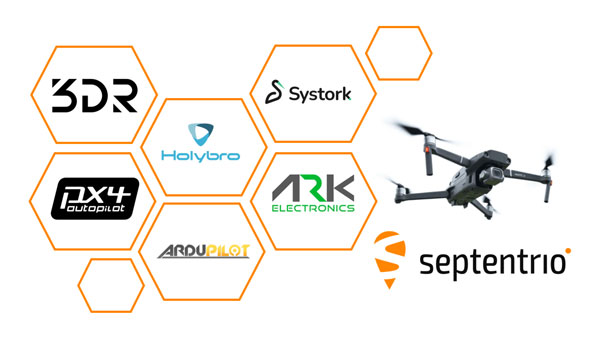
    Septentrio is closely working with several UAV solutions providers including 3DR, Holybro, ARK Electronics and Systork, resulting in various new products that allow for easier prototyping or integration of the Septentrio mosaic GNSS receiver into UAVs.

    mosaic is a compact triple-frequency receiver leveraging signals from all available GNSS constellations to offer the highest degree of positioning availability, even under challenging conditions. Built-in anti-jamming and anti-spoofing technology protects mosaic against intentional or unintentional interference. A high level of positioning reliability is also required by UAVs, which operate in challenging environments such as around high structures, under foliage or in places of possible RF interference. In addition to collaborations with hardware integrators, Septentrio works closely with the open-source autopilot community including PX4 and Ardupilot, which aims to facilitate a smooth integration process for end-users.

    The recently available products, which are designed to bring reliable high-accuracy positioning to UAVs, include Holybro H-RTK mosaic-H (dual antenna heading), 3DR mosaic-X5 CAN GPS, Systork Linnet mosaic-X5 and ARK mosaic-x5 GPS. These products offer UAV-centered features such as magnetometer, barometer and UAV CAN communication. The integrated mosaic module receives signals from all GNSS constellations and outputs centimeter-level RTK positioning as well as full GNSS carrier raw data

    Dual antenna operation is also supported with mosaic-H for heading and pitch or heading and roll orientation with sub-degree accuracy. Its anti-interference technology AIM+ is designed to protect the system from malicious jamming and spoofing attacks and reduces the risk of self-interference which occurs when nearby electronics like cameras and servos accidentally emit radio signals that interfere with GPS/GNSS.

  • Inertial Labs to develop lidar system for Sony UAV

    Inertial Labs to develop lidar system for Sony UAV

    Image: Inertial Labs
    Image: Inertial Labs

    Inertial Labs and Sony have partnered to integrate lidar technology into Sony’s Airpeak UAV. The collaboration aims to improve the UAVs applications in surveying, mapping and cinematic videography, as well as provide high accuracy and detail to aerial data acquisition.  

     The partnership will incorporate Inertial Labs’ RESEPI lidar remote sensing payload instrument GEN-II into Sony’s UAV to enhance Airpeak’s ability to produce detailed aerial maps and 3D models.  

     Tailored for professionals, the lidar system integrated into Sony’s Airpeak drone UAV will significantly enhance workflow efficiency and data accuracy, particularly in sectors such as construction, agriculture, and filmmaking, according to Inertial Labs. The system allows for extensive data handling and facilitates longer durations of data collection without frequent offloads. 


  • VIAVI Solutions to acquire Spirent Communications

    VIAVI Solutions to acquire Spirent Communications

    Photo:VIAVI Solutions will acquire Spirent Communications for $1.27 billion. According to VIAVI, the acquisition aims to boost its position as a premier provider for research labs, service providers, data centers and mission-critical infrastructures worldwide.

    The merger aims to integrate VIAVI and Spirent’s complementary product portfolios and services and to offer a broad spectrum of solutions across various markets and applications.

    This collaboration is expected to meet the demands of high-growth sectors such as cloud service providers, enterprise/IT networks, and emerging 5G and 6G technologies, as well as positioning, navigation and timing (PNT) verticals.

    As a result of the acquisition, VIAVI aims to accelerate technology development and product innovation, particularly in areas such as artificial intelligence, machine learning, security, cloud-native architecture and automation. By using both companies’ joint engineering, research, and development expertise, VIAVI intends to foster innovation, enhance operational efficiency and generate substantial cost synergies.

    The partnership is expected to yield annual run-rate cost synergies of up to $75 million within two years post-acquisition.

    This acquisition aims to bolster VIAVI’s position as a global provider of test, assurance and security solutions. Moving forward, the focus will be on delivering high-performance, integrated solutions that ensure reliability, efficiency and security across critical network infrastructures and digital ecosystems, VIAVI said.

  • Microchip: Inductive position sensors measure movements

    Microchip: Inductive position sensors measure movements

    Controlling an earthmoving machine to perform a task requires knowing exactly where its bucket or blade contacts the dirt. Therefore, in addition to knowing the machine’s position, it is necessary to model, in real-time, the rotation at each pivot point and apply some mathematics and trigonometry.

    Microchip makes an integrated circuit, known as an inductive position sensor, that is very well suited for machine control because it is not affected by the harsh conditions on most construction sites — temperature extremes, water, dust and dirt — and the vibrations caused by the machine itself. Additionally, it is not affected by the stray magnetic fields generated by electric motors, which are increasingly common on those machines.

    Inductive position sensors are used in many automotive systems. (Photo: Microchip)
    Inductive position sensors are used in many automotive systems. (Photo: Microchip)

    “We use our inductive position sensing to measure the angle or the linear movement of some sort of target to get a machine to perform its task,” said Mark Smith, product line manager for many different mixed signal products at Microchip. “For example, to control a blade on an earthmoving machine to do something, you need to have feedback about its current angle.”

    Microchip also makes sensors for human interfaces, such as accelerator pedals in cars, which no longer have cables that run up to the motor. “Any sort of movement, such as the angles of rotation of a robotic arm, must be monitored and measured. Inductive position sensing is one of the up-and-coming ways to do it,” said Smith.

    To direct a task, a central processing unit must then analyze and integrate the data from the sensors. For that, Microchip makes many types of computing elements — including mini-computers and microcontrollers.

    “One of the things that’s coming up with many of these vehicles is ambient magnetic noise in the system,” said Smith, “because you’re next to electric motors these days. You want sensors that are immune to stray magnetic fields. We started with automotive, but we’re also seeing it now in industrial environments, including earthmoving vehicles.” Inductive position sensors, Smith said, are simpler, cheaper, lighter, and better able to withstand extreme temperatures than what they are replacing. “Also, because they are non-contact, the circuit board can be environmentally protected.”

    Vibrations also are a concern. “There is an air gap between the target and the sensor itself,” Smith said. “We have an automatic gain control at the sensing side that is constantly adjusting the gain to get the maximum signal strength. This is a fast-moving control algorithm that can adjust the gain to ensure that the vibration does not affect the performance. When everything is operating at its maximum torque, this starts to matter.”

  • Inertial Labs, E38 collaborate for UAV-lidar integration

    Inertial Labs, E38 collaborate for UAV-lidar integration

    Image: Inertial Labs
    Image: Inertial Labs

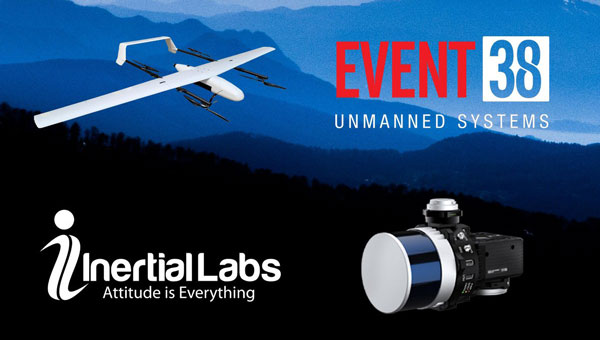
    Inertial Labs has entered a strategic partnership with E38 to integrate Inertial Labs’ RESEPI lidar payload into E38’s advanced E455 UAV. The technology is ideal for professional surveying, mapping and inspection services.

    RESEPI is a sensor-fusion platform designed for accuracy-focused remote sensing applications. It leverages a high-performance Inertial Labs inertial navigation system (INS) and a high-accuracy single or dual-antenna GNSS receiver integrated with a Linux-based processing core and data-logging software. The lidar system will seamlessly integrate with the E455 drone, which aims to improve its capabilities to capture high-resolution, 3D spatial data across various environments. The technology can be used in construction, agriculture and environmental monitoring by offering detailed and accurate data.

    The E455 is a fixed-wing vertical takeoff and landing (VTOL) UAV designed to operate on battery power with a maximum takeoff weight of up to 29.5 kg. It features a removable payload bay with an open architecture at the center of gravity to provide maximum utility and flexibility for a variety of mission requirements. Capable of flying for over two hours or carrying payloads of almost 7 kg, the E455 is ideal for extensive surveying and mapping missions with the integrated RESEPI Payload Lidar system.

    Combining the E455 drone’s robust flight capabilities with the high-precision lidar technology of the RESEPI payload will enable users to gather detailed topographic data in challenging terrains and under diverse conditions.

  • DTC, Inertial Labs collaborate on GNSS-denied UAV solution

    DTC, Inertial Labs collaborate on GNSS-denied UAV solution

    Photo:Domo Tactical Communications (DTC) and Inertial Labs have partnered to develop an integrated uncrewed systems solution for UAV manufacturers and end users. The new solution combines technologies from both companies to create a single navigation, command and control (C2), and intelligence, surveillance and reconnaissance (ISR) system.

    DTC’s Manet Mesh radio — with MeshUltra product family waveforms — aims to provide robust, high-bandwidth C2 and ISR links, which can allow uncrewed vehicles to operate successfully in hostile RF environments. By integrating Inertial Labs’ inertial navigation system (INS) and DTC’s Mesh-based RF ranging capability, those same vehicles are designed to operate when space-based positioning systems are unavailable due to jamming, spoofing or lack of sky view. The INS provides assured position, navigation and timing (APNT), and alternative navigation (ALTNAV) solutions directly to the uncrewed vehicle.

  • DTC, Inertial Labs collaborate on GNSS-denied UAV solution

    DTC, Inertial Labs collaborate on GNSS-denied UAV solution

    Photo:Domo Tactical Communications (DTC) and Inertial Labs have partnered to develop an integrated uncrewed systems solution for UAV manufacturers and end users. The new solution combines technologies from both companies to create a single navigation, command and control (C2), and intelligence, surveillance and reconnaissance (ISR) system.

    DTC’s Manet Mesh radio — with MeshUltra product family waveforms — aims to provide robust, high-bandwidth C2 and ISR links, which can allow uncrewed vehicles to operate successfully in hostile RF environments. By integrating Inertial Labs’ inertial navigation system (INS) and DTC’s Mesh-based RF ranging capability, those same vehicles are designed to operate when space-based positioning systems are unavailable due to jamming, spoofing or lack of sky view. The INS provides assured position, navigation and timing (APNT), and alternative navigation (ALTNAV) solutions directly to the uncrewed vehicle.

  • Wingtra launches lidar UAV solution

    Wingtra launches lidar UAV solution

    Image: Wingtra
    Image: Wingtra

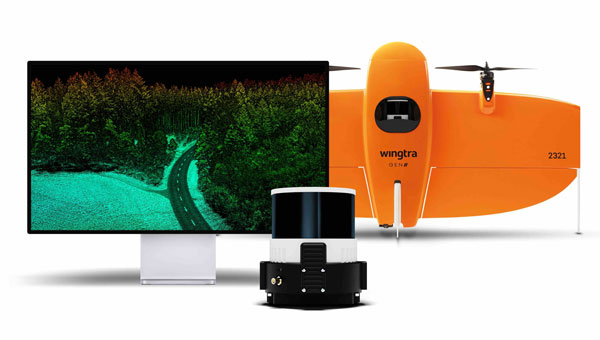
    Wingtra, a UAV technology company, has introduced a lidar UAV mapping solution that combines the WingtraOne GEN II UAV with a newly developed lidar sensor. This integration aims to advance UAV lidar efficiency, increase accuracy and simplify integration.

    The lidar solution incorporates a Hesai scanner, Inertial Labs IMU and NovAtel GNSS designed to optimize data acquisition and reduce the need for post-processing strip alignment. This advancement offers immediate access to precise terrain information following each flight and enhances the efficiency of mapping and photogrammetric analysis in various sectors.

    One of the key features of the lidar system is its reduced field time, with no calibration needed and a one-minute initialization process. The Wingtra lidar application and the system’s automated features offer a streamlined data capture process, which makes it accessible even to those new to lidar technology.

    Carlos Femmer, director of data acquisition at HDR, tested the Wingtra lidar payload and noted its ability to produce high-quality data on both vegetated and non-vegetated surfaces with minimal noise compared to other sensors in the same price range.

    The solution offers a vertical accuracy of 3 cm from a 60 m flight height, with leading point density in its class. The WingtraOne GEN II’s design and automated flight patterns offer consistent results across different pilots.

  • Thank you for registering

    Thank you for registering for the upcoming webinar, “Practical tips for reducing cost and complexity of high precision RTK solutions” sponsored by u-blox.

    A link to the live event will be sent to you two hours before the event. Your personalized event URL will be automatically generated by the ON24 system. To ensure receipt of the email, please whitelist this email address by adding it to your contacts: [email protected].

    This presentation will begin at 1 p.m. EDT / 10 a.m. PDT on Thursday, March 14. A recording will also be sent to you the following day so you can watch it on-demand.

    Audience members may arrive 15 minutes prior to live time. If you have any questions, please contact event producer Jesse Khalil at [email protected].

  • Trimble partners with IIT Kanpur to enhance UAV technology in India

    Trimble partners with IIT Kanpur to enhance UAV technology in India

    Image: Polina Shuvaeva/ iStock / Getty Images Plus/ Getty Images
    Image: Polina Shuvaeva/ iStock / Getty Images Plus/ Getty Images

    Trimble has begun collaborating with the Indian Institute of Technology in Kanpur (IIT Kanpur) to support a new UAV program offered by the Department of Aerospace Engineering.

    Under the partnership, Trimble will provide the institution with direct georeferencing (DG) products for UAV survey and mapping, including a suite of Applanix board sets and supporting processing software. Trimble will also provide training and support to educate the UAV engineering team on how best to integrate and use the products within their teaching curriculum.

    India is projected to be the fastest-growing UAV market by 2025, according to a recent report by PricewaterhouseCoopers.

    The collaboration is designed to help the country develop local expertise in using UAV georeferencing best practices while providing future generations with the knowledge and capabilities to work with the latest UAV technology.

    IIT Kanpur was declared an Institute of National Importance (INI) by the Government of India under the Institutes of Technology Act. With a dedicated program for UAV education, it receives government funding to develop UAV technology and build out labs to support student training and research. IIT Kanpur’s researchers are credited with creating the first solar-powered UAVs developed in India, named MARAAL-1 and MARAAL-2.

  • Point One Navigation expands Polaris RTK location network to South Korea

    Point One Navigation expands Polaris RTK location network to South Korea

    Image: Point One Navigation
    Image: Point One Navigation

    Point One Navigation has expanded its Polaris real-time kinematic (RTK) location network to South Korea.

    The network is set to provide comprehensive coverage throughout the country. Existing Polaris customers can use the South Korean integration to enhance the precision and efficiency of their location-based projects.

    Polaris offers centimeter-level accurate GNSS positioning with accuracy ranging from 1 cm to 10 cm, which makes it ideal for challenging environments, such as urban areas with limited sky view. Unlike standard GNSS systems — which face position uncertainty due to atmospheric signal delay, satellite orbit variation, clock drift and signal multipath — the Polaris network counters these issues using additional information from compact base stations.

    Point One’s FusionEngine software further integrates inertial measurement, wheel odometry and additional sensors to achieve the desired level of precision in the complete absence of satellite signals.

    The Polaris network with FusionEngine software can be used as a precision location service for autonomy and robotics applications. Polaris supports all major GNSS constellations and has an extremely dense global network of base stations that cover the United States, Europe, New Zealand, South Korea, and parts of Canada and Australia.

    Developers can integrate the Polaris RTK network and FusionEngine software using GraphQL API. The network can be built into demanding applications such as industrial autonomy, precision agriculture, logistics and delivery, robots and advanced driver-assistance systems (ADAS).