Tag: RTCM

  • Cleared for the dirt: How robotic rovers are revolutionizing military runway assessment

    Cleared for the dirt: How robotic rovers are revolutionizing military runway assessment

    Tactical air-lifters such as the Airbus A400M, Lockheed C-130 and Boeing C-17 require precise runway roughness assessments to operate safely on unpaved surfaces. An autonomous rover system developed at the Royal Military Academy of Belgium uses RTK/PPK GNSS positioning and sensor fusion to deliver centimeter-level height measurements, drastically reducing survey time. The system provides a practical solution for rapid runway certification across military operations and humanitarian response missions.

    Unpaved runway assessment

    The Airbus A400M Atlas, the Lockheed C-130 Hercules and the Boeing C-17 Globemaster III routinely operate from unpaved runways in harsh environments far from established infrastructure. Before these aircraft can safely land, flight crews require accurate runway roughness data to assess whether the surface meets operational limits. This assessment relies on precise, quantitative measurements of the runway’s surface characteristics — a task that traditionally requires specialized survey teams and hours of manual work with GNSS equipment, resources that are often unavailable in high-tempo tactical or emergency response scenarios.

    The challenge is particularly acute because different aircraft have specific roughness tolerances. The A400M uses an equivalent bump height (EBH) methodology, while Boeing employs its Boeing Bump Criteria. The EBH requires vertical measurement precision of ±1 cm over wavelengths ranging from 5 to 100 meters. Meeting these stringent requirements with rapid, field-deployable methods has remained an operational gap — until now.

    At the Royal Military Academy (RMA) of Belgium, we developed a novel solution to this critical challenge. Our system features a rugged, autonomous unmanned ground vehicle that can rapidly perform a centimeter-accurate runway assessment with minimal user intervention. It represents a fusion of robotics, geodesy, and advanced GNSS techniques, designed specifically for ease of use by military teams in the field. The system is called Belgian Navigational Surface Inspector (BENSI).

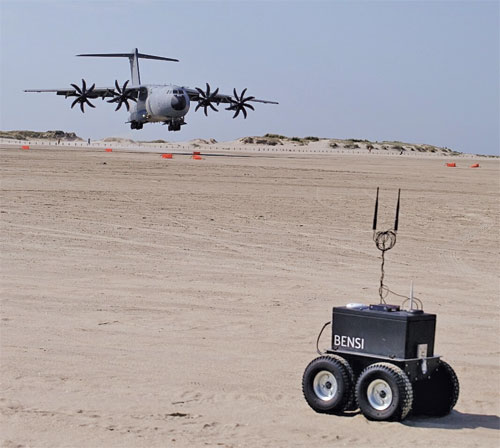
    FIGURE 1 shows the BENSI system during a mission at a tactical landing zone with the A400Min the background. FIGURE 2 shows the BENSI system being configured by the operator during a landing preparation.
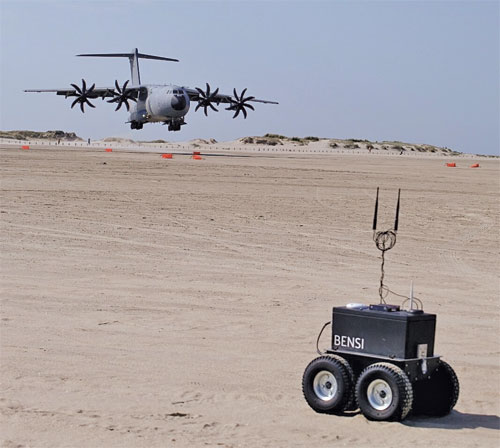
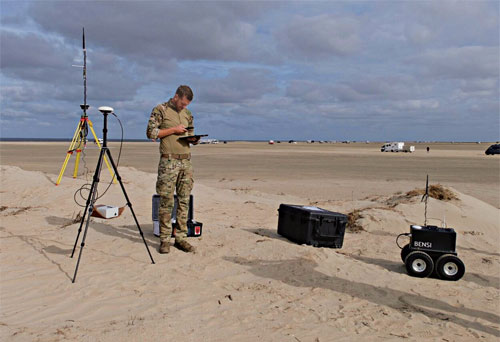
    Figure 1 The autonomous UGV (BENSI) during a mission at a tactical landing zone with the A400M Atlas in the background.
    Figure 1 The autonomous UGV (BENSI) during a mission at a tactical landing zone with the A400M Atlas in the background.
    Figure 2 The BENSI system being configured by the operator 
during the beach landing preparation at Rømø, Denmark.
    Figure 2 The BENSI system being configured by the operator
    during the beach landing preparation at Rømø, Denmark.

    This article details the system’s architecture, the integration of multiple technologies that enable the stringent precision required achieved by GNSS and sensor fusion, self-driving capabilities and its successful deployment in demanding field tests. We present a military graded solution for ensuring tactical airlift safety, enabled by modern, accessible GNSS technology and robotics.

    Quantifying runway roughness

    Deployable Air Traffic Management (DATM) and Pathfinders are responsible for ensuring the safety of aircraft operations on unpaved runways. They are tasked with assessing the quality of the runway and the Runway Safety Area (RSA) to ensure that the aircraft can land safely. The pilots analyze their assessment and take the final decision to land.

    FIGURE 3 is an example of a landing zone having an unpaved runway that needs to be evaluated for landing. FIGURE 4 overviews the landing zone by mapping and indicating features of the runway that need to be considered by the pilots. An important aspect of the DATM’s assessment is the runway’s roughness, which is quantified by the EBH.
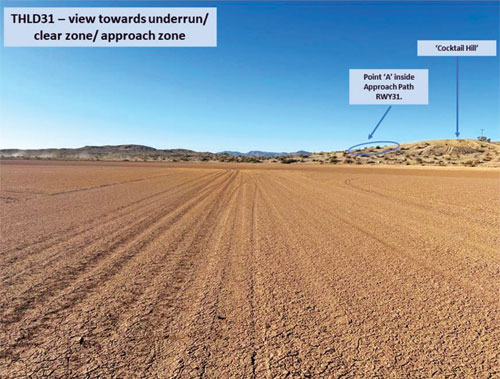
    Figure 3  An example of a tactical landing zone.
    Figure 3 An example of a tactical landing zone.

    For modern military transport aircraft operations, runway roughness assessment is a critical safety parameter. Both major manufacturers — Airbus with its EBH methodology and Boeing with its Boeing Bump Criteria — have developed sophisticated approaches to characterize runway longitudinal roughness profiles. These methods analyze height variations over wavelengths ranging from 5 to 100 meters, requiring vertical measurement precision of ±1 cm. This rigorous assessment is essential to reduce aircraft structural fatigue, minimize maintenance costs, prevent exceedance of design limit loads, and ultimately ensure safe operations. For the A400M specifically, Airbus requires EBH characterization to determine operational limitations of the aircraft’s maximum payload.
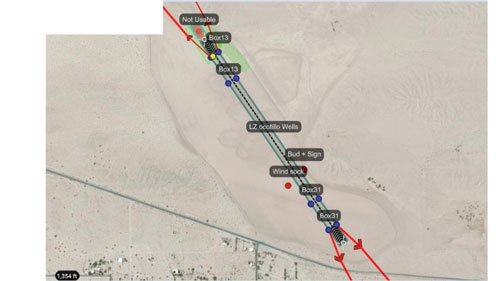
    Figure 4  A typical mapping of a landing zone showing a 
condensed overview of DATM’s assessment.
    Figure 4 A typical mapping of a landing zone showing a
    condensed overview of DATM’s assessment.

    Traditionally, achieving this precision would involve a painstaking survey conducted by specialists using a GNSS survey system mounted on a trolley requiring human guidance along the measurement tracks totaling more than 3 km of length. For military units like the DATM and Pathfinder teams, who often are the first on the ground, this is impractical. They need a system that is rapid, reliable, simple to operate without a surveying background, and robust enough for field conditions.

    A GNSS-Centric design

    Our solution is a two-part system designed for rapid deployment: a portable GNSS base station and autonomous rover. FIGURE 5 shows a schematic overview of the system architecture.
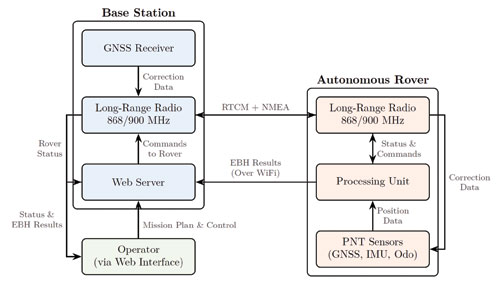
    Figure 5  A schematic overview of the system architecture, showing the data (NMEA) and correction (RTCM) flow between the base station, rover and operator.
    Figure 5 A schematic overview of the system architecture, showing the data (NMEA) and correction (RTCM) flow between the base station, rover and operator.

    The base station: The system’s anchor

    Housed in a compact, portable case, weighing just 2 kg including tripod and radios (as seen in FIGURE 2), it serves as the operational hub. Once set up on its lightweight tripod, it performs an automatic survey to establish its precise coordinates. Its primary role for positioning is to generate and transmit Radio Technical Commission for Maritime Services (RTCM) 3.x correction data to the rover via a robust long-range radio link (operating in the868/900MHz bands).

    Beyond its GNSS duties, the base station acts as a self-contained command center. It hosts a Wi-Fi hotspot and a web server, allowing the operator to connect with any standard tablet, smartphone or laptop. This web interface is used for mission planning, command and control of the rover, and real-time monitoring of survey progress. At the end of the mission, the operator can download the EBH data and additional quality metrics of the runway for analysis such as a summary report of the complete measurement, a gradient analysis, and a runway map highlighting zones with bumps or troughs exceeding the specified criteria.

    An autonomous, all-terrain surveyor

    The UGV is a lightweight but rugged platform chosen for its durability and open-source software architecture, which allows for deep integration of our custom navigation and control algorithms. The rover has been designed to be able to traverse rough terrain and survive in harsh weather conditions. The UGV consists of two parts, the chassis (11 kg) and the processing payload(8 kg). The heart of the rover is the processing payload, which contains a sophisticated sensor suite designed for high-precision localization and navigation.

    ■ Primary GNSS receiver. A high-grade, multi-constellation Septentrio receiver with a Calian/Tallysman GNSS antenna provides the main source of positioning information.

    ■ GNSS heading. A second Calian/Tallysman GNSS antenna, set up in a moving-base configuration, provides degree-accurate true heading, which is critical for maintaining precise track-following.

    ■ Inertial measurement unit (IMU). An industrial-grade Xsens IMU provides high-frequency data on the rover’s orientation and acceleration, bridging any brief GNSS outages, providing the sensor fusion algorithm with high-rate data, and helping to smooth the final trajectory.

    ■  Radio communication. The radio modules provide robust long-range communication with the base station operating in the 868/900MHz bands.

    ■ Wheel odometry. Encoders on the rover’s wheels provide continuous velocity information, acting as a crucial input for the sensor fusion algorithm. All sensor data is fed into an onboard mini-PC running the Robot Operating System, a flexible framework for developing robotic applications.

    Path to precision

    Achieving centimeter-level accuracy on a moving platform in challenging environments requires more than just a good GNSS receiver. Our approach is built on a robust foundation of sensor fusion and a dual processing strategy using real-time kinematic and post-processing kinematic (RTK/PPK). An extended Kalman filter (EKF) is at the core of the rover’s navigation software. The EKF continuously fuses data from the GNSS receivers, IMU and wheel encoders to produce a single, high-integrity “pose” (position and orientation) estimate.

    For runway surveying, we employ two modes of GNSS processing:

    RTK. During the mission, the rover uses the RTCM corrections from the base station to compute a centimeter-accurate position in real-time. This is used for autonomous navigation, allowing the rover to follow its generated mission plan configured by the operator with high precision.

    PPK. While RTK provides excellent real-time results, the most demanding applications benefit from post-processing. Both the rover and the base station log all raw GNSS observables during the mission. After the survey is complete, these raw data files are processed together which allows for more rigorous quality control and can often resolve ambiguities or fix cycle slips that were not solvable in real-time, providing the definitive, highest accuracy trajectory for the EBH analysis.

    A final crucial step is extracting the height profile for each EBH track and subsequently transforming and reformatting this data for Airbus’ AssurTool. The step also is automated and carried out by the software. It takes care of the following:

    ■ The conversion of the geodetic coordinates (latitude, longitude, and height above the World Geodetic System 1984 [WGS84] ellipsoid) to Universal Transverse Mercator plane coordinates and orthometric heights (heights relative to a geoid).

    ■ The extraction of the height profile of each EBH track.

    ■ Quality control of the precision of the height profile flags tracks that do not meet the required accuracy or show inconsistencies.

    ■ The transformation and reformatting of this data for Airbus’ AssurTool.

    Self-driving capabilities

    The rover uses a navigation framework with a custom planner for generating smooth, curved paths that match the rover’s turning capabilities and steers the rover using a controller based on the Regulated Pure Pursuit tracking algorithm. A specialized lane-generation algorithm creates optimal survey patterns from runway corner points, with behavior-tree recovery strategies for robust operation.

    FIGURE 6 shows a typical EBH survey pattern generated from the mission plan and executed by the rover and a depiction of how the rover plans the smooth curved path between the lanes.
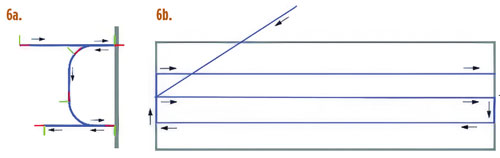
    Figure 6 Features of the navigation framework used for planning the EBH tracks. (a) A typical EBH survey pattern generated from the mission plan and executed by the rover. (b) A depiction of how the rover plans the smooth curved path between the lanes.
    Figure 6 Features of the navigation framework used for planning the EBH tracks. (a) A typical EBH survey pattern generated from the mission plan and executed by the rover. (b) A depiction of how the rover plans the smooth curved path between the lanes.

    A streamlined workflow

    The system was designed from the ground up to be operated by non-surveyors. A typical mission workflow is as follows:

    Setup. The operator places the base station on a tripod near the runway and unfolds the rover. The entire hardware setup takes less than 10 minutes.

    Mission planning. Using a ruggedized tablet (or any other device with a web browser), the operator connects to the base station’s WiFi and opens the web interface. They define the runway by entering the coordinates of the runway’s corners. The software automatically calculates the EBH lines based on the required spacing. FIGURE 7a shows the user interface displayed on a tablet, showing the EBH mission configuration page.
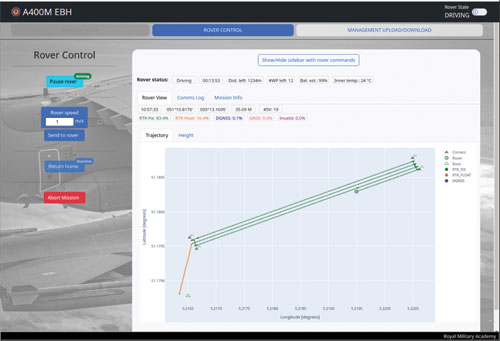
    Figure 7a The user interface of the web application.
    Figure 7a The user interface displayed on a tablet, showing the EBH mission configuration.

    Execution. The operator initiates the mission, and the UGV autonomously navigates to the start of the first line and begins the survey. The operator can monitor and control the rover’s progress, position, and GNSS quality status in real-time on the web interface. FIGURE 7b shows the user interface displayed on a tablet, showing the rover control, the real-time status of the UGV and the measurements.
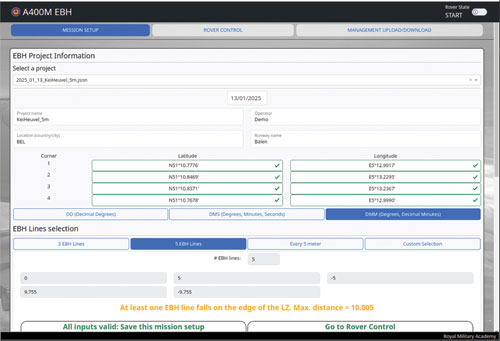
    Figure 7b The tablet showing the rover control and the real-time status of the UGV and the EBH results.
    Figure 7b The tablet showing the rover control and the real-time status of the UGV and the EBH results.

    Data retrieval. Upon completion, the rover returns to the base station. The system automatically processes the data, producing downloadable files formatted for direct import into Airbus’ AssurTool and additional useful quality metrics for the operator. These consist of a summary report of the complete measurement, a gradient analysis, and a runway map highlighting zones with bumps or troughs exceeding the specified criteria.

    Analyzing the data

    Once the rover completes its survey and returns to the base station, the system automatically initiates post-processing of the collected data. This critical step validates the quality of every measurement and generates operator-ready outputs for both Airbus’ AssurTool and field assessment.

    The post-processing pipeline applies rigorous quality criteria to each survey line. Lines failing these criteria are automatically flagged with detailed diagnostics explaining the cause.

    For operational decision-making, the system generates a comprehensive visualization report. The operators receive planimetric maps showing the height profile plots and a detailed gradient analysis identifying critical slope transitions. A key capability is the generation of a 3D interpolated height map of the entire runway surface. This color-coded surface map provides an intuitive view of the runway’s topography, clearly highlighting zones with excessive bumps, depressions, or gradient anomalies that facilitates the assessment of the runway.

    These analysis reports are accessible through the web interface for immediate download to the operator’s tablet. FIGURES 8 shows examples of the visualization report.
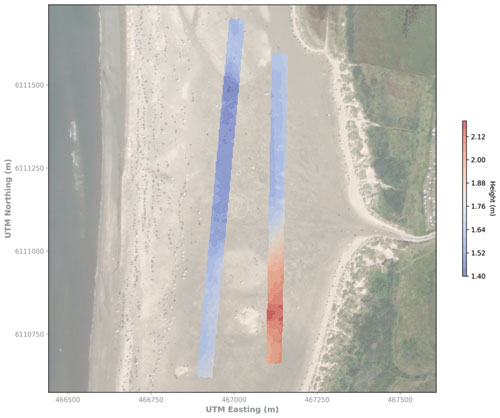
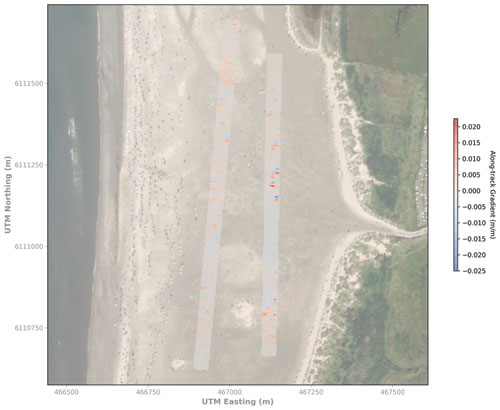
    Figure 8a 2D height and gradient contour maps of two surfaces generated by the BENSI system. (a) A height contour map of two landing zone (LZ) surfaces automatically generated by the BENSI system.
    Figure 8a 2D height and gradient contour maps of two surfaces generated by the BENSI system. (a) A height contour map of two landing zone (LZ) surfaces automatically generated by the BENSI system.
    Figure 8b  A gradient contour map of two LZ surfaces automatically generated by the BENSI system.
    Figure 8b A gradient contour map of two LZ surfaces automatically generated by the BENSI system.

    Proven performance

    The UGV system is a mature prototype that has been validated in numerous international military exercises. It has successfully surveyed tactical landing zones in varied environments, from the desert strips of Yuma, Arizona, and 29 Palms, California, to the sandy shores of Denmark and fields in France, Portugal and Italy. In all tests, the system has consistently delivered the sub-centimeter height precision required for A400M EBH certification.

    2025 Rømø Head-to-Head Trial. During beach-landing preparations in August 2025, our autonomous rover and a manual system (human-guided trolley) using a professional GNSS survey system ran side-by-side on a 1 000m landing zone on the Rømø beach in Denmark. The BENSI solution matched the manual survey system height profile with a standard deviation of 8mm and demonstrated significantly better lane-tracking consistency (mean deviation: 8,5 cm vs 16 cm and deviation error: 3 cm vs 9 cm). FIGURE 9 shows the height-error distribution between the BENSI system and the manual survey system at Rømø, Denmark.
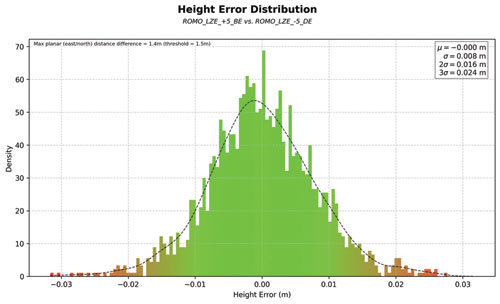
    Figure 9  Height-error distribution between the BENSI system and the manual survey system at Rømø, Denmark.
    Figure 9 Height-error distribution between the BENSI system and the manual survey system at Rømø, Denmark.

    Rapid humanitarian response

    While BENSI was conceived for tactical airlift operations, its capabilities extend naturally to humanitarian assistance and disaster-relief missions. Belgium’s civil rapid-response unit Belgian First Aid & Support Team (B-FAST) routinely deploys doctors, paramedics, firefighters, and other professionals worldwide following earthquakes, floods, or epidemics. Leveraging the A400M’s ability to land on short, unpaved strips away from congested or contested airfields drastically cuts transit times — but only if the runway’s condition can be certified quickly.

    The BENSI systems enables a DATM team to quickly relay an EBH report and awareness map of the immediate area to the inbound aircrew. This rapid assessment unlocks critical early access for life-saving medical supplies and personnel when every hour counts.

    Conclusion and the Road Ahead

    The fusion of autonomous robotics and high-precision GNSS offers a powerful solution to the critical challenge of certifying unpaved runways. Our system saves valuable time, reduces the burden on specialized personnel, and provides objective, high-quality data that directly enhances the safety of tactical airlift operations.

    Development is ongoing. Our current efforts focus on several key areas:

     Improving navigation in degraded environments. We are exploring tighter coupling between the GNSS and IMU to provide more robust navigation through areas of poor satellite visibility.

    ■ RSA assessment. We are experimenting with integrating a lidar sensor to generate a 3D point cloud of the runway and its surroundings. This will automate obstacle detection and the assessment of the RSA, though we are carefully working to mitigate potential electromagnetic interference from the lidar that can interfere with GNSS reception.

    ■ Handheld corner point device. To further improve absolute accuracy, we are developing a small, handheld device that uses RTK corrections from the base station, allowing operators to mark the runway corners with centimeter-level precision.

    This project demonstrates a clear application of GNSS technology in a demanding military aviation context, with broader implications for any field requiring rapid and precise surface profiling, from civil engineering to disaster response.

    Development Team

    ■ Pieterjan De Meulemeester ([email protected]) is a Ph.D. research engineer at the RMA of Belgium.

    ■ Alain Muls ([email protected]) is professor at the RMA of Belgium. He teaches the courses Military Satellite Based Positioning andMilitary Geodesy.

    ■ Jarno Van Audenhoven ([email protected]) is a Robotics Development and Research Engineer at the RMA of Belgium.

    ■ Pascal De Kimpe is a technician at the RMA of Belgium.

    ■ The BENSI system was developed by the R&D team at the RMA of Belgium in collaboration with Belgian Defense. The system has been successfully field-tested during international military exercises and is being evaluated for operational deployment.

    All photos courtesy of BENSI Development Team of the Royal Military Academy of Belgium

  • CHC Navigation releases 3D Grade Control System

    CHC Navigation releases 3D Grade Control System


    Image: CHC Navigation
    Image: CHC Navigation

    CHC Navigation has released the TG63, a 3D Grade Control System designed for motor graders.

    With a tightly coupled dual-GNSS positioning system and inertial sensor, the TG63 provides reliable 3D positioning and heading to ensure accuracy of the grader blade within ±2 cm.

    The TG63 is designed to withstand the harsh environment of construction sites and supports multiple applications, including real-time kinematic networked transport of RTCM via internet protocol and ultra-high frequency base stations.

    In addition, GradeNav software, operating on a 10.1 in industrial display, supports standard AutoCAD DXF design files to manage multiple grading operations, including surfaces, slopes, TINs and road features.

  • SuperSurv mobile app increases RTCM 3.1 support

    Makers of the mobile GIS app SuperSurv, developed by Supergeo Technologies Inc., are working to increase its GNSS positioning functionality.

    In recent weeks, the SuperSurv product team began to enhance SuperSurv’s NTRIP solution, aiming to adopt more RTCM versions and provide a better GNSS positioning service. NTRIP (Networked Transport of RTCM via internet protocol) is a protocol to send GNSS-related data through the internet, which enables users of differential GPS or network RTK to get correction parameters after connecting to the internet. The correction parameters can be used to calculate a more accurate GNSS location.

    Supergeo’s product team is developing the support for RTCM 3.1, including Type 1021 and 1023, two kinds of messages. Type 1021 contains the seven parameters for 3-axis coordinate transformation — three for 3-axis translation, another three for 3-axis rotation and a scale factor.

    Through the original projection method, users can only get rough coordinates. However, with NTRIP solution, users can send the current location to the server and then receive the parameters provided by it. This makes it easier to obtain a suitable local coordinates frame for more precise coordinates.

    The Type 1023 message provides more accurate grid residuals. By establishing a 4 x 4 mask window around the rover, users will receive the 3-axis corrections within these 16 grids. Accordingly, a more accurate GNSS positioning is achievable after interpolation.

    Image: SuperSurv
    Image: SuperSurv

    After completing the development, this technique will be implemented in the current version, SuperSurv 10.1. Combined with SuperSurv’s existing GIS features, Supergeo believes the newly supported RTCM 3.1 will bring a brand-new experience to fieldworkers.

    Launched in November 2017, current version 10.1 offers three major new features, including snapping, coordinate system customization and Layerset. Google Maps and TIFF are also supported.

    Supergeo’s product manager for mobile GIS, Zara Yu, recommend that users activate the point-data auto-collection with RTCM 3.1. This method not only helps users skip repeated operations but also enhances the data quality and efficiency.

    SuperSurv can be downloaded and tried at no cost. Online tutorials are also available.

  • CNES offers new Android apps for GNSS

    PPPWizzlight
    PPP Wizzlight.

    French space agency CNES has made available two applications on the Google Play store for Android apps. Both are compatible with Android N (Nougat).

    RTCM Converter: This app aims to convert the smartphone GNSS raw measurements to Radio Technical Commission for Maritime Services (RTCM message type 1077) and send them to a caster, for use by third-party software.

    PPP WizzLite: This app is a port of the CNES PPP client (code and Doppler only, light version) on Android. Accuracies of 1-2 meters can be reached in kinematic mode, and sub-meter in static mode (using external SBAS data). To do so, users need to pull external RTCM streams for orbits/clocks corrections and broadcasts, such as ones available from the International GNSS Service Real-Time Service (IGS RTS).

    Both apps have been validated on a Nexus 5X device with no phase support.


  • System of Systems: DHS Receiver Improvements, Australian SBAS

    System of Systems: DHS Receiver Improvements, Australian SBAS

    DHS Spells Out Receiver Improvements

    In early January, a new Department of Homeland Security (DHS) document appeared: “Improving the Operation and Development of Global Positioning System (GPS) Equipment Used by Critical Infrastructure.”

    The document focuses on receivers used in critical infrastructure, with an emphasis on timing receivers. It provides owners, operators, researchers, designers and manufacturers with information to improve the security and resilience of PNT equipment across the spectrum of equipment development, deployment and use.
    Specifically, its recommendations address:

    • installation and operation strategies that can be implemented for current equipment,
    • strategies that can result in more robust and resilient new and/or improved products based on existing technology and knowledge,
    • research and development that can lead to improved future capabilities.

    It introduces clear definitions of different categories of threats and hazards, including the new term “data spoofing.” It recommends some creative ways to install receive antennas, such as using decoy antennas and obscuring the location of the actual antennas being used, presumably to foil some spoofing attacks.
    It also points out that modern GNSS receivers are computers, and need to be operated and maintained with good cyber hygiene, just like other computers.

    The extensive list of recommended development strategies will challenge manufacturers while informing purchasers about the features they can seek in new equipment.

    Implementing these recommendations will lead to increased competence — that is, equipment that is better able to accommodate imperfect or faulty inputs, intentional or not.

    This document reflects the recognition that many reported problems or difficulties with GPS could be prevented or mitigated by improvements in GPS user equipment and how it is installed and operated. It is encouraging to see DHS taking steps to remedy this situation, and important that manufacturers of timing receivers, as well as critical infrastructure owners and operators that use timing receivers, follow through on these recommendations.


    Also for Receiver Manufacturers

    The Radio Technical Commission for Maritime Services (RTCM) has issued a paper with calculation algorithms to promote consistent BeiDou IODE and IODC computational approaches within the community.


    To improve precision navigation, a second-generation SBAS will use signals from both GPS and Galileo, and dual frequencies, to achieve even greater GNSS integrity and accuracy.
    To improve precision navigation, a second-generation SBAS will use signals from both GPS and Galileo, and dual frequencies, to achieve even greater GNSS integrity and accuracy.

    Second-Generation SBAS

    Geoscience Australia, an agency of the Commonwealth of Australia, will collaborate with Lockheed Martin,  Inmarsat and GMV on research to show how augmenting signals from multiple GNSS constellations can enhance positioning, navigation and timing for a range of applications.

    The project aims to demonstrate how a second-generation satellite-based augmentation system (SBAS) testbed can for the first time use signals from both GPS and Galileo, as well as dual frequencies, to provide greater integrity and accuracy. Over two years, the testbed will validate applications in nine industry sectors: agriculture, aviation, construction, maritime, mining, rail, road, spatial and utilities.

    Basic GNSS signals require augmentation to meet higher safety-of-life navigation requirements. The second-generation SBAS will mitigate that issue. Once the testbed is operational, basic GNSS signals will be monitored by widely distributed reference stations operated by Geoscience Australia.

    A master station, installed by GMV, will collect the data, compute corrections and integrity bounds for each GNSS satellite signal, and generate augmentation messages.

    A Lockheed Martin uplink antenna at Uralla, New South Wales, will send these augmentation messages to an SBAS payload hosted aboard a geostationary Earth orbit satellite, owned by Inmarsat, which rebroadcasts the augmentation messages containing corrections and integrity data to end users. The whole process takes less than six seconds.

  • Recommendations: RTCM on BeiDou use, DHS on critical timing receivers

    Two documents of interest and importance to GNSS designers and manufacturers have been published, one from the Radio Technical Commission for Maritime Services (RTCM) and one from the U.S. Department of Homeland Security (DHS).
    Improving_the_Operation_and_Development_of_Global_Positioning_System_(GPS)_Equipment_Used_by_Critical_Infrastructure_S508C-cover

    The latter document is the subject of a news story concerning receivers used in critical infrastructure, with an emphasis on timing receivers. It provides owners, operators, researchers, designers and manufacturers with information to improve the security and resilience of PNT equipment across the spectrum of equipment development, deployment and use. It makes specific recommendations.

    The first-mentioned document is a white paper issued by the RTCM. It follows here, largely verbatim. It is titled “GNSS Community Benefit from Strong International Coordination and Cooperation,” and it addresses an important issue for GNSS receiver manufacturers and others concerning use of BeiDou signals. The authors believe that early publication and dissemination of the recommendation is needed to prevent possible confusion down the line.


    GNSS Community Benefit from Strong International Coordination and Cooperation

    Introduction

    The ephemeris broadcast by China’s BeiDou Navigation Satellites do not directly provide unique identifiers that are similar to the GPS’s “Issue of Data, Ephemeris” (IODE) and “Issue of Data, Clock” (IODC) values. Special Committee #104 (SC-104) of the Radio Technical Commission for Maritime Services (RTCM) has been working with the China Satellite Navigation Office (CSNO) to ensure that equivalent BeiDou IODE and IODC values can be generated.

    This paper presents the BeiDou IODE and IODC calculation algorithms that were developed by RTCM’s SC-104 and are being shared with the GNSS community in an effort to promote consistent BeiDou IODE and IODC computational approaches within the community.

    Background

    Most GNSS position and timing related algorithms need to know exactly where the satellite was at the moment the signal component of interest was transmitted. The signal sent from these satellites also contain messages, which contain parameters used to calculate the position and clock errors of that satellite for a moment of interest within the validity period of those orbital parameters. Because this validity period is relatively short (e.g., +/-4 hours of the current time), the satellites are periodically broadcasting new orbital parameters. These orbital parameters are often referred to as the satellite broadcast ephemeris. Plots from the different broadcast ephemeris for the same satellite do not directly overlay each other because there are forces acting on those satellites (such as solar wind, ionospheric drag, and gravitational anomalies) that do not permit long term exact prediction of orbits and clocks.

    Many differential correction services require both the correction generator system (e.g., reference station and reference networks) and the correction consumer (e.g., GNSS rover receivers) know and use the exact same orbital parameters. That is, the consumer of the corrections needs to apply those corrections using the exact same orbital parameters as those used to create the corrections. Failure to do so results in errors and biases for reasons earlier described. In such correction services, the correction message contains information enabling the consumer to uniquely identify the orbital parameters used by the generator.

    Correction services need a mechanism to uniquely identify the orbit parameters used by the correction generator system. The GPS Broadcast ephemeris messages are uniquely identified for a certain period of time by what are known as the “Issue Of Data, Ephemeris” (IODE) and the “Issue of Data, Clock” (IODC). Other GNSS constellations have similar concepts, or at least other parameters that can be used for similar purposes. Unfortunately, the 2011, 2012 and 2013 BeiDou Signal-In-Space Interface Control Documents (BDS-SIS-ICD) have offered no information enabling one to develop some mechanism for such a unique identification.

    In 2013 RTCM SC-104 created the BeiDou Working Group (BDS WG). Since then, the BDS WG has worked closely with the China Satellite Navigation Office (CSNO) to ensure proper inclusion of BeiDou in RTCM standards and recommendations. As part of this effort, RTCM SC-104 and the CSNO explored several avenues concerning equivalent BeiDou values of IODE and IODC. Ultimately an approach was selected by the CSNO. The selected approach stems from a ground-segment based approach which does not require a change to the BeiDou broadcast message format. However, it does then require that the users of BeiDou needing IODE and/or IODC values ensure that they employ the exact same algorithm to compute those values from the data available in the broadcast ephemeris.

    In May 2016, Kendall Ferguson (RTCM SC-104 Chair), Shaowei Han (Wuhan Navigation and LBS, Ltd. and Chair of the RTCM SC-104 BDS WG), and Dr. Hui Liu (Wuhan University /Wuhan Navigation and LBS, Ltd. and co-Chair of the RTCM SC-104 BDS WG) met with the Deputy Director of the CSNO. In that meeting, the CSNO Deputy Director indicated that a soon to be release BDS-SIS-ICD would provide information that would enable calculation of equivalent BeiDou IODE and IODC values. In November 2016, the CSNO released the BDS-SIS-ICD, Version 2.1, and that ICD contains the needed information.

    The language in the new BDS-SIS-ICD indicates that the normal ephemeris update (i.e., with new ephemeris parameters) will occur every hour on the hour when everything is normal.  If new parameters are needed for whatever reason, they will occur on 12 minute slots within the hour.  Any parameter that is changed in a broadcast ephemeris that is related to toc will result in a new toc (coincident with the 12-minute slot of the hour).  Likewise, any parameter that is changed in a broadcast ephemeris that is related to toe will result in a new toe (coincident with the 12-minute slot of the hour).  Whenever toc changes so will toe.  There will be no repeated toc or toe values within a week.

    On February 3, 2017, RTCM SC-104 formally approved algorithms for BeiDou ephemeris unique identifiers that can be computed by both message generators and message consumers. The reason for announcing this approval is to proactively prevent a wide variety of BeiDou IODE/IODC algorithms from emerging throughout the GNSS community.

    These RTCM BeiDou IODE and IODC algorithms are:

    BDS IODC=mod (toc / 720, 240)

    BDS IODE=mod (toe / 720, 240)

    The modulo 240 gives an 8-bit IODE (and an 8-bit IODC) that provides 2 days of uniqueness and which offers the smaller bit size needed for correction messages.   The values from 240 to 255 thus offer some future expansion should additional cases be needed.

    Unlike the relationship between the GPS IODE and GPS IODC, the BDS IODC may not be equal to the BDS IODE. The BDS IODC may be updated much more often than BDS IODE. However, whenever the BDS IODE is changed, the BDS IODC is also changed at the same time. Thus, RTCM will be using the BDS IODC as the unique ephemeris identifier in its messages.

    Conclusions

    Special Committee #104 (SC-104) of the Radio Technical Commission for Maritime Services (RTCM) has been working with the China Satellite Navigation Office (CSNO) seeking methods where by BeiDou equivalents of the GPS IODE and IODC might become available. The BDS-SIS-ICD, Version 2.1, released November 2016, provides information about the constellation allowing computation of IODE and IODC values from its broadcast ephemeris. In February 2017, RTCM SC-104 approved the algorithms it will use to compute unique ephemeris identifiers that will be contained in its messages, thus allowing the recipients of RTCM BeiDou related messages to identify the ephemeris used by the sender of such messages. RTCM is announcing these algorithms in an effort to prevent a variety of such algorithms from emerging and thus causing community confusion.


  • BKG NTRIP Client update coming April 18

    BKG NTRIP Client update coming April 18

    A new version 2.12 of the BKG NTRIP Client (BNC) will be available on April 18.

    Originally developed in cooperation of the Federal Agency for Cartography and Geodesy (BKG) and the Czech Technical University (CTU) with a focus on multi-stream real-time access to GNSS observations, the software has been substantially extended.

    The BKG Ntrip Client is an open source multi-stream client program designed for a variety of real-time GNSS applications. It was primarily designed for receiving data streams from any NTRIP supporting broadcaster. The program handles the HTTP communication and transfers received GNSS data to a serial or IP port feeding networking software or a DGPS/RTK application. In previous years, BNC has been enriched with RINEX quality and editing functions.

    BNC on a Mac system for static real-time precise point positioning with Google Maps, such as for early warning of natural hazards.
    BNC on a Mac system for static real-time precise point positioning with Google Maps, such as for early warning of natural hazards.

    Its primary objective is the promotion of open standards as recommended by the Radio Technical Commission for Maritime Services (RTCM). Implemented RTCM messages comprise satellite orbit and clock corrections, code and phase observation biases, and the Vertical Total Electron Content (VTEC) of the ionosphere.

    Beside its graphical user interface, the real-time software for Windows, Linux and Mac platforms now comes with complete command line interface and considerable post-processing functionality. RINEX Version 3 file editing and quality check with full support of Galileo, BeiDou and SBAS — besides GPS and GLONASS — are among the new features.

    Comparison of satellite orbit/clock files in SP3 format is another new feature of BNC.

    BNC version 2.12 now allows a simultaneous multi-station Precise Point Positioning (PPP) for real-time displacement-monitoring of entire reference station networks.

    BNC version 2.12 generates RINEX version 3.03 observation and navigation files to support near real-time GNSS post processing applications. Whenever BNC starts to generate RINEX observation files, it first tries to retrieve information needed for RINEX headers from so-called public RINEX skeleton files (skl files), which are derived from site logs. Therefore, BKG provides the current system observation types (sot files) per station. From April 18 onward, the sot files with BDS frequency bands consistent to the definition in RINEX version 3.03 will be provided.

    Old configuration files cannot be used without problems. Nevertheless, BNC 2.12 download is coming out with a large set of examples for all the different applications, which can be easily adapted introducing a valid user account.

  • SkyTraq launches low-power RTK receiver

    SkyTraq Technology Inc.Photo: SkyTraq Technology Inc., developer of high-performance chipset and module solutions for the GNSS market, unveiled its new S2525F8-RTK low-power, single frequency RTK receiver for applications requiring centimeter-level accuracy positioning.

    S2525F8-RTK is a multi-constellation GNSS RTK receiver that can use 12 GPS, eight SBAS, six BDS, and one QZSS signal. In situations where an RTK fix is not possible, a Float RTK mode can be used for decimeter-level accuracy positioning.

    A moving-base mode supports a precise heading GPS compass application. The receiver is 25 millimeters by 25 millimeters form factor, weighs 3 grams and consumes 250 milliwatts of power for any outdoor mobile applications requiring high precision RTK positioning, SkyTraq reported in a news release.

    S2525F8-RTK supports both base station and rover modes. As a rover, it receives RTCM (Radio Technical Commission for Maritime Services) 3.0 or 3.1 data from a base station — or raw measurements from another S2525F8-RTK receiver serving as base station — and performs carrier phase RTK processing to achieve relative positioning with 1 centimeter plus 1 part-per-million position accuracy with 10-kilometer baseline. Decimeter-level accuracy for over 10-kilometer baseline can be achieved using the Float RTK mode. Two S2525F8-RTK receivers can be used to form a GPS compass that provides better accuracy and more reliable heading solution than conventional digital magnetometers that’s affected by changes in the magnetic environment, according to SkyTraq.

    A $50 NS-HP evaluation board is available for evaluation and integration into portable survey equipment, unmanned vehicles, machine control applications and robotic guidance applications. The standard NMEA-navsat-driver package of Robot Operating System (ROS) works directly with NS-HP, enabling accessible centimeter-level accuracy positioning for robotic applications, SkyTraq says.

    S2525F8-RTK is now in mass production.

  • Innovation: Carrier-Phase Ambiguity Resolution

    Innovation: Carrier-Phase Ambiguity Resolution

    Handling the Biases for Improved Triple-Frequency PPP Convergence

    By Denis Laurichesse

    Precise point positioning (PPP) can be considered a viable tool in the kitbag of GPS positioning techniques. One precision aspect of PPP is its use of carrier-phase measurements rather than just pseudoranges. But there is a catch. Often many epochs of measurements are needed for a position solution to converge to a sufficiently high accuracy. In this month’s column, we look at how using measurements from three satellite frequencies rather than just two can help.

    INNOVATION INSIGHTS by Richard Langley
    INNOVATION INSIGHTS by Richard Langley

    PPP? WHAT’S THAT? This acronym stands for precise point positioning and, although the technique is still in development, it has evolved to a stage where it can be considered another viable tool in the kitbag of GPS positioning techniques. It is now supported by a number of receiver manufacturers and several free online PPP processing services. You might think, looking at the name, that there’s nothing particularly special about it. After all, doesn’t any kind of positioning with GPS give you a precise point position including that from a handheld receiver or a satnav device? They key word here is precise.

    The use of the word precise, in the context of GPS positioning, usually means getting positional information with precision and accuracy better than that afforded by the use of L1 C/A-code pseudorange measurements and the data provided in the broadcast navigation messages from the satellites. A typically small improvement in precision and accuracy can be had by using pseudoranges determined from the L2 frequency in addition to L1. This permits the real-time correction for the perturbing effect of the ionosphere. Such an improvement in positioning is embodied in the distinction between the two official GPS levels of service: the Standard Positioning Service provided through the L1 C/A-code and the Precise Positioning Service provided for “authorized” users, which requires the use of the encrypted P-code on both the L1 and L2 frequencies. Civil GPS users will have access to a similar level of service once a sufficient number of satellites transmitting the L2 Civil (L2C) code are in orbit. However, this capability will only provide meter-level accuracy. The PPP technique can do much better than this.

    It can do so thanks to two additional precision aspects of the technique. The first is the use of more precise (and, again, accurate) descriptions of the orbits of the satellites and the behavior of their atomic clocks than those included in the navigation messages. Such data is provided, for example, by the International GNSS Service (IGS) through its global tracking network and analysis centers. These so-called precise products are typically used to process receiver data after collection in a post-processing mode, although real-time correction streams are now being provided by the IGS and some commercial entities.

    Now, it’s true that a user can get high precision and accuracy in GPS positioning using the differential technique where data from one or more base or reference stations is combined with data from the user receiver. However, by using precise products and a very thorough model of the GPS observables, the PPP technique does away with the requirement for a directly accessed base station.

    The other precision aspect of PPP is its use of carrier-phase measurements rather than just pseudoranges. Carrier-phase measurements have a precision on the order of two magnitudes (a factor of 100) better than that of pseudoranges. But there is a catch to the use of carrier-phase measurements: they are ambiguous by an integer multiple of one cycle. Processing algorithms must resolve the value of this ambiguity and ideally fix it at its correct integer value. Unfortunately, it is difficult to do this instantaneously, and often many epochs of measurements are needed for a position solution to converge to a sufficiently high accuracy, say better than 10 centimeters. Researchers are actively working on reducing the convergence time, and in this month’s column, we look at how using measurements from three satellite frequencies rather than just two can help.


    “Innovation” is a regular feature that discusses advances in GPS technology and its applications as well as the fundamentals of GPS positioning. The column is coordinated by Richard Langley of the Department of Geodesy and Geomatics Engineering, University of New Brunswick. He welcomes comments and topic ideas. To contact him, see the “Contributing Editors” section on page 6.


    While carrier-phase measurements typically have very low noise compared to pseudorange (code) measurements, they have an inherent integer cycle ambiguity: the carrier phase, interpreted as a range measurement, is ambiguous by any number of cycles. However, integer ambiguity fixing is now routinely applied to undifferenced GPS carrier-phase measurements to achieve precise positioning. Some implementations are even available in real time. This so-called precise point positioning (PPP) technique permits ambiguity resolution at the centimeter level.

    With the new modernized satellites’ capabilities, performing PPP with triple-frequency measurements will be possible and, therefore, the current dual-frequency formulation will not be applicable. There is also a need for a generalized formulation of phase biases for Radio Technical Commission for Maritime Services (RTCM) State Space Representation (SSR) needs. In this RTCM framework, the definition of a standard is important to allow interoperability between the two components of a positioning system: the network side and the user side.

    Classical Formulation

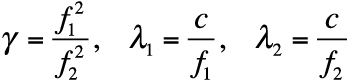
    In this section, we review the formulation of the observation equations. We will use the following constants in the equations:

    Eq-0

    where f1 and f2 are the two primary frequencies transmitted by all GPS satellites and c is the vacuum speed of light. For the GPS L1 and L2 bands, f1 = 154f0 and f2 = 120f0, where f0 = 10.23 MHz.

    The pseudorange (or code) measurements, P1 and P2, are expressed in meters, while phase measurements, L1 and L2, are expressed in cycles. In the following, we use the word “clock” to mean a time offset between a receiver or satellite clock and GPS System Time as determined from either code or phase measurements on different frequencies or some combination of them.

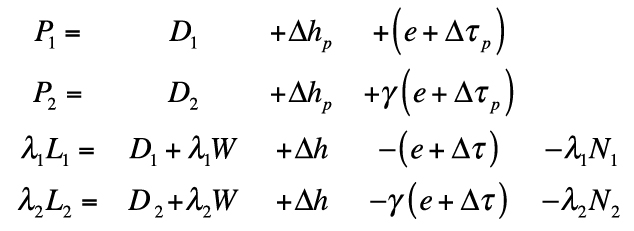
    The code and phase measurements are modeled as:

    Eq1  (1)

    where:

    • D1 and D2 are the geometrical propagation distances between the emitter and receiver antenna phase centers at f1 and f2 including troposphere elongation, relativistic effects and so on.
    • W is the contribution of the wind-up effect (in cycles).
    • e is the code ionosphere elongation in meters at f1. This elongation varies with the inverse of the square of the carrier frequency and is applied with the opposite sign for phase.
    • Δh = hihj is the difference between receiver i and emitter j ionosphere-free phase clocks. Δhp is the corresponding term for code clocks.
    • Δτ = τiτj is the difference between receiver i and emitter j offsets between the phase clocks at f1 and the ionosphere-free phase clocks. By construction, the corresponding quantity at f2 is γΔτ. Similarly, the corresponding quantity for the code is Δτp (time group delay).
    • N1 and N2 are the two carrier-phase ambiguities. By definition, these ambiguities are integers. Unambiguous phase measurements are therefore L1 + N1 and L2 + N2.

    Equations (1) take into account all the biases related to delays and clock offsets. The four independent parameters, Δh, Δτ, Δhp, and Δτp, are equivalent to the definition of one clock per observable. However, our choice of parameters emphasizes the specific nature of the problem by identifying reference clocks for code and phase (Δhp and Δh) and the corresponding hardware offsets (Δτp and Δτ). These offsets are assumed to vary slowly with time, with limited amplitudes.

    The measured widelane ambiguity, nw , (also called the Melbourne-Wübbena widelane) can be written as:

    Eq2(2)

    where Nw is the integer widelane ambiguity, μ j is the constant widelane delay for satellite j and μi is the widelane delay for receiver i (which is fairly stable for good quality geodetic receivers). The symbol brackets means that all quantities have been averaged over a satellite pass.

    Integer widelane ambiguities are then easily identified from averaged measured widelanes corrected for satellite widelane delays. Once integer widelane ambiguities are known, the ionosphere-free phase combination can be expressed as

    Eq3  (3)

    where  Eq-8   is the ionosphere-free phase combination computed using the known Nambiguity, Dc is the propagation distance, hi is the receiver clock and j is the satellite clock. N1 is the remaining ambiguity associated to the ionosphere-free wavelength λc (10.7 centimeters).

    The complete problem is thus transformed into a single-frequency problem with wavelength λc and without any ionosphere contribution. Many algorithms can be used to solve Equation (3) using data from a network of stations. If Dc is known with sufficient accuracy (typically a few centimeters, which can be achieved using a good floating-point or real-valued ambiguity solution), it is possible to simultaneously solve for N, hi and j. The properties of such a solution have been studied in detail. A very interesting property of the j satellite clocks is, in particular, the capability to directly fix (to the correct integer value) the N1 values of a receiver that was not part of the initial network.

    The majority of the precise-point-positioning ambiguity-resolution (PPP-AR) implementations are based on the identification and use of the two quantities μ j and j. These quantities may be called widelane biases and integer phase clocks, a decoupled clock model or uncalibrated phase delays, but they are all of the same nature.

    A Real-Time PPP-AR Implementation

    A PPP-AR technique was successfully implemented by the Centre National d’Etudes Spatiales (CNES) in real time in the so-called PPP-Wizard demonstrator in 2010 and has been subsequently improved. In this demonstrator and in the framework of the International GNSS Service (IGS) Real-Time Service (RTS) and the RTCM, the GPS and GLONASS constellation orbits and clocks are computed. Additional biases for GPS ambiguity resolution are computed and broadcast to the user. The demonstrator also provides an open-source implementation of the method on the user side, for test purposes. Centimeter-level positioning accuracy in real time is obtained on a routine basis.

    Limitations of the Bias Formulations. The current formulation works but it has several drawbacks:

    • The chosen representation is dependent on the implemented method. Even if the nature of the biases is the same, their representation may be different according to the underlying methods, and this makes it difficult for a standardization of the bias messages.
    • The user side must implement the same method as the one used on the network side. Otherwise, the user side would have to convert the quantities from one method to another, leading to potential bugs or misinterpretations.
    • It is limited to the dual-frequency case. There are only two quantities to be computed in the dual-frequency case (uj12 and hj12), but in the triple-frequency case, there are many more possible combinations. For example, one can have (this is a non-exhaustive list) uj12uj15, uj25,hj12, hj15, hj25, where the indices refer to different pairs of frequencies, and other ionosphere-free combinations such as phase widelane-only or even phase ionosphere-free and geometry-free combinations are possible.

    New RTCM SSR Model

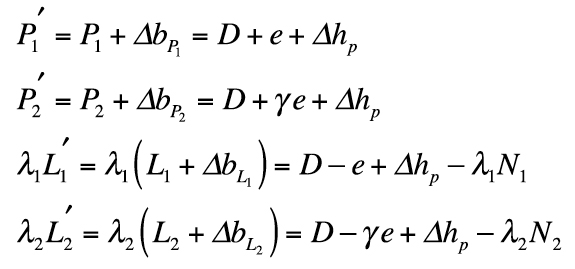
    The new model, as proposed by the RTCM Special Committee 104 SSR working group for phase bias messages is based on the idea that the phase bias is inherent to each frequency. Thus, instead of making specific combinations, one phase bias per phase observable is identified and broadcast.

    It is noted that this convention was adopted a long time ago for code biases. Indeed, in the RTCM framework, and unlike the standard differential code bias (DCB) convention where code biases are undifferenced but combined, the RTCM SSR code biases are defined as undifferenced and uncombined. The general model for uncombined code and phase biases is therefore:

    Eq4   (4)

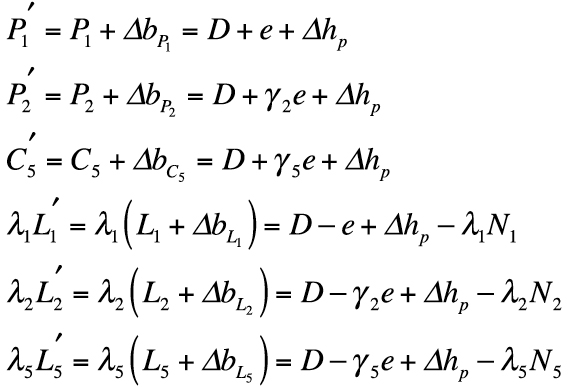
    Time group delays, τ, and phase clocks, h, in Equation (1) are replaced by code and phase biases (Δband ΔbL respectively). RTCM SSR code and phase biases correspond to the satellite part of these biases. The prime notation denotes the “unbiasing” process of the measurements. Here, the clock definition is crucial. As the biases are uncombined, they are referenced to the clocks. The convention chosen for the standard is natural: it is the same as the one used by IGS, that is, ΔhP in our notation.

    This new model can be extended to the triple-frequency case very easily, as it does not involve explicit dual-frequency combinations:

    Eq5    (5)

    This new model simplifies the concept of phase biases for ambiguity resolution. This representation is very attractive because no assumption is made on the method used to identify phase biases on the network side. All the implementations are valid if they respect this proposed model. It also allows convenient interoperability if the network and user sides implement different ambiguity resolution methods.

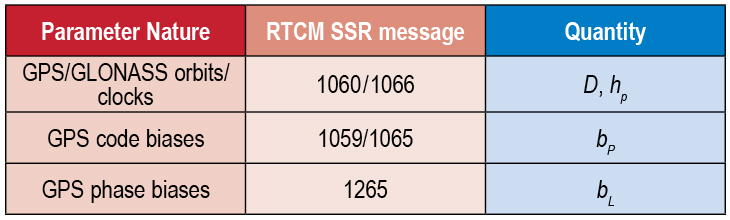
    TABLE 1 summarizes the different messages used for PPP-AR in the context of RTCM SSR:

    TABLE 1. RTCM SSR messages for PPP-AR.
    TABLE 1. RTCM SSR messages for PPP-AR.

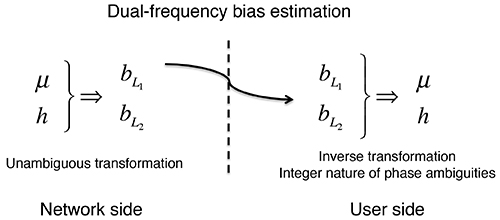
    Bias Estimation in the Dual-Frequency Case. The new phase biases identification in the dual-frequency case is straightforward. There are two biases (bL1, bL2 ) to be estimated using two combinations (µ and h). The problem to be solved is described in FIGURE 1.

    FIGURE 1. Phase biases estimation in the dual-frequency case.
    FIGURE 1. Phase biases estimation in the dual-frequency case.

    It can be solved very easily on the network side by means of a 2 × 2 matrix inversion:

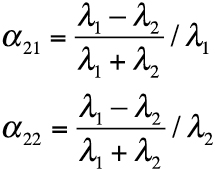
    Eq6   (6)

    with

    Eq7

    Note: All the quantities denote the satellite part of the Δ operator defined above.

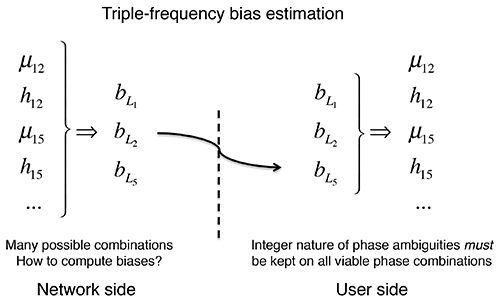
    Bias Estimation in the Triple-Frequency Case. The triple-frequency bias identification is tricky due to the need, using only three biases, to keep the integer nature of phase ambiguities on all viable ionosphere-free combinations, and in particular combinations that were not used in the identification process. At this level, one cannot make assumptions on what kind of combinations will be employed by a user. The problem to be solved is described in FIGURE 2.

    FIGURE 2. Phase biases estimation in the triple-frequency case.
    FIGURE 2. Phase biases estimation in the triple-frequency case.

    As an example, a naïve solution would be to identify the extra-widelane phase biases,uj25, using the dual-frequency widelane approach, and then identify thebL5bias. Given the large wavelength of the extra-widelane combination, such identification would be very easy. However, the corresponding bias would be only helpful for extra-widelane ambiguity identification, and its noise would prevent its use for widelane 15 (L1/L5) ambiguity resolution or other useful combinations available in the triple-frequency context.

    Each independent phase bias can be directly estimated in a filter; however, in order to keep ascending compatibility with the dual-frequency case during the deployment phase of the new modernized satellites, we have chosen to stay in the old framework, that is, to work with combinations of biases. The resolution method is the following:

    • The widelane biases, that is, the identification of all the bLi – bLj quantities, are solved. For this computation and in order to have an accurate estimate of these biases, the two MW-widelane biases µ12 and µ15 are used coupled to an additional phase bias, which is given by the triple-frequency ionosphere-free phase combination with the integer widelane ambiguities already fixed. This last combination using only phase measurements is much more accurate than MW-widelanes. The system to be solved is redundant and the noise of the different equations has to be chosen carefully.
    • The remaining bias (bLi ) is estimated using the traditional ionosphere-free phase combination of L1 and L2.

    This computation has been implemented in the CNES real-time analysis center software, and since September 15, 2014, CNES broadcasts phase biases compatible with this triple-frequency concept on the IGS CLK93 real-time data stream.

    Real Data Analysis

    To prove the validity of the concept, at CNES, we compute several ambiguity combinations using real data. The process is the following:

    • Look for good receiver locations having a large number of GPS Block IIF satellites (transmitting the L5 signal) in view for a period of time exceeding 30 minutes, and choose among them, one participating in the IGS Multi-GNSS (MGEX) experiment. The station CPVG (Cape Verde) in the Reseau GNSS pour l’IGS et la Navigation (REGINA) network was chosen for the time span on September 28, 2014, between 19 and 20 hours UTC. During this period, four Block IIF satellites were visible simultaneously (PRNs 1, 6, 9, 30) for a total of 14 GPS satellites in view.
    • Record a compatible phase-bias stream. The CLK93 stream is recorded during the time span of the experiment.
    • Perform a PPP solution using the measurements, CLK93 corrections and biases to estimate the propagation distance, the troposphere delay and the receiver clock and phase ambiguity estimates according to Equation (5).
    • For different ambiguity estimates, compute and plot the obtained residuals.

    We present in the following graphs various ambiguity residuals for the four Block IIF satellites in view. The values of each ambiguity are offset by an integer value for clarity purposes.

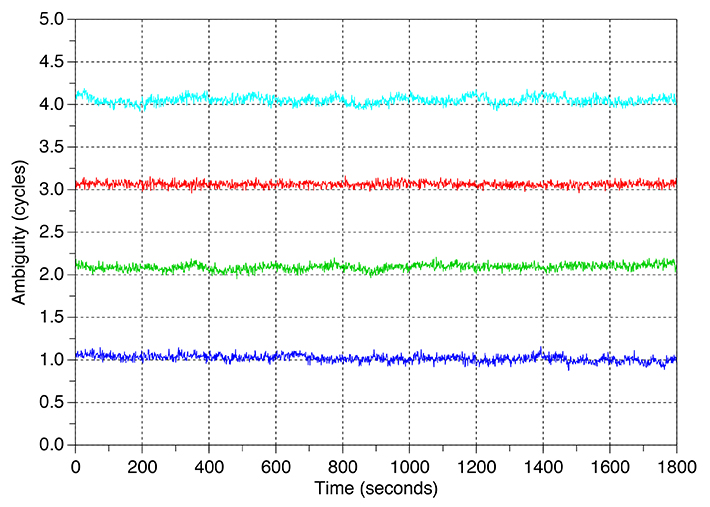
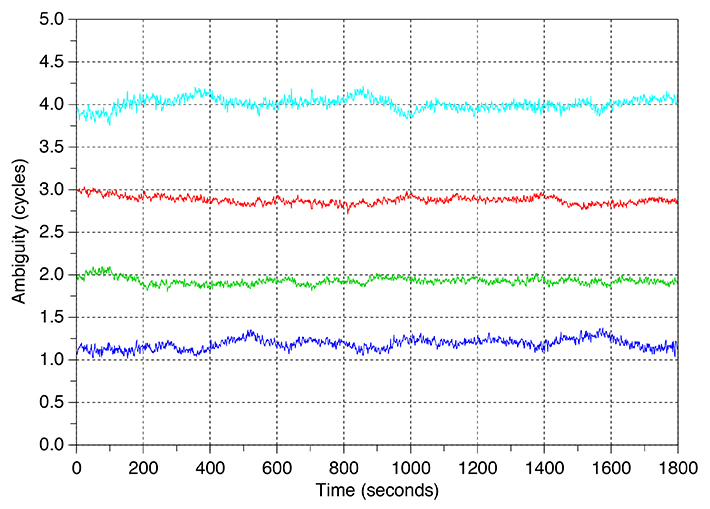
    Melbourne-Wübbena Extra-Widelane. FIGURE 3 represents the MW extra-widelane (between frequencies L2 and L5) ambiguity estimation using our process. The MW extra-widelane ambiguity has a wavelength of 5.86 meters. The noise of the combination expressed in cycles is very low, and the integer nature of ambiguities in this combination is clearly visible.

    FIGURE 3. Ambiguity residuals for the extra-widelane 5-2 combination.
    FIGURE 3. Ambiguity residuals for the extra-widelane 5-2 combination.

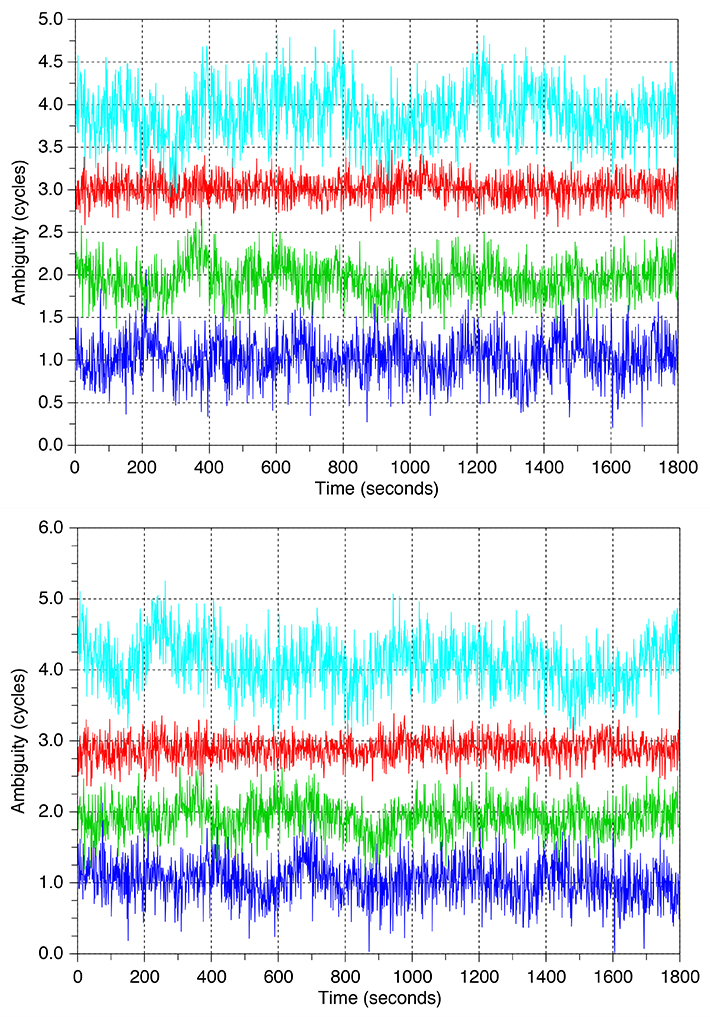
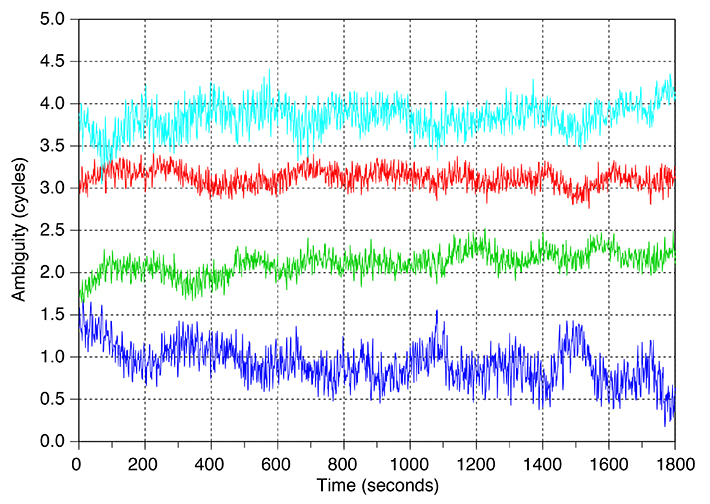
    Melbourne-Wübbena Widelanes. FIGURE 4 represents the MW-widelanes (the regular 1-2 and 1-5 combinations). Here again, the integer nature of the four ambiguities is clearly visible.

    FIGURE 4. Ambiguity residuals for widelane combinations; top: 1-2 widelane, bottom: 1-5 widelane.
    FIGURE 4. Ambiguity residuals for widelane combinations; top: 1-2 widelane, bottom: 1-5 widelane.

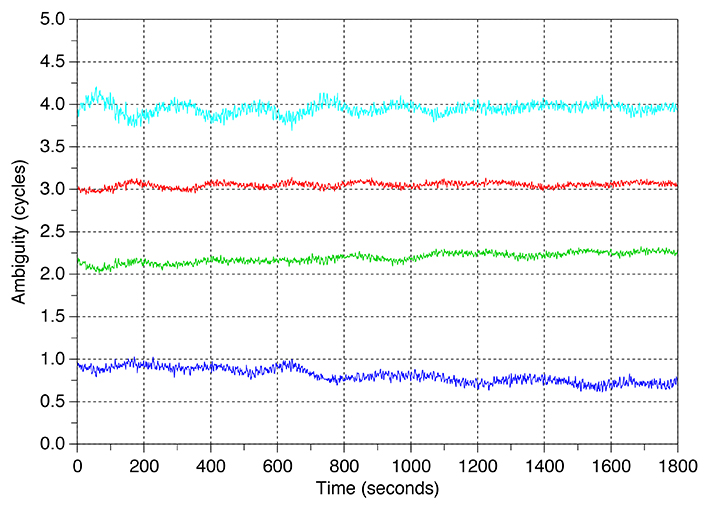
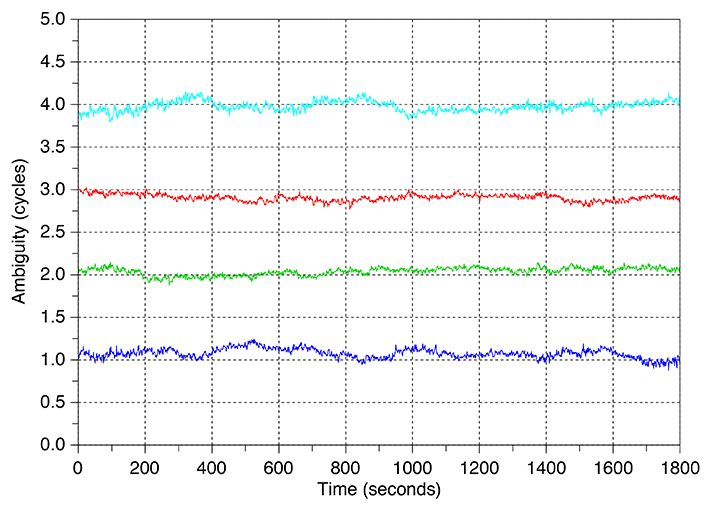
    Widelane-Only Ionosphere-Free Phase. In the triple-frequency context, there is a possibility of forming an ionosphere-free combination of the three phase observables. This combination has an important noise amplification factor (>20), but would allow us to perform decimeter-accuracy PPP using only the solved widelane integer ambiguities and if the corresponding phase biases are accurate. In addition, it can be shown that the wavelength of the widelane ambiguity when the extra-widelane ambiguity is solved is about 3.4 meters. It means that the remaining widelane using this combination can be solved if the position is accurate enough (a few tens of centimeters) and the extra-widelane is known. FIGURE 5 shows such a case, that is, the residuals of the widelane ambiguity using this combination and assuming that the extra-widelane is already solved for.

    FIGURE 5. Ambiguity residuals for widelane-only 1-2-5 ionosphere free combinations.
    FIGURE 5. Ambiguity residuals for widelane-only 1-2-5 ionosphere free combinations.

    Such a case where the solution is the most biased  is shown (the dark blue curve). This behavior is mainly due to the difficulty in estimating the phase biases on this combination accurately using only a few Block IIF satellites. We hope that in the future the increasing number of modernized satellites will help such bias estimation.

    N1 Ionosphere-Free Phase. FIGURES 6 to 8 show the three possible ambiguity estimates using the ionosphere-free phase combination with two measurements (we assume that the corresponding widelane has already been solved). In each case, the computed biases allow us to easily retrieve the integer nature of the N1 ambiguity.

    FIGURE 6. Ambiguity residuals for the N1 combination using a fixed 1-2 widelane.
    FIGURE 6. Ambiguity residuals for the N1 combination using a fixed 1-2 widelane.

    FIGURE 7. Ambiguity residuals for the N1 combination using a fixed 1-5 widelane.
    FIGURE 7. Ambiguity residuals for the N1 combination using a fixed 1-5 widelane.

    FIGURE 8. Ambiguity residuals for the N1 combination using a fixed 2-5 widelane.
    FIGURE 8. Ambiguity residuals for the N1 combination using a fixed 2-5 widelane.

    Application to Triple-Frequency PPP

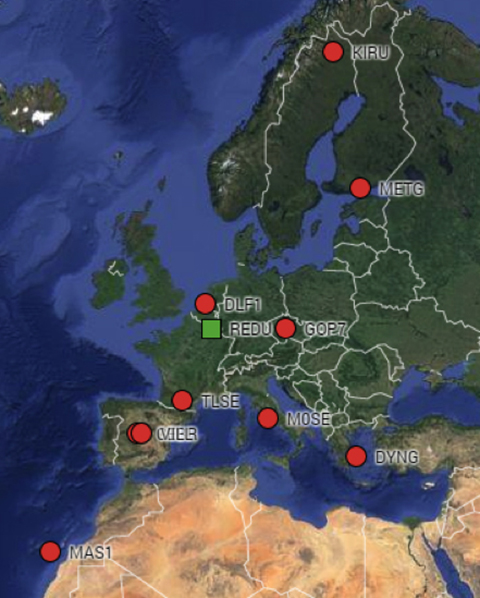
    The results presented above show that the integer ambiguity nature of phase measurements is conserved for various useful observable combinations and prove the validity of the model. Another experiment has been carried out to estimate the impact of ambiguity convergence in the triple-frequency context. For that, in order to maximize the observability of the GPS Block IIF constellation and thus the accuracy of the biases, a network of ten stations across Europe has been chosen for the phase biases computation (see FIGURE 9). The station REDU (in green) was the test station to be positioned. The test occurred on January 10, 2015, around 11:00 UTC. At that time, four Block IIF satellites were visible simultaneously (PRNs 1, 3, 6, 9) for a total of 10 satellites in view.

    FIGURE 9. Network used for the triple-frequency PPP study.
    FIGURE 9. Network used for the triple-frequency PPP study.

    The PPP-Wizard open source client was used to perform PPP in real time. The advantage of this implementation is that it directly follows the uncombined observable formulation described in Equations (5). The strategy for ambiguity resolution is a simple bootstrap approach.

    Convergence of the Widelane-Only Solution. In this test, a PPP solution was performed, but only the fixing of the widelane ambiguities was implemented. As noted in the previous section, the wavelength of the widelane ambiguity when the extra-widelane ambiguity is solved is about 3.4 meters, so it is expected that all the widelanes can be fixed in a very short time. Despite the amplification factor of about 20 of the equivalent unambiguous phase combination, we expect to obtain an accuracy of about 10 centimeters with such a solution.

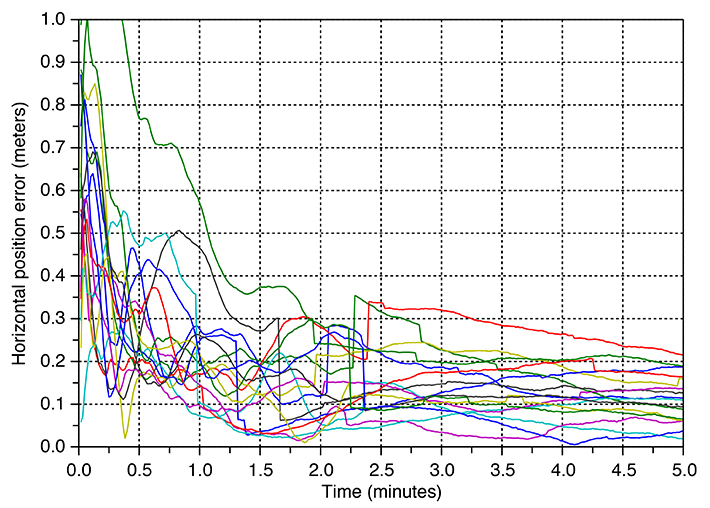
    FIGURE 10 shows the convergence time of several PPP runs in this context (16 different runs of five minutes are superimposed), in terms of horizontal position error.

    FIGURE 10. Widelane-only triple-frequency PPP convergence (horizontal position error).
    FIGURE 10. Widelane-only triple-frequency PPP convergence (horizontal position error).

    The extra-widelanes are fixed instantaneously; the remaining widelanes are fixed in about two minutes on average to be below 30 centimeters (this is represented by the different sharp reductions of the errors). This new configuration, available in the triple-frequency context, is very interesting as it provides an intermediate class of accuracy, which converges very quickly and which is suitable for applications that do not demand centimeter accuracy. Another interesting aspect of this combination is the gap-bridging feature. In PPP, gap-bridging is the functionality that allows us to recover the integer nature of the ambiguities after a loss of the receiver measurements over a short period of time (typically a pass through a tunnel or under a bridge). This is done usually by means of the estimation of a geometry-free combination (ionosphere delay estimation) during the gap. Realistic maximum gap duration in the dual-frequency case is about one minute. In the triple-frequency case, the wavelength of the geometry-free combination involving the widelane (if the extra-widelane is fixed) is 1.98 meters. With such a large wavelength, the gaps are much easier to fill, and we can safely extend the gap duration to several minutes. In addition, the widelane combinations are wind-up independent, so there is no need to monitor a possible rotation of the antenna during the gap, as in the dual-frequency case.

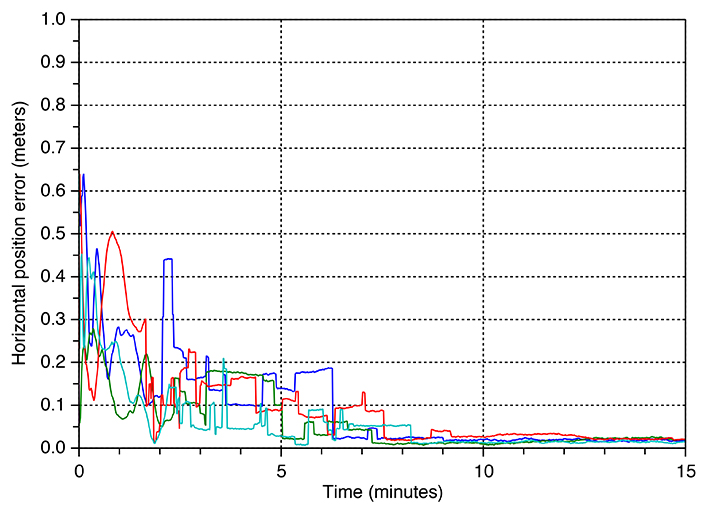
    Overall Convergence (All Ambiguities). Another PPP convergence test has been carried out with all ambiguities fixing activated (four different runs of 15 minutes are superimposed). Results are shown in FIGURE 11.

    FIGURE 11. All ambiguities triple-frequency PPP convergence (horizontal position error).
    FIGURE 11. All ambiguities triple-frequency PPP convergence (horizontal position error).

    The centimeter accuracy is obtained in this configuration within eight minutes, which is a significant improvement in comparison to the dual-frequency case. Further improvement of this convergence time is expected with an increase in the number of Block IIF satellites and, subsequently, GPS IIIA satellites.

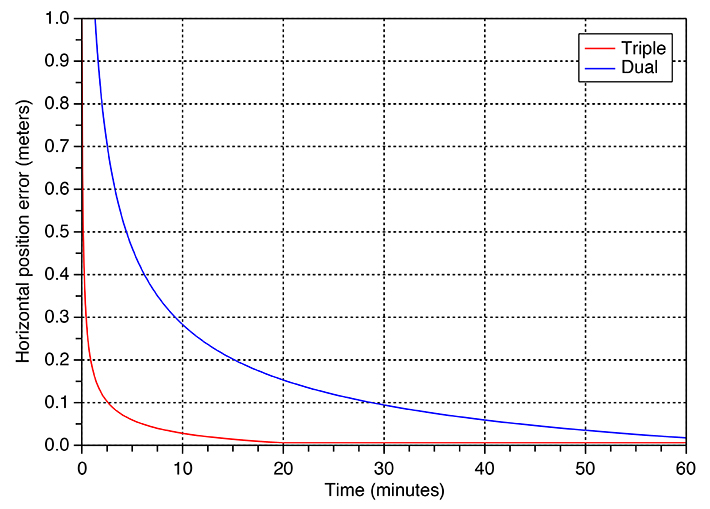
    Convergence Time Comparison Between the Dual- and Triple-Frequency Contexts. Thanks to these new results, a realistic picture for PPP convergence in the dual- and triple-frequency contexts can be drawn. To do so, polynomial functions have been fitted over the data points obtained in the previous studies. Two data sets were used:

    • Standard dual-frequency convergence (GPS only, 10 satellites in view).
    • Triple-frequency convergence (GPS only, 10 satellites in view, four Block IIF satellites).

    FIGURE 12 represents the comparison between the two polynomials (horizontal error).

    FIGURE 12. Realistic PPP convergence comparison between dual- and triple-frequency contexts (horizontal position error).
    FIGURE 12. Realistic PPP convergence comparison between dual- and triple-frequency contexts (horizontal position error).

    Conclusion

    The new phase-bias concept proposed for RTCM SSR has been successfully implemented in the CNES IGS real-time analysis center. This new concept represents the phase biases in an uncombined form, unlike the previous formulations. It has the advantage of the unification of the different proposed methods for ambiguity resolution, and it prepares us for the future; for example, for a widely available triple-frequency scenario. The validity of this concept has been shown; that is, the integer ambiguity nature of phase measurements is conserved for various useful observable combinations.

    In addition, we have also shown that the triple-frequency context has a significant impact on ambiguity convergence time. The overall convergence time is drastically reduced (to some minutes instead of some tens of minutes) and there is an intermediate combination (widelane-only) that has some interesting properties in terms of convergence time, accuracy and gap-bridging for non-demanding centimeter-level applications.

    Acknowledgments

    The contributions of colleagues contributing to the IGS services are gratefully acknowledged. Geo++ is thanked for useful discussions on the standardization of phase bias representation.


    DENIS LAURICHESSE received his engineering degree and a Diplôme d’études appliquées (an advanced study diploma) from the Institut National des Sciences Appliquées in Toulouse, France, in 1988. He has worked in the Spaceflight Dynamics Department of the Centre National d’Etudes Spatiales (CNES, the French Space Agency) in Toulouse since 1992, responsible for the development of the onboard GNSS Diogene navigator. He was involved in the performance assessment of the EGNOS and Galileo systems and is now in charge of the CNES International GNSS Service real-time analysis center. He specializes in navigation, precise satellite orbit determination and GNNS-based systems. He was the recipient of The Institute of Navigation Burka Award in 2009 for his work on phase ambiguity resolution.


    Further Reading

    Undifferenced Ambiguity Resolution

    Phase Biases Estimation for Undifferenced Ambiguity Resolution” by D. Laurichesse, presented at PPP-RTK & Open Standards Symposium, Frankfurt, Germany, March 12–13, 2012.

    “Undifferenced GPS Ambiguity Resolution Using the Decoupled Clock Model and Ambiguity Datum Fixing” by P. Collins, S. Bisnath, F. Lahaye, and P. Héroux in Navigation, Journal of The Institute of Navigation, Vol. 57, No. 2, Summer 2010, pp. 123–135, doi: 10.1002/j.2161-4296.2010.tb01772.x.

    “Integer Ambiguity Resolution on Undifferenced GPS Phase Measurements and Its Application to PPP and Satellite Precise Orbit Determination” by D. Laurichesse, F. Mercier, J.-P. Berthias, P. Broca, and L. Cerri in Navigation, Journal of The Institute of Navigation, Vol. 56, No. 2, Summer 2009, pp. 135–149, doi: 0.1002/j.2161-4296.2009.tb01750.x.

    “Resolution of GPS Carrier-Phase Ambiguities in Precise Point Positioning (PPP) with Daily Observations” by M. Ge, G. Gendt, M. Rothacher, C. Shi, and J. Liu in Journal of Geodesy, Vol. 82, No. 7, pp. 389–399, doi: 10.1007/s00190-007-0187-4. Erratum: 10.1007/s00190-007-0208-3.

    Real-Time Precise Point Positioning

    Coming Soon: The International GNSS Real-Time Service” by M. Caissy, L. Agrotis, G. Weber, M. Hernandez-Pajares, and U. Hugentobler in GPS World, Vol. 23, No. 6, June 2012, pp. 52–58.

    “The CNES Real-time PPP with Undifferenced Integer Ambiguity Resolution Demonstrator” by D. Laurichesse in Proceedings of ION GNSS 2011, the 24th International Technical Meeting of The Satellite Division of the Institute of Navigation, Portland, Ore, September 20–23, 2011, pp. 654–662.

     RTCM PPP State Space Representation

    PPP with Ambiguity Resolution (AR) Using RTCM-SSR” by G. Wübbena, M. Schmitz, and A. Bagge, presented at IGS Workshop, Pasadena, Calif., June 23–27, 2014.

    “The RTCM Multiple Signal Messages: A New Step in GNSS Data Standardization” by A. Boriskin, D. Kozlov, and G. Zyryanov in Proceedings of ION GNSS 2012, the 25th International Technical Meeting of The Satellite Division of the Institute of Navigation, Nashville, Tenn., September 17–21, 2012, pp. 2947-2955.

    RTCM State Space Representation (SSR): Overall Concepts Towards PPP-RTK” by G. Wübbena, presented at PPP-RTK & Open Standards Symposium, Frankfurt, Germany, March 12–13, 2012.

    Precise Point Positioning

    Improved Convergence for GNSS Precise Point Positioning by S. Banville, Ph.D. dissertation, Department of Geodesy and Geomatics Engineering, Technical Report No. 294, University of New Brunswick, Fredericton, New Brunswick, Canada. Recipient of The Institute of Navigation 2014 Bradford W. Parkinson Award.

    Precise Point Positioning: A Powerful Technique with a Promising Future” by S.B. Bisnath and Y. Gao in GPS World, Vol. 20, No. 4, April 2009, pp. 43–50.