Tag: digital edition

  • Thales partners with ESA on Galileo cybersecurity and enhancements

    Thales partners with ESA on Galileo cybersecurity and enhancements

    From left to right: Sylvain Loddo, director of the Galileo ground segment program at ESA, Ennio Guarino, head of the EGNOS and Galileo programs at ESA, Lionel Salmon, director of cybersecurity for information systems at Thales, and Alexandra Porez, director of cybersecurity for satellite systems at Thales. (Image: Thales)
    From left to right: Sylvain Loddo, director of the Galileo ground segment program at ESA, Ennio Guarino, head of the EGNOS and Galileo programs at ESA, Lionel Salmon, director of cybersecurity for information systems at Thales, and Alexandra Porez, director of cybersecurity for satellite systems at Thales. (Image: Thales)

    Thales and the European Space Agency (ESA) will be working together on the cybersecurity aspects of the Galileo Second Generation (G2G) program.

    Under the partnership, Thales’ scalable and flexible architecture, and security equipment will enable the G2G program to strengthen its ability to detect and respond to new cyberthreats. The end-to-end solution Thales proposed will contribute to the development of greater security and resilience of satellites.

    In addition, Thales Alenia Space has partnered with the ESA to design and build the G2G ground mission segment, as well as support system engineering and technical assistance activities. The company also will provide six of the 12 satellites of the constellation.

    The second-generation ground mission segment is designed to generate and connect the navigation services to the Galileo satellites and to keep the satellites synchronized with a common time reference. The first version will arrive in time for the launch of the first second-generation satellites and for the validation of the system’s in-orbit capabilities. The second version will be responsible for the missions of both the first- and second-generation Galileo satellites.

    The new ground mission system, which includes several major technological innovations, will provide more than four billion users worldwide with improved performance in terms of positioning, navigation and synchronization.

  • The sinking city: Maps show Venice may be underwater soon

    The sinking city: Maps show Venice may be underwater soon

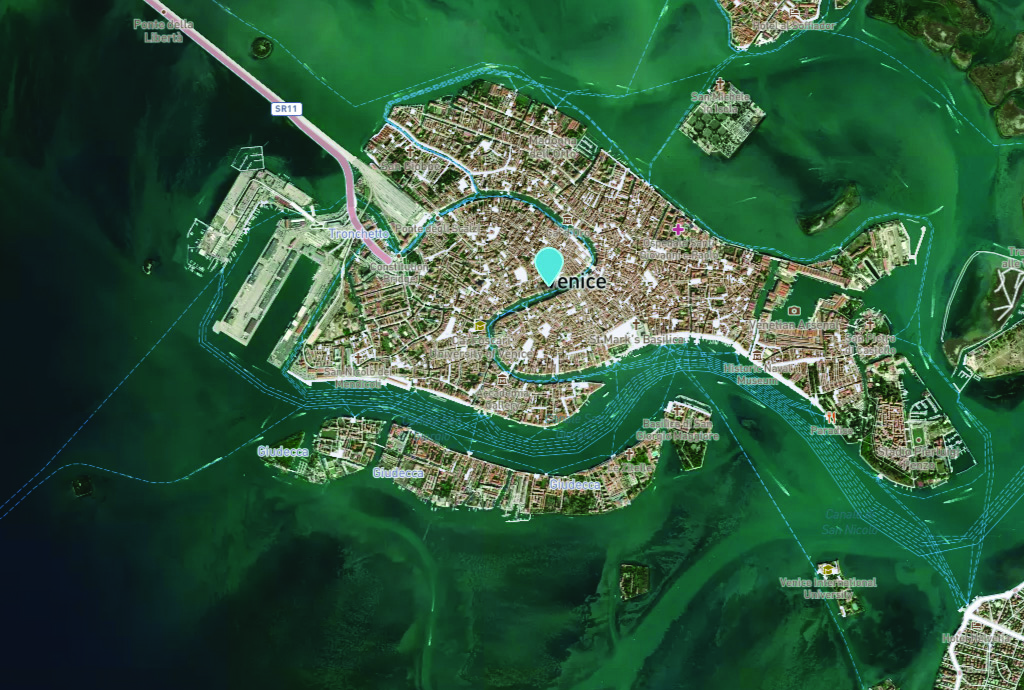
    Venice arose after the fall of the Roman Empire. The city holds 450 palaces, more than 400 bridges and is home to the notable St. Mark’s Basilica. It is also known for its many canals, which are full of gondolas the way the streets of other cities are full of taxis or rickshaws. (Image: Freeartist/iStock/Getty Images Plus/Getty Images)
    Venice arose after the fall of the Roman Empire. The city holds 450 palaces, more than 400 bridges and is home to the notable St. Mark’s Basilica. It is also known for its many canals, which are full of gondolas the way the streets of other cities are full of taxis or rickshaws. (Image: Freeartist/iStock/Getty Images Plus/Getty Images)

    It is hard to believe that Italy’s “floating city” could be underwater soon.

    The average rate of relative sea-level rise is 2.5 mm/year, per the European Geosciences Union’s journal Natural Hazards and Earth System Sciences. This photo of Venice from the European Space Agency (ESA) was taken in 2008 by Ikonos-2, a commercial satellite (Image: ESA)
    The average rate of relative sea-level rise is 2.5 mm/year, per the European Geosciences Union’s journal Natural Hazards and Earth System Sciences. This photo of Venice from the European Space Agency (ESA) was taken in 2008 by Ikonos-2, a commercial satellite (Image: ESA)

    Predictions for the future of the city vary, but most scientists agree that the sea level is rising due to climate change. Natural Hazards and Earth System Sciences, an interdisciplinary journal of the European Geosciences Union, published a report in 2021 suggesting the average sea level could be between 17 cm and 120 cm higher in Venice by 2100.

    Venice was built in the middle of a shallow lagoon in the Adriatic Sea. Therefore, it has always been at risk of flooding or “acqua alta,” meaning high water. There is evidence of severe flooding dating back to around the 8th century.

    The Venetian lagoon is more than 500 km2 in total, but has an average depth of only 1 m, according to Royal Museums-Greenwich. High tides and severe storms have a devastating impact on the wetland environment on which Venice is built.

    Compared to the image of Venice in 2008, this U.S. Geological Survey (USGS) satellite image of Venice from May 2023 shows the rise in sea level within the past 15 years. (Image: USGS)
    Compared to the image of Venice in 2008, this U.S. Geological Survey (USGS) satellite image of Venice from May 2023 shows the rise in sea level within the past 15 years. (Image: USGS)

    In November 2019, Venice experienced the second-worst flooding event in almost 100 years. The tide reached 187 cm (6.1 ft) above sea level, covering 80% of the city in water, reported the BBC.

    City records show there have been 324 intense high-water events since 1872 and more than half of those have been in the past 30 years. Among the many and vast consequences of human-caused climate change may be the end of one of the world’s most beautiful cities.

    Only time will tell the fate of Venice.

  • GPS and AI collaborate on lifesaving emergency service solutions

    GPS and AI collaborate on lifesaving emergency service solutions

    Image: Kara Capaldo/iStock/Getty Images Plus/Getty Images
    Image: Kara Capaldo/iStock/Getty Images Plus/Getty Images

    Whether preparing for natural disasters or responding to everyday emergencies, first responders depend on the accuracy and dependability of GPS data to keep our communities safe. However, the increasing number and intensity of natural disasters, such as wildfires and hurricanes, and ongoing first responder staffing shortages have pushed the industry to look for ways to combine the tried-and-true benefits of GPS with new artificial intelligence (AI) technology to alert sooner, respond faster, and restore better than ever. The integration of AI’s adaptive learning capabilities with the ability of GPS to operate in areas of low or no connectivity make for cutting-edge emergency service solutions.

    New technologies incorporating both AI and GPS have already proven to save time and protect lives by quickly identifying and assessing potential fires. For example, in 2022, Sonoma County, California, used FireScout — an AI-powered fire detection solution — to monitor live footage for signs of fire and alert authorities. In one instance, the county found that FireScout’s AI solution detected and located — using GPS data — a fire 10 minutes before the 911 service was alerted about it, giving responders a head start on containing the fire. FireScout looks to integrate GPS functions more fully into their AI-enabled cameras with exact coordinate information. Investments in innovations that facilitate rapid response to natural disasters will lead to greater safety for first responders and their communities across the country.

    One way the industry is investing in GPS-powered AI innovation is through problem-solving competitions such as XPrize Wildfire, which encourages the development of cutting-edge solutions to wildfires. Teams will compete in one of two tracks: the Autonomous Wildfire Response track, which requires teams to combine AI and GPS data to differentiate between high-risk actual fires and decoy fires and then quickly suppress the real fires, and the Space-Based Wildfire Detection and Intelligence track, which requires teams to use satellites to accurately pinpoint fires across vast areas then relay that information to stations on the ground. GPS industry leader Lockheed Martin is providing a $1 million Accurate Detection Intelligence Bonus Prize to the winner of the XPrize Wildfire competition. Competitions such as XPrize Wildfire will result in products that can identify fires faster, reducing response times and minimizing damages to communities.

    Additionally, new GPS-powered AI solutions are bringing emergency resources to more people in the wake of hurricanes. In the aftermath of hurricanes, emergency personnel are tasked with identifying and allocating resources to restoration efforts. GPS-powered AI technologies such as the University of Connecticut’s hurricane monitoring system, compare pre-storm and post-storm satellite imagery to spot potential environmental and safety issues, such as flood water or damaged neighborhoods. The system then highlights those areas on a map and shares the coordinates of high-damage areas with emergency personnel. Services such as these support communities and allow restoration efforts to begin sooner with less risk to surveyors and responders.

    Beyond natural disasters, GPS also is being used with AI technology to shorten response times for emergency vehicles. Many towns, including St. Louis, Michigan, and Leon Valley, Texas, have implemented AI traffic light systems that use location data to detect the location of ambulances and fire trucks to give the vehicles a path of green lights, clearing out any traffic that might have slowed response times. Similarly, researchers at the University of Southern California are using UAVs — guided and tracked using GPS data — to carry automated external defibrillators (AEDs) to remote locations. These UAVs use coordinates provided by GPS receivers to operate in areas of limited connectivity and AI to determine the most efficient landing locations for different terrains. Ongoing research and further investment into the critical intersections of GPS and AI technology will help promote a safer future by supporting first responders and protecting communities in emergencies.

    The GPS Innovation Alliance (GPSIA) welcomes innovations in GPS and AI technologies that continue to revolutionize the way we respond to natural disasters and life-threatening emergencies. GPSIA is proud to support the expansion of these disaster-mitigating solutions by uplifting innovative research and design efforts, promoting new ideas, and ensuring adequate regulation is in place to protect users across the globe.

  • OEMs take tech to the next level

    OEMs take tech to the next level

    OEM products are vital to many industries. Companies such as Septentrio and SBG Systems design and produce a variety of OEM devices for many different applications. (Image: sankai/E+/Getty Images)
    OEM products are vital to many industries. Companies such as Septentrio and SBG Systems design and produce a variety of OEM devices for many different applications. (Image: sankai/E+/Getty Images)

    OEM devices are an integral part of many applications requiring precise positioning technology. As the OEM market grows and performance requirements become more demanding, it is critical for OEM devices to be reliable, accurate, and easy to integrate. From precision agriculture, to surveying and mapping, to UAV missions, there are OEM devices on the market suitable for demanding applications.

    Survey and Map Like a Pro

    Surveying and mapping is one area in which OEM boards are embedded deep in many products. Septentrio designs and manufactures multi-frequency, multi-constellation, GPS/GNSS positioning technology and offers a variety of OEM products for demanding applications.

    Image: Septentrio
    Image: Septentrio

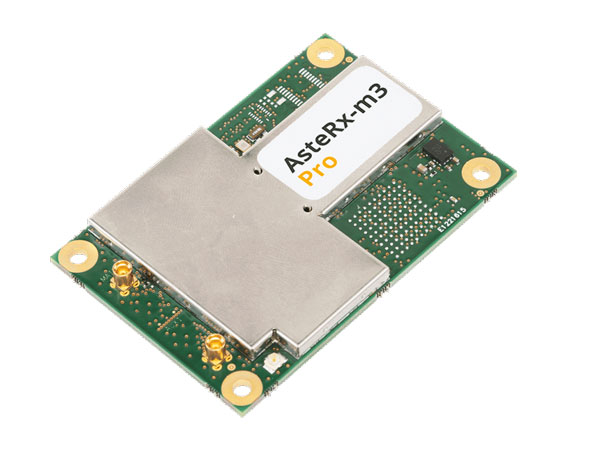
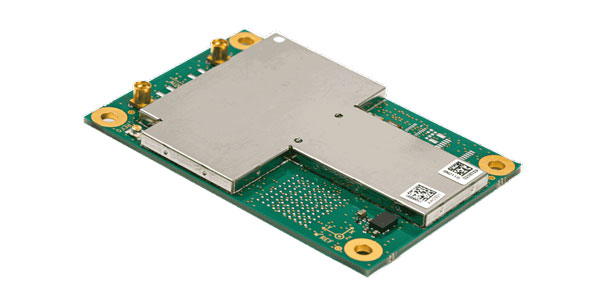
    The AsteRx-m3 Pro is an ultra-low power GNSS rover receiver. It is compact and high-performance, making it suitable for integration into high-precision industrial applications. It incorporates multi-frequency, multi-constellation GNSS technology as well as anti-jamming algorithms for availability and reliability. The AsteRx-m3 Pro features AIM+ advanced anti-jamming and anti-spoofing technology as a part of Septentrio’s GNSS+ Technology Suite.

    This receiver is designed for rover (mobile) applications, making it an easy-to-integrate solution for any kinematic application where reliable high-accuracy positioning is needed. It is available in single or dual antenna mode, for high quality heading and pitch, or heading and roll information.

    GNSS heading is available directly from initialization and removes reliance on vehicle dynamics or magnetic sensors. This is an optional feature.

    “Septentrio OEM receivers come in a variety of form factors, from compact modules to credit-card boards,” Danilo Sabbatini, OEM product manager at Septentrio, stated. “Our multi-frequency OEM receiver portfolio includes products that fit various user needs from purely rover GNSS high accuracy positioning to heading receivers, as well as GNSS/INS boards for inertial navigation or mapping.”

    Image: Septentrio
    Image: Septentrio

    Aside from surveying and mapping, the AsteRx-m3 Pro is suitable for assured position, navigation and timing (PNT), autonomous vehicles, precision agriculture, logistics and port operations, mining and construction, rail, robotics, space and UAV applications.

    Plowing the Way

    The increase in demand for food due to population growth challenges farmers to increase production. To help them do this, Septentrio is working with manufacturers of agricultural machinery to enable them to achieve centimeter-level positioning accuracy.

    Image: Septentrio
    Image: Septentrio

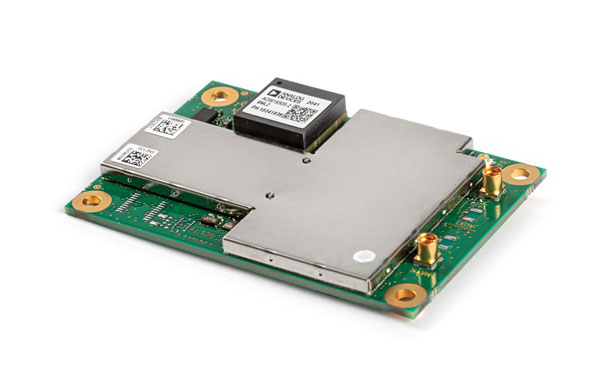
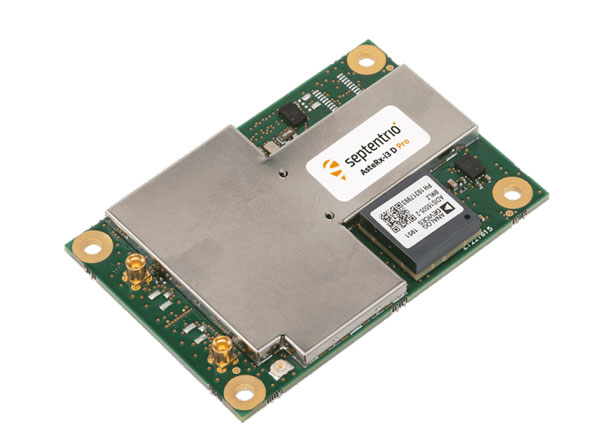
    The AsteRx-i3 D Pro is a ready-to-use GNSS/INS single-board receiver that delivers reliable centimeter-level positioning combined with 3D orientation (heading, pitch and roll) in demanding environments. Its inertial sensor provides orientation and positional dead-reckoning, making it suitable for systems that require continuous positioning even during short GNSS outages. It provides reliable and accurate positioning by enhancing GNSS with an inertial measurement unit (IMU).

    Image: Septentrio
    Image: Septentrio

    The AsteRx-i3 D Pro is quad-constellation and multi-frequency. It provides all-in-view real-time kinematic positioning and features AIM+ unique interference monitoring and mitigation system and other advanced GNSS+ algorithms.

    Like the AsteRx-m3 Pro, the AsteRx-i3 D Pro is also suitable for assured PNT, autonomous vehicles, logistics and port operations, mining and construction, rail, robotics, space, survey and mapping, and UAV applications.

    For more information about Septentrio’s OEM boards, click here.

    Flying High

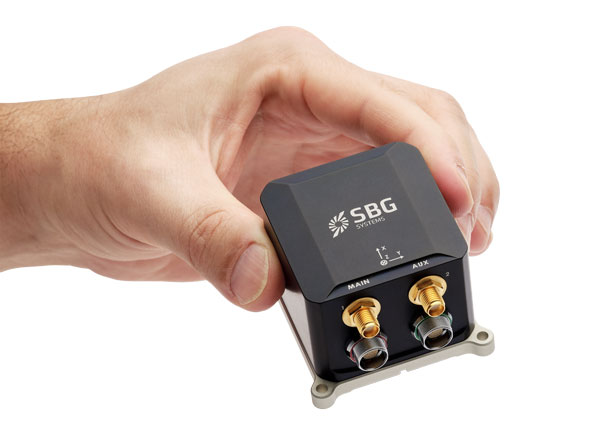
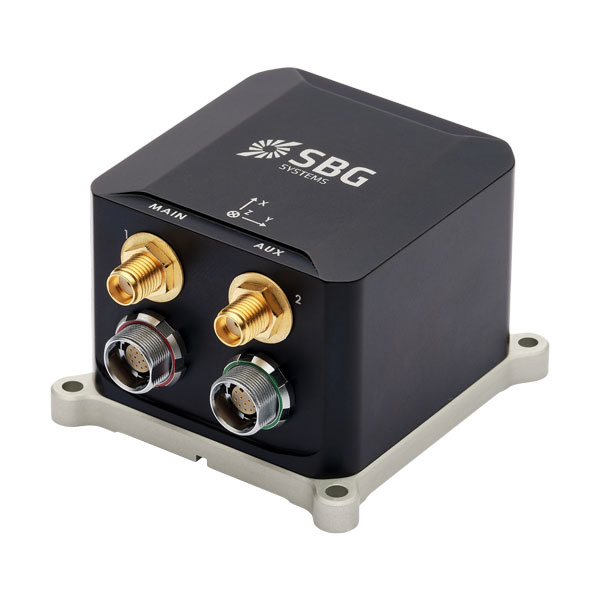
    SBG Systems has released Ekinox Micro, a compact and rugged high-performance inertial navigation solution designed to deliver accuracy in challenging environments. Ekinox Micro combines a high-performance MEMS tactical inertial sensor with a quad-constellation, dual-antenna GNSS receiver, making it suitable for mission-critical applications.

    Image: SBG Systems
    Image: SBG Systems

    GPS World caught up with Yoann Plénet, head of products at SBG Systems, at AUSVI XPONENTIAL in May. He elaborated on Ekinox Micro’s key markets and features.
    “This is Quanta Micro in a box with the same performance and the same benefits that you get [with the Quanta Micro]: inertia, enhanced GNSS, and complement[ing] the GNSS,” Yoann said. “At the same time, we are targeting very rough environments, especially larger drones which are most likely military ones. So, [Ekinox Micro] is a very rugged product.”

    Ekinox Micro includes pre-configured motion profiles for land, air and marine applications, enabling the sensor and algorithms to be tuned for maximum performance in any condition. The device is designed for ease of use and integration, with simple connectors, a web configuration interface, a datalogger, Ethernet connectivity, a PTP server, a REST API for configuration, and multiple input and output formats.

    Image: SBG Systems
    Image: SBG Systems

    Ekinox Micro is compatible with real-time kinematic (RTK) and based on a tactical 0.8°/h class inertial measurement unit calibrated across the entire operating temperature range. It features accuracy roll/pitch of 0.015°, accuracy heading of 0.035°, and accuracy position of 1.2 m without any corrections or 1 cm in RTK.

    Yoann also said that with the rise of jamming and spoofing, Ekinox Micro is designed with enhanced technology to mitigate those threats.

    “Jamming and spoofing is ongoing and is an issue for more and more of our clients. So, we have worked a lot — and that is something that is beneficial to all of our product ranges — on enhancing our algorithms and our technology so we can better detect jamming and spoofing than we could before,” Yoann said.

    Ekinox Micro will be commercially available in September. Click here for more information on Ekinox Micro.

    Bonus Device

    Image: Septentrio
    Image: Septentrio

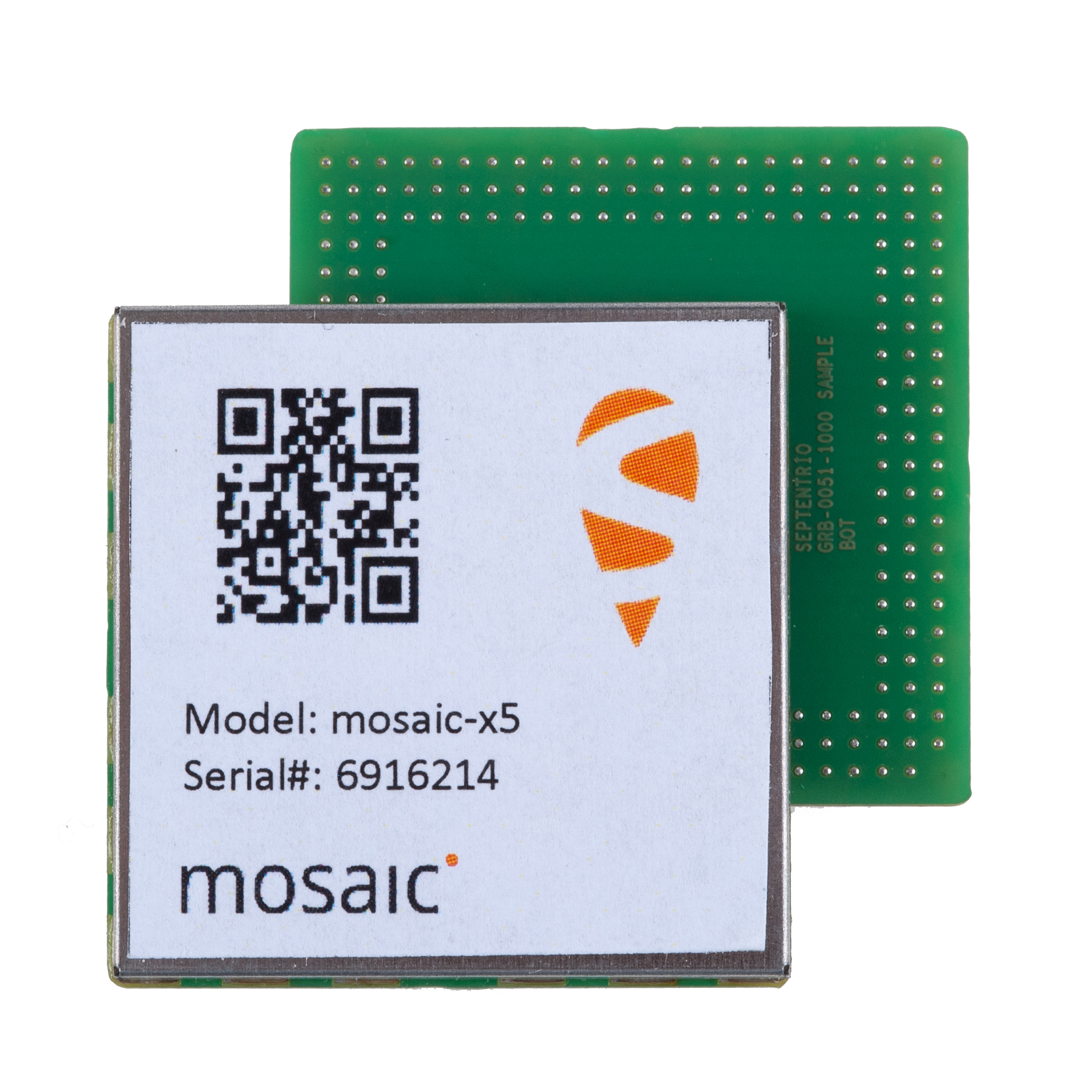
    The Septentrio mosaic-X5 is a multi-band, multi-constellation GNSS receiver in a low power surface mount module with a wide array of interfaces. It is designed for mass market applications such as robotics and autonomous systems — capable of tracking all GNSS constellations, supporting current and future signals.

    The mosaic-X5 has an update rate of 100 Hz, is easy to integrate, and is optimized for automated assembly.
    Antoon De Proft, Septentrio’s CEO, mentioned in the April 2023 issue of GPS World the company’s innovation in Leuven, Belgium.

    “Septentrio’s 20 years of experience in GNSS technology as well as our strategic partnership with the European Space Agency and close collaboration with the IMEC semiconductor technology hub has enabled us to produce the mosaic-X5 receiver,” he said. “This compact module is one of the highest performing and resilient GNSS receivers on the market. It is used in a wide array of applications, especially where the position is mission critical. Examples include a wide variety of autonomous devices, including drones that benefit from mosaic’s lightweight and low-power design.”

    Francois Freulon, head of product management, added, “Reliability and resilience to GNSS vulnerabilities is a key pillar on which we base our receiver design. RF interference in the form of jamming and spoofing* is increasingly common, which is why we are investing heavily in securing our receivers at the core with the latest hardware and software techniques. In addition to the AIM+ patented technology, the mosaic module already includes OSNMA functionality, which will offer end-to-end authentication on Galileo’s civilian signals, protecting receivers from GNSS spoofing attacks.”
    For more information about Septentrio’s mosaic GPS/GNSS modules, click here.

  • Launchpad: Mobile mapping, timing modules and UAVs

    Launchpad: Mobile mapping, timing modules and UAVs

    A roundup of recent products in the GNSS and inertial positioning industry from the July 2023 issue of GPS World magazine.


    TIMING

    Image: Hexagon

    PTP Firmware
    To synchronize accurate time from GNSS

    The 7.09.00 firmware with a precise timing protocol (PTP) feature enables users to synchronize accurate time from GNSS with other devices and sensors on a shared network. The 7.09.00 firmware’s PTP feature brings stable timing to a user’s other sensor systems connected through a local network to best support positioning, navigation and timing (PNT) and automotive and autonomous applications. The firmware includes SPAN GNSS+INS technology improvements — including a secondary INS solution for built-in redundancy and reliability in challenging conditions. The enhancements are available on all OEM7 cards and enclosures, including all PwrPak7 and CPT7 enclosure variants. The 7.09.00 firmware also features improvements to the time to first fix, a secondary SPAN solution for a more accurate and reliable GNSS+INS output and more. The 7.09.00 firmware is not for precision agriculture applications and is not supported on NovAtel’s SMART antenna products.
    Hexagon | NovAtel, novatel.com

    Image: Furuno

    Timing Antenna
    A multi-GNSS and high-performance device

    The AU-500 antenna is suitable for time synchronization applications. It supports all constellations in the L1 and L5 bands, including GPS, QZSS, GLONASS, Galileo, BeiDou, and NavIC. A built-in noise filter eliminates interference in the vicinity of 1.5 GHz caused by 4G/LTE mobile base stations as well as other radio waves that can adversely affect GNSS reception. The antenna is equipped with lightening protection and features a high-quality polymer radome that prevents snow accumulation. It is also waterproof and dustproof in compliance with IP67. The AU-500 achieves the best performance in time accuracy and robustness fundamental in critical infrastructure, when combined with Furuno’s GNSS receiver, GT-100. The antenna will be available this month.
    Furuno, furuno.com

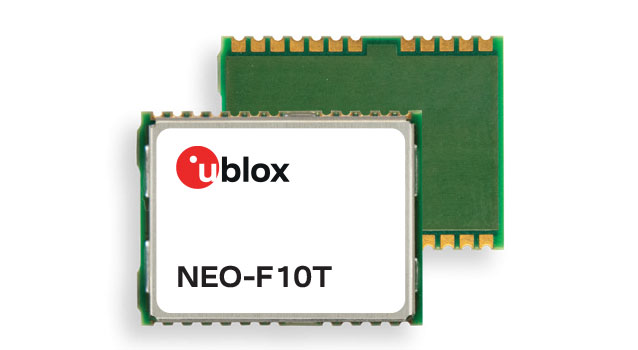
    The u-blox NEO-F10T (Image: u-blox)

    Timing Module
    Dual-band and secure for 5G communications

    The NEO-F10T offers nanosecond-level timing accuracy, meeting the stringent timing requirements for 5G communications. It is compliant with the u-blox NEO form factor (12.2 mm x 16 mm), allowing space-constrained designs to be realized without the need to compromise on size. The NEO-F10T is the successor to the NEO-M8T module, providing an easy upgrade path to dual-band timing technology. This allows NEO-M8T users to access nanosecond-level timing accuracy and enhanced security. Dual-band technology mitigates ionospheric errors and greatly reduces timing errors, without the need of an external GNSS correction service. Additionally, when within the operational area of a satellite-based augmentation system (SBAS), the NEO-F10T offers the possibility to improve the timing performance by using the ionospheric corrections provided by the SBAS system.
    The NEO-F10T supports all four GNSS and L1/L5/E5a configurations, simplifying global deployments. It includes advanced security features such as secure boot, secure interfaces, configuration lock and T-RAIM to provide the highest-level timing integrity and ensure reliable, uninterrupted service.
    u-blox, u-blox.com


    MOBILE

    Image: Unicore Communications
    Image: Unicore Communications

    GNSS RTK Module
    A high precision module for multiple applications

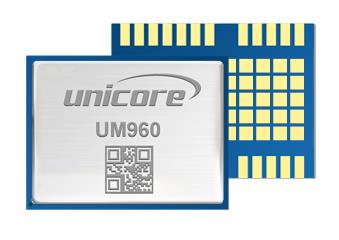
    The UM960 module can be used for a wide range of applications, such as robotic mowers, deformation monitoring, UAVs, handheld GIS, and more. It features a high position fix rate and provides accurate and reliable GNSS positioning data. The UM960 module supports BDS B1I/B2I/B3I/B1c/B2a, GPS L1/L2/L5, Galileo E1/E5b/E5a, GLONASS G1/G2, and QZSS L1/L2/L5. The module also has 1,408 channels. In addition to its small size, the UM960 features low power consumption — less than 450 mW. The UM960 also supports single point positioning and real-time kinematic (RTK) positioning data output at 20 Hz.
    Unicore Communications, unicore.euTualcom

    CRPA System
    A GPS/GNSS anti-jamming system

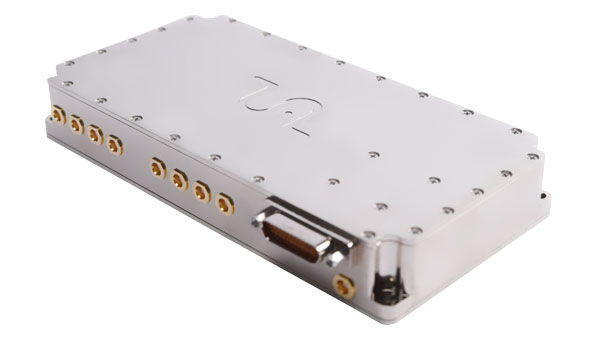
    This system eliminates interference by applying novel beam forming techniques. With an 8-array CRPA antenna, the system can assure the normal operation of a GNSS receiver in the presence of multiple jamming sources. The anti-jam GNSS CRPA system can be deployed using various configurations and operates with civil and military GPS receivers for land, sea, air platforms (including unmanned aerial systems), and fixed installations. The device has an embedded GNSS receiver that supports all satellite constellations. The device is lightweight and compact. It requires minimal integration training and easily integrates into new or legacy platforms. The antenna also offers assured positioning, navigation and timing.
    Tualcom, tualcom.com

    KP Vehicle Antenna

    IoT Antennas
    Rugged and designed to enhance connectivity

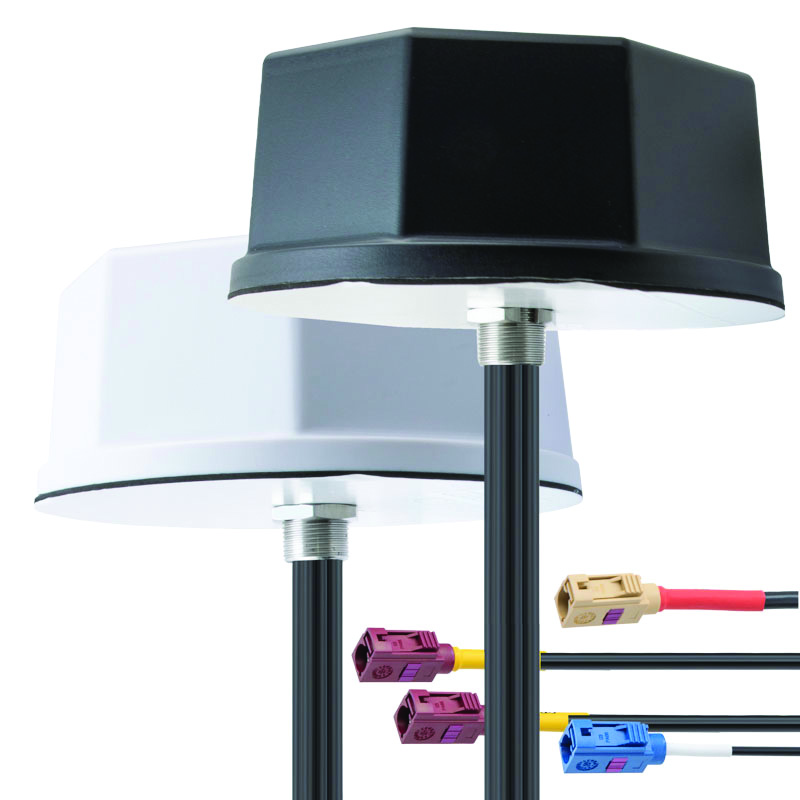
    KP Performance Antennas’ internet of things (IoT) multiband combination antennas are designed to enhance connectivity for vehicle fleets and base stations. The IoT multiband combination antennas have dedicated ports for cellular, Wi-Fi and GPS bands. They are also indoor and outdoor IP69K rated and can withstand harsh environmental conditions, such as extreme temperatures, water and dust. The antennas are suitable for transportation emergency response and agriculture applications. The IoT multiband combination antennas are in-stock and available now.
    KP Performance Antennas, kpperformance.com

    Image: Tallysman Wireless

    Smart Antennas
    With integrated technology for centimeter-accuracy

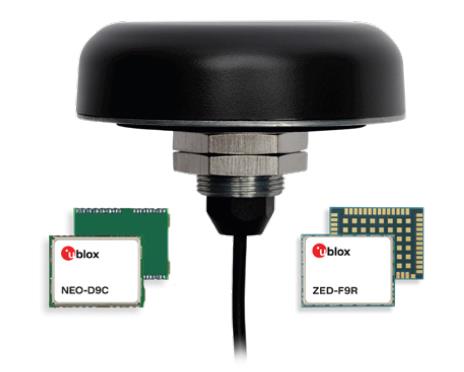
    PointPerfect PPP-RTK augmented smart antennas combine the ZED-F9R high precision GNSS and the NEO-D9S L-band receivers from u-blox and Tallysman Accutenna technology. The multi-band (L1/L2 or L1/L5) architecture removes ionospheric errors, and the multi-stage enhanced XF filtering improves noise immunity while relying on the dual-feed Accutenna element to mitigate multi-path signal interference rejection. Some versions of the new smart antenna solutions include an inertial measurement unit (for dead reckoning) and an integrated L-band corrections receiver to ensure operation beyond terrestrial network reach. The PointPerfect GNSS augmentation service is now available in North America, Europe and parts of Asia Pacific.
    Tallysman Wireless, tallysman.com/u-blox, u-blox.com


    SURVEYING & MAPPING

    Photo:

    Airborne Laser Scanner
    Suitable for mapping applications

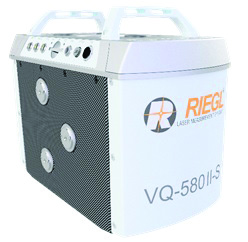
    The compact and lightweight VQ-580 II-S meets the increasing requirements of compact laser scanners for medium- and wide-area mapping as well as for corridor mapping. The successor of the VQ-580 II airborne laser scanner, provides a maximum measurement range of 2.45 m. It can be integrated with gyro-stabilized mounts as well as into the VQX-1 Wing Pod. It features high accuracy ranging based on waveform-lidar technology. The VQ-580 II-S also has a mechanical and electrical interface for inertial measurement unit (IMU)/GNSS integration.
    RIEGL, rieglusa.com

    Photo:

    Tablet and GNSS Solution
    For surveying applications

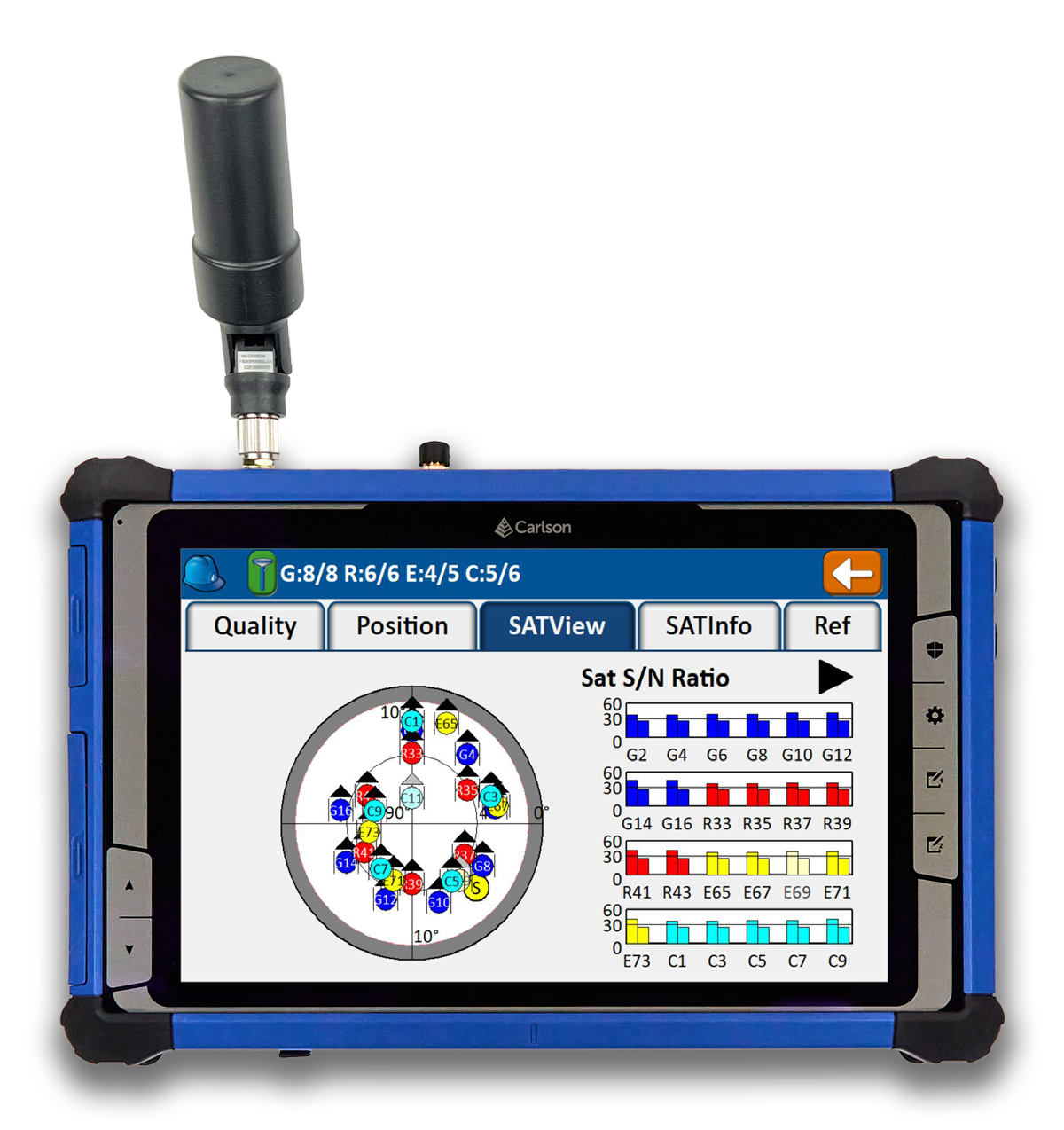
    The RT5 rugged tablet data collector and the RTk5 GNSS solution, which integrate the form factor of the RT5 with real-time kinematic GNSS performance, are suitable for land surveyors, engineers, GIS professionals, and users in need of advanced GNSS positioning with an RTK rover. The RT5 is designed for surveying, stakeouts, construction layout and GIS mapping, and is bundled with Carlson SurvPC — the Windows-based data collection program. The RT5 can run SurvPC with Esri OEM for use in the field. The RTk5 adds an advanced GNSS solution to the RT5, enabling accuracy in a compact, light and versatile package. It comes with a custom-built pole and cradle, a survey-grade antenna, and a small portable helix antenna for handheld GNSS use.
    Carlson Software, carlsonsw.comDJI Enterprise

    Lidar and RGB Solution
    Suitable for aerial surveying

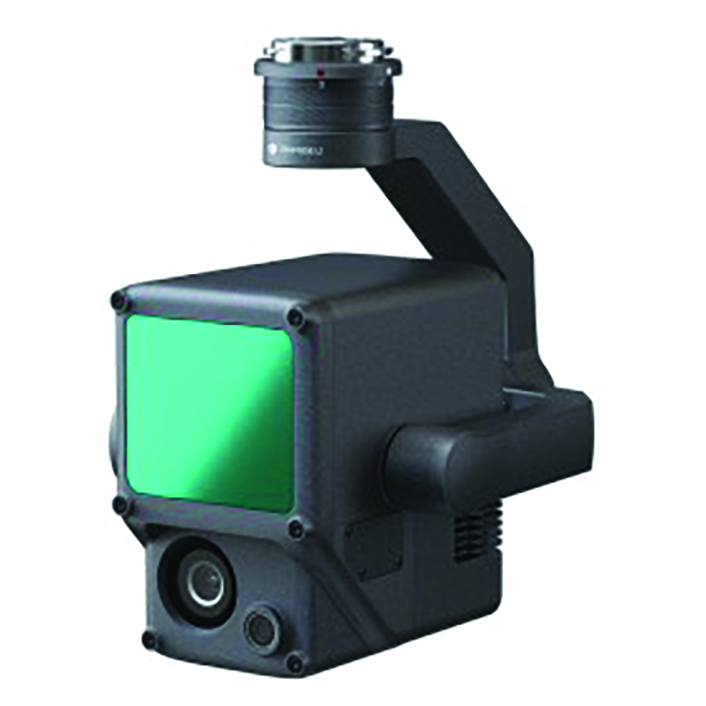
    The Zenmuse L1 integrates a Livox lidar module, a high-accuracy inertial measurement unit (IMU), and a camera with a 1 in CMOS on a 3-axis stabilized gimbal. When used with Matrice 300 real-time kinematic (RTK) and DJI Terra, the L1 forms a complete solution that gives users real-time 3D data, capturing the details of complex structures and delivering highly accurate reconstructed models. Users can render centimeter-accurate reconstructions with the high-accuracy IMU, a vision sensor for positioning accuracy, and the incorporation of GNSS data. The solution’s IP54 rating allows the L1 to be operated in rainy or foggy environments. The lidar module’s active scanning method enables users to fly at night.
    DJI Enterprise, enterprise.dji.com

    Mapping Platform
    Real-time, crowd-sourced map data

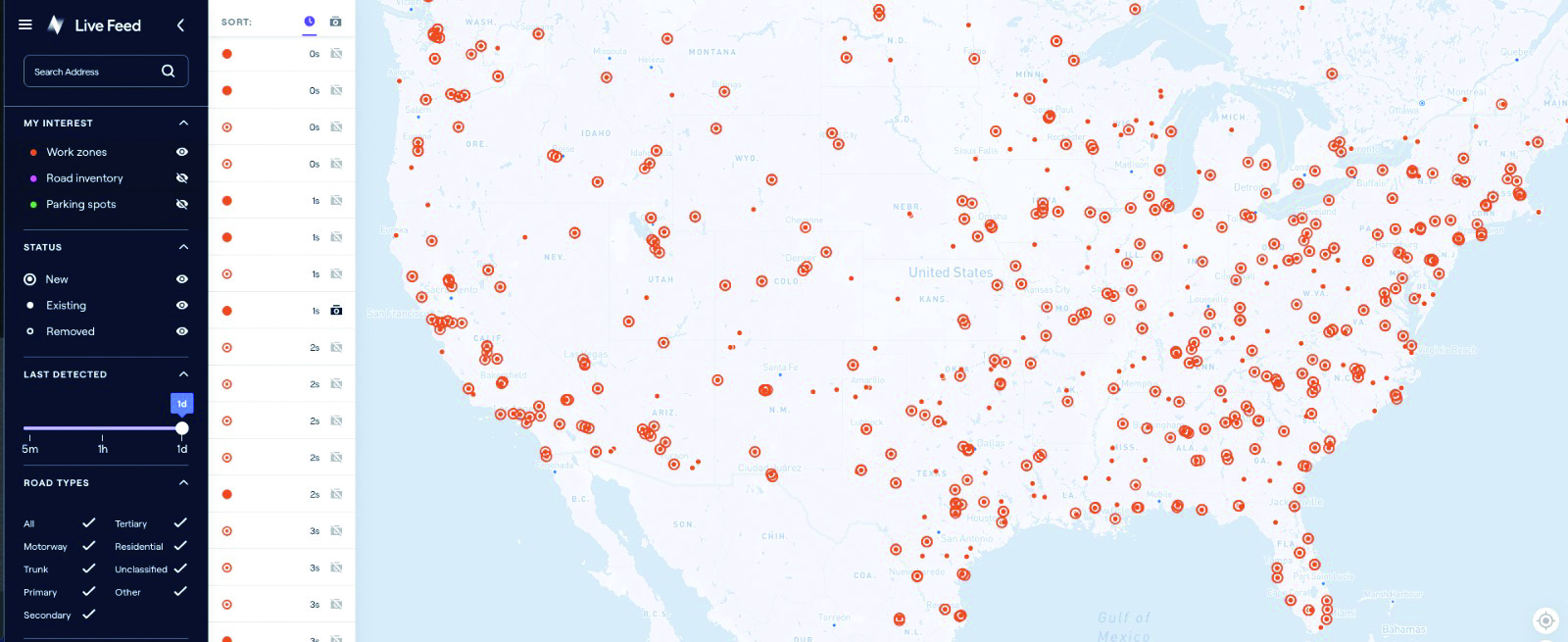
    CityStream Live is a real-time mapping (RTM) platform that enables the mobility industry — including connected vehicles, maps, mobility services, digital twins or smart city applications — to access a continuous stream of crowdsourced road data. This platform provides real-time data on nearly every road across the United States at a reduced cost. Utilizing a crowdsourcing network and artificial intelligence software, CityStream Live offers users and developers a live data feed to increase situational awareness, enhance driving capabilities, increase safety and more. By combining massive data aggregation with real-time data curation, CityStream Live is the first platform to deliver road data streams in real time and at scale, supporting several urban and highway use cases.
    Nexar, us.getnexar.com

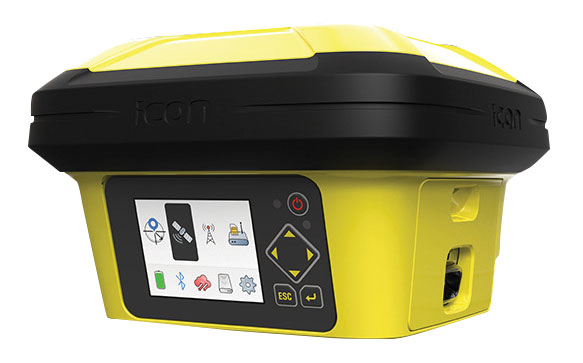
    Leica iCON gps 160 (Image: Leica Geosystems)
    Leica iCON gps 160 (Image: Leica Geosystems)

    Smart Antenna
    Contains features that increase productivity on construction sites

    The iCON gps 160 is a versatile solution for various applications. It can be used as a base station, as a rover or for machine guidance. The device is a modernization and enhancement of the successful Leica iCON gps 60, which has been well accepted in the market. The result is a smaller, more compact GNSS antenna with additional features and a larger display for ease of use. The Leica iCON gps 160 is particularly suited to complex construction environments with different GNSS requirements because the ability to switch between the different applications is at the users’ fingertips. Besides checking grade, cut and fill, stakeout points and lines, users can also benefit from using this solution for basic-level GNSS machine guidance. It has an integrated color display, a user-friendly interface, smart setup wizards and an intuitive construction-specific workflow to help contractors get the most out of their investment from day one. Size and weight reductions make the iCON gps 160 easy to handle, while the latest GNSS and communication technologies improve data reception.
    Leica Geosystems, leica-geosystems.com


    UAVPhoto:

    Positioning Solution
    For UAV delivery applications

    The PX-1 RTX is designed for accurate, robust positioning and heading for commercial UAV delivery applications. This solution enables UAV integration companies to add precise positioning capabilities so operators can plan and execute takeoff, navigation and landing tasks as UAV delivery advances to take on more challenging operations. The PX-1 RTX leverages CenterPoint RTX corrections and small, high-performance GNSS-inertial hardware to provide real-time, centimeter-level positioning and accurate inertial-derived true heading measurements. This solution allows operators precise control of UAVs during takeoff and landing to tackle more demanding operations in tight or partially obstructed spaces. It also minimizes operational risks from poor sensor performance or magnetic interference by ensuring greater positioning redundancy, which is especially important as commercial UAV delivery operations venture into difficult urban and suburban environments.
    Trimble Applanix, applanix.com

    Certification Reference Guide
    A guide for the AAM industry

    Business and government leaders, engineers, members of the media and any user with an interest in the future of flight can use the Honeywell State of UAS and UAM Certification Guide to help navigate and communicate the complexities of vehicle certification and operational approval across multiple vehicle segments. Industry professionals can access the living document online at aerospace.honeywell.com/us/en/products-and-services/industry/urban-air-mobility. The certification reference guide summarizes evolving Federal Aviation Administration and European Union Aviation Safety Agency rules across multiple advanced air mobility (AAM) segments. It also links to documents that AAM professionals can reference to better understand detailed certification requirements.
    Honeywell Aerospace, aerospace.honeywell.com

    Photo:
    Image: A2Z Drone Delivery

    Delivery UAV
    Suitable for aerial mapping, UAV inspection, forestry services, search and rescue operations, water sample collection, offshore deliveries, mining, and more

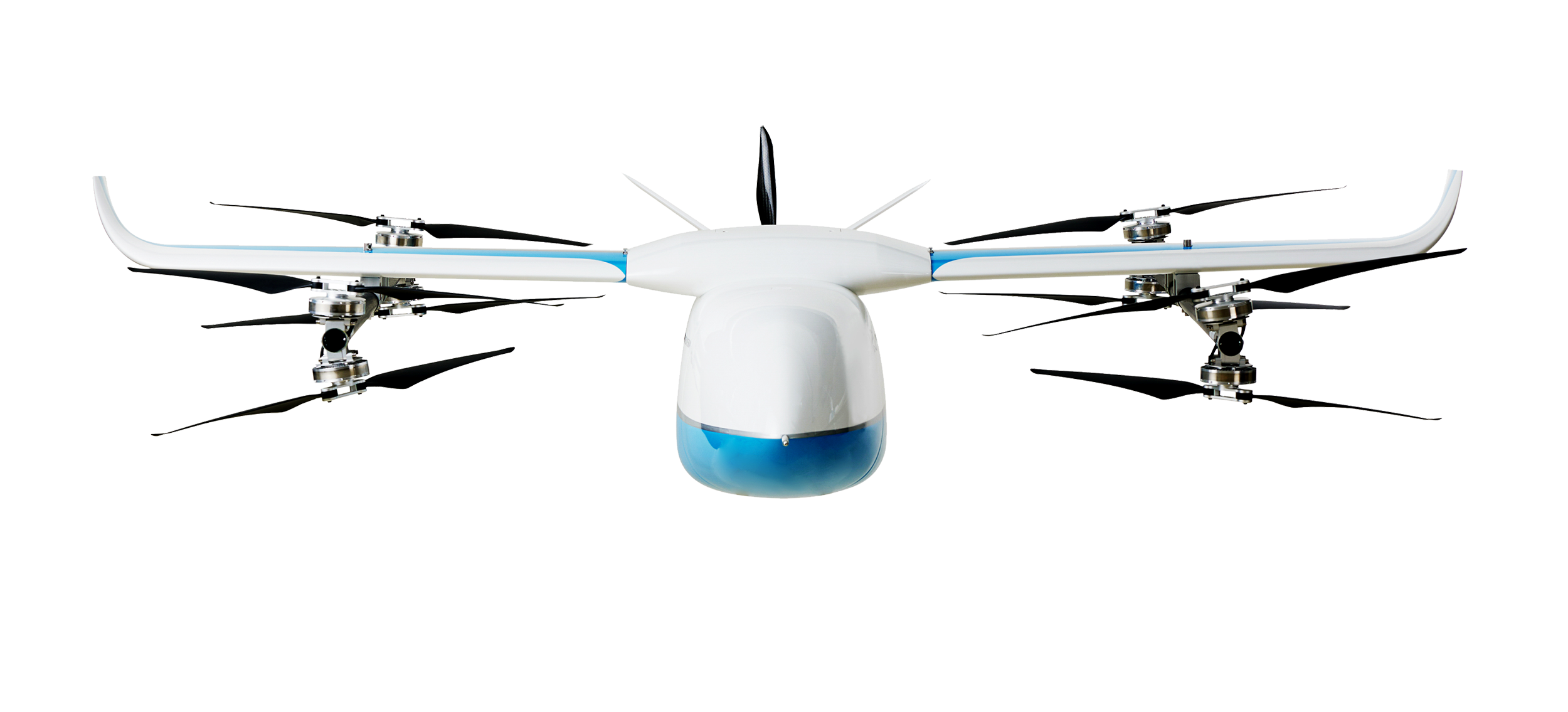
    The RDSX Pelican leverages a hybrid vertical takeoff and landing (VTOL) airframe with no control surfaces to combine the reliability and flight stability of a multirotor platform, with the extended range of a fixed-wing craft. With no ailerons, elevator, or rudder, the Pelican’s durable design eliminates common points of failure and extends operational time between maintenance overhauls. Designed to meet the 55 lb takeoff weight limitation for Federal Aviation Administration Part 107 compliance, the Pelican can carry payloads of 5 kg on missions up to 40 km, roundtrip. The Pelican can be optimized for extended range operations or to deliver payloads from altitude with the company’s RDS2 UAV delivery winch. Available in multiple configurations, the RDSX Pelican can be customized for an array of missions. The Pelican enables deliveries from altitude where spinning propellers are kept far from people and property, mitigating consumer privacy concerns of low-flying UAVs while abating intrusive rotor noise. Alternatively, for missions in which the UAV can safely land at its destination, a simple servo-release mechanism can release payloads and expand the Pelican’s payload capacity.
    A2Z Drone Delivery, a2zdronedelivery.com

    UAS
    Suitable for mapping applications

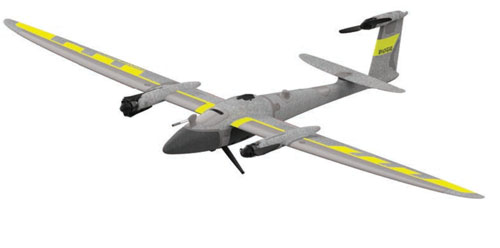
    The Trinity Pro UAS features Quantum-Skynode autopilot, using a Linux mission computer. This provides additional onboard computing power, increased internal storage, versatility and interoperability. Included in the Trinity Pro system is QBase 3D operations software. As the Trinity Pro is built on the Trinity F90+ UAS, its new capabilities include planning functions for missions requiring takeoff and landing at different locations, allowing for efficient and safe long corridor flights and beyond visual line of sight operations. The platform also incorporates advanced self-diagnostics to ensure safe operation. The UAS now includes an enhanced terrain- following system. Additionally, improvements to trigger point calculations results in improved image overlap and higher data quality. The Trinity Pro features automatic wind simulation for crash avoidance in bad weather and a linear approach for landing. The UAS is equipped with a downfacing lidar scanner that provides highly accurate ground avoidance and landing control. The system features USB-C ports for faster data transfer. The Trinity Pro is protected against dust and water damage and features increased wind limits of up to 14 m/s in cruise mode and 11 m/s during hover.
    Quantum Systems, quantum-systems.com

  • First Fix: Still waiting for M-Code

    First Fix: Still waiting for M-Code

    Max Weber famously described how bureaucratic inertia often leads formal organizations, such as government agencies, to devise new justifications for themselves after they have outlived their original purpose. That is certainly not the case for the U.S. Space Force, which is in its infancy and is responsible for key missions, including operating the Global Positioning System that it took over from the United States Air Force about two years ago.

    However, bureaucratic inertia can also refer to the tendency of organizations to continue to pursue projects or approaches that may no longer be the best match for their goals, missions, or budgets. A recent, congressionally-mandated report by the United States Government Accountability Office (GAO) — Report to Congressional Committees, GPS MODERNIZATION: Space Force Should Reassess Requirements for Satellites and Handheld Devices, issued in June — questions the Space Force’s approach to modernizing GPS with a more jam-resistant, military-specific signal known as M-code.

    In 2005, the Air Force launched the first GPS satellite capable of broadcasting the M-code signal, which is at the core of a multi-billion-dollar modernization and sustainment effort. Yet, 18 years later, widespread adoption of the technology is still hampered by delays in upgrading GPS ground and user equipment. Approximately 700 types of weapon systems — including ground vehicles, ships and aircraft — will ultimately require M-code-capable user equipment.

    Providing M-code requires the cooperation of GPS’ ground, space and user equipment segments. Regarding the first one, the report states: “In 2022, Space Force further delayed delivery of the ground control segment due to development challenges. This delay pushes delivery until December 2023 at a minimum. Space Force officials have not finalized a new schedule and acknowledged that remaining risks could lead to additional delays.”

    Regarding the space segment, it states: “Space Force met its approved requirement for 24 M-code-capable satellites on orbit but determined that it needs at least three more to meet certain user requirements for accuracy. Building and maintaining this larger constellation presents a challenge. GAO’s analysis indicates it is not likely that 27 satellites will be available on a consistent basis over the next decade.”

    Finally, regarding the user segment, it notes that development of the Military GPS User Equipment (MGUE) Increment 1 has progressed “to the point where the military departments are ready to commence activities in support of testing and fielding it on the lead weapon systems.” However, it cautions that “[d]elays and unexpected challenges could affect the fielding of capability for some systems.”

    GAO’s report recommends that the United States Department of Defense (DOD) assess the number of GPS satellites necessary to meet operational needs, and either develop a sound business case for the M-code-capable Increment 2 handheld, or not initiate the effort. The DOD concurred with both recommendations.

    Who Runs GPS?”, the special feature in our February 2023 issue, which detailed the structure of this vast enterprise, listed an executive committee, a coordination office, an oversight council, two Space Force commands, and, as partners, several federal departments and agencies. Has this complex structure become too diffuse to make tough decisions?

    Matteo Luccio | Editor-in-Chief
    [email protected]

  • PNT by Other Means: Locata

    PNT by Other Means: Locata

    An exclusive interview with Nunzio Gambale, Co-Founder, President and CEO, Locata. For more exclusive interviews from this cover story, click here. 


    Image: Locata
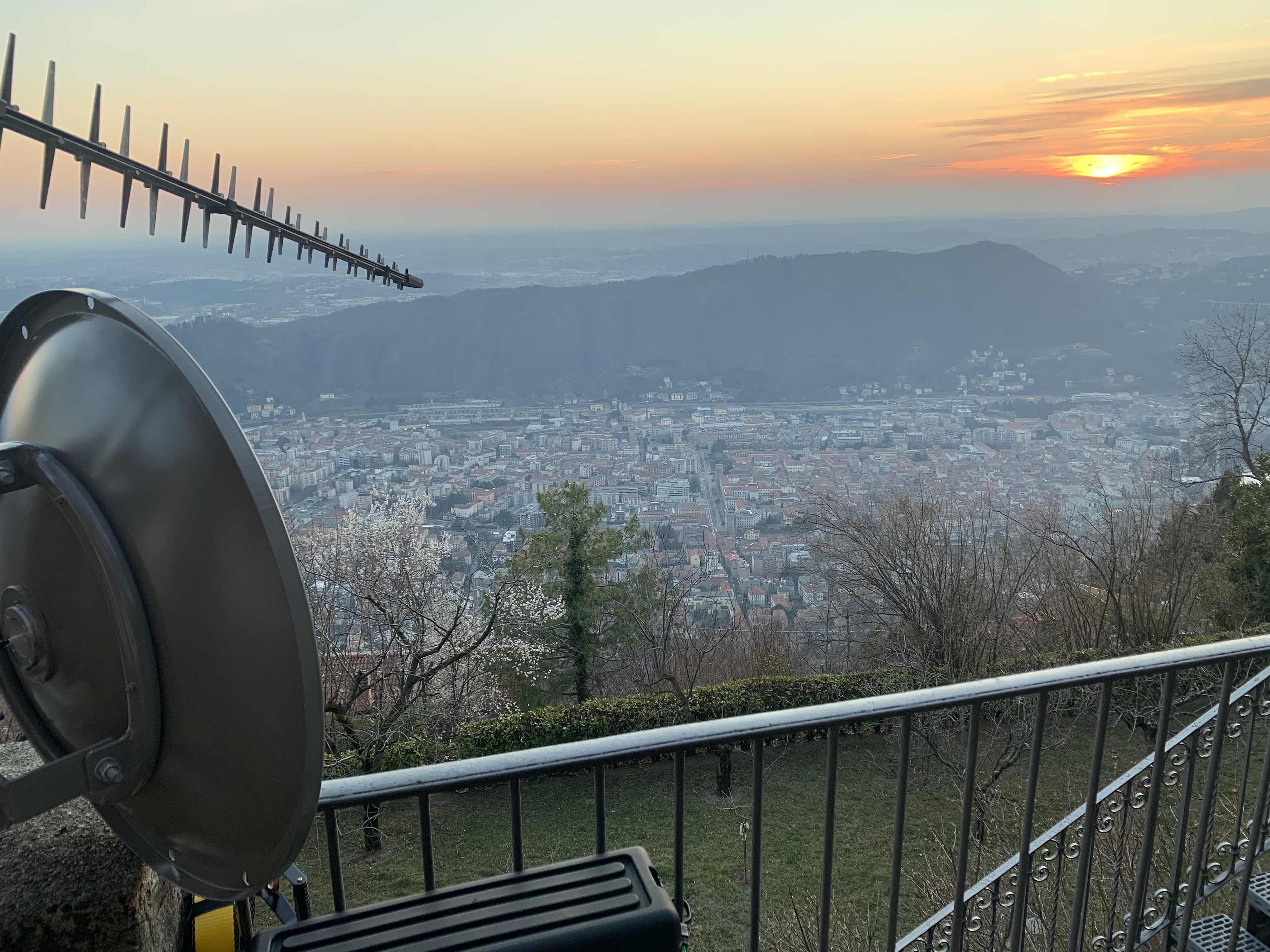
    Locata dish antenna pointed to the European Union’s Joint Research Center in Ispra, Italy, 44 km away, just under the setting sun. The Yagi antenna above is pointed to a cell tower in Como and used to connect the system for remote control and data logging. (Image: Locata)

    In brief, how does Locata work? What are the key concepts?

    Almost everything you know about GNSS pretty much applies to Locata. We are an extremely close cousin. We use trilateration; in other words, we use time of flight from transmitter to receiver as our pseudorange. We work with both code and carrier solutions. We transmit CDMA Gold Codes, chipped at 10MHz. Everything in the algorithms that you use for GNSS is pretty much the same, and so it feels extremely familiar to any GNSS engineer. We have an interface control document (ICD) that describes our over-the-air interface, exactly as GPS or Galileo does. That’s available to our integration partners. So, the similarities are incredibly close.

    The main place where we diverge greatly from GNSS is in the use of atomic clocks. One of the three fundamentals of GNSS is that all your transmitters have to be synchronized for the trilateration to work at your receiver. Syncing the satellites requires a master clock — in the case of GPS, with a redundant feed from the U.S. Naval Observatory — and a very complex ground infrastructure. Our system requires neither atomic clocks nor a control segment. Importantly, just like GNSS, our satellites do not communicate with each other. LocataLites, our version of the satellites, only broadcast a signal, thereby enabling an unlimited number of receivers to use our devices.

    Locata’s core inventive step was the Time Lock loop invented by my partner, David Small. Any engineer is familiar with a frequency lock loop or a phase lock loop, which allows you to align either phase and frequency in a very intelligent way by looking at the offsets and then moving the two components into alignment. That’s what we do with time. It is a fundamental difference from requiring clocks, which all drift and are very difficult to synchronize, as the complexity and cost of the ground segment testifies. Many people get confused because they believe that super accurate atomic clocks will all give you the same time. Clearly, that’s not the case, because they drift relative to each other. However, satellite navigation requires keeping the clocks synchronized.

    Our system is a synchronization technology that does not require atomic clocks. We synchronize our transmitters to incredible levels, better than what’s generally available from the synchronization of atomic clocks. That allows us to do everything that a GNSS does in our coverage area.

    We’ve invented the Time Lock loop. Dave has more than 170 granted patents on this and on multipath mitigation. Nobody else has done this or can do it. All other high-precision systems require external correction systems. Our carrier solution is a single point solution. We don’t need any external corrections provided from reference stations, or communication links between our devices. Our system is, and remains, synchronous to the picosecond level, which allows us to do carrier-phase positioning without corrections. That’s utterly unique.

    As the old joke goes, a person with a watch always knows what time it is, a person with two watches never does.

    That’s one of my favorite quotations for people who don’t understand this.

    It has been said that the only replacement for a GNSS is another GNSS.

    And my favorite riposte to that is “the solution to satellite-based problems is not more satellites”!

    We now have four GNSS but they have some common failure points. What’s your view of the debate about GNSS vulnerabilities and the need for complementary PNT? How does Locata fit into it?

    One of our main drivers is the knowledge that all those global systems are fundamentally military based. Galileo tries to make itself an exception, I know, but the core motivation for nations to put up these kinds of very complex and expensive systems is for full global military purposes. Locata has probably been working on this complementary PNT technology longer than just about anybody else. We began in 1995, with the problem that GNSS does not work indoors. That was the first light bulb moment for us about the issues with GNSS not being able to serve all the potential future applications. So, we’ve been at this a long time. Global systems absolutely have their place, but there are many applications now and in the future that do not require them.

    Where did your realization lead you?

    We started to look at ways of filling in the holes that we saw in GNSS. That led us to the two unique capabilities that we’ve currently developed and commercialized: the synchronization of transmitters, which is the heart of all radio-based positioning, and, because we work in terrestrial systems, how to deal with multipath. Those are the core new enabling capabilities that Locata brings to the industry today.

    There are mountains of reports detailing the vulnerabilities of GNSS, starting with the 2001 report by the John A. Volpe National Transportation Systems Center for the U.S. Department of Transportation right through the very latest one from the European Commission’s Joint Research Center (JRC) in Ispra, Italy. All those myriad reports document the vulnerabilities of GNSS and the dire dependencies they create. These dependencies mean that the more than 95% of applications that are civilian are vulnerable, if and when the military have to do what they have to do with their systems in a military conflict. So, for us, it’s all about giving civilians and nations sovereignty, and national-level resiliency, firstly to critical infrastructure systems.

    That’s what we set out to demonstrate with our long-range deployments at the JRC. Our systems must be able to be scaled, in time, from purely local up to national systems. Because Locata’s focus must be on civilian systems and sovereignty that can be delivered back to nations, with systems that are independent from the military ones. We’re not trying to replace global systems, at least for now.

    GNSS provide positioning, navigation and timing (PNT) at the global level. You have addressed the global level. Let’s talk now about PNT.

    P, N and T are all important. Timing, of course, is GNSS’s hidden component for most people, but it is critical to many applications. Anybody who wants to see the work that Locata has put in over the last couple of decades to bring new capabilities to the industry should look at the JRC’s report, which is the very latest and probably one of the most comprehensive reports that’s been produced in the past decade. The European engineers were incredibly thorough in the way they tested all candidate systems, including Locata. If I could speak proudly about our team’s achievements, Locata’s P, N and T results presented in that report speak for themselves. Locata’s technology was demonstrated to perform in every environment the JRC engineers requested, including indoors.

    That’s one of the functions that we absolutely want to bring to market. Our systems don’t stop at the wall, they can continue to work indoors, you can propagate positioning and timing from outside to inside. The performance that was measured independently by the researchers showed that indoors we were delivering centimeter-level positioning in brutal multipath conditions, as well as outdoors.

    Locata is doing superb work with some of the most complex automation systems in the world now, which unfortunately we’re constrained from discussing because of nondisclosure agreements.

    Say more about the role of synchronization.

    Locata dish antenna pointed to the European Union’s Joint Research Center in Ispra, Italy, 44 km away, just under the setting sun. The Yagi antenna above is pointed to a cell tower in Como and used to connect the system for remote control and data logging. (Image: Locata)
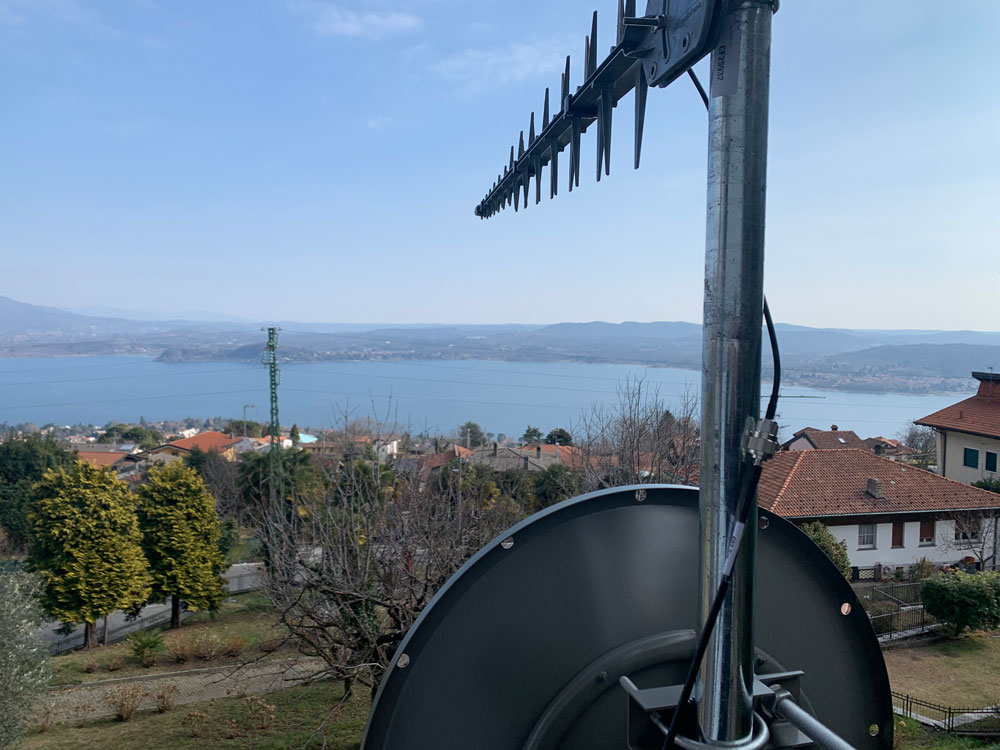
    Locata dish antenna pointed to the EU’s Joint Research Centre, 8km away across Lake Maggiore in Northern Italy. This antenna was an intermediate node during the EU’s independent testing of Locata’s picosecond-level time transfer over a 105km distance. (Image: Locata)

    Synchronization is the heart and soul of everything that we do with radio positioning. Clearly, Locata has been able to do high-precision synchronization without atomic clocks, at an almost unbelievable level, for many years. The first system that we deployed is at the White Sands Missile Range in New Mexico, where the U.S. Air Force jams GNSS over a vast area, yet Locata continues to deliver centimeter-level positioning and picosecond-level synchronization. That is unprecedented and cannot be done with satellite-based systems. The European JRC engineers measured our synchronization at the picosecond level, cascaded 8 times from one transmitter to another over more than 105 km. This is an extremely difficult thing to do, given that you’re trying to remove the propagation and component delays introduced by each intermediate transmitter. Our synchronization was measured to basically deliver timing equivalent to fiber, but over the air, using RF. I don’t believe any other company can demonstrate that.

    This development allows us to start deploying systems commercially, which we are doing today via integration partners. In the future, as we miniaturize, bring the price down and scale our capabilities into other frequencies and at power levels that are commensurate to national-level systems, we intend to cover entire nations with our capability, and deliver not just what’s required today, but what’s required for future apps.

    One of the few things that we don’t agree with in the JRC tender and report is that they set the PNT “performance bar” at 100 meters and one microsecond. For 80% or 90% of serious applications — especially for autonomous systems, and any applications that need fine control, including surveying — 100 meters is completely unusable, apart from maybe intercontinental aviation systems. Locata delivers the picoseconds and the centimeters that future applications require. As we commercialize further, we will deploy more and more systems that demonstrate that capability.

    So, you could not use Locata to navigate on transoceanic flights.

    No, we’re clearly not focused on doing that. We’re a business, and we’re working on the applications for which we see the most civilian, commercial value. Nevertheless, the U.S. Air Force does use Locata and so we’re in discussions with other militaries now. Clearly, we can cover very large areas — say, around airports and military bases — and continue to work at very precise levels, both for timing and positioning, in anything up to completely denied environments. It’s a proven fact that our systems are being used on a regular basis where GNSS has been jammed, and Locata is the truth for those tests. You cannot get a more convincing demonstration of non-GNSS-based PNT than the U.S. Air Force’s use of Locata at White Sands.

    What about the application with by far the greatest number of users, which is cell phones?

    Absolutely, without question, we believe Locata will eventually be used in mobile phone systems, especially for indoor positioning. Locata’s receivers today look very much like the 1990s version of GNSS receivers. However, there are zero engineering roadblocks to scaling or reducing our devices to a chipset. It’s a chicken and egg business development problem: you can’t get to mobile phone-type scale until you’ve engaged and are working with companies in that industry. Part of the reason we worked so diligently to demonstrate our new capabilities in the JRC tests, is that many of the claims that we’ve made about centimeters and picoseconds have been fairly unbelievable in terms of the capabilities that were previously publicly demonstrated. Our participation in the JRC tests was motivated in many ways by being able to point to the 140-page report produced by the engineers in Europe, and prove beyond question that we actually do what we claim.

    We have now begun discussions with companies in the cell phone industry. Technically there’s no question that in the future we can reduce our receivers, firstly, and then our transmitters, into either chipsets or into IP cores that can be dropped into other companies’ chips. That’s a work in progress. The engineering to take this down to a chipset is now mostly constrained by not yet conducting business development in that market segment. However, we are working toward that, and are in discussion with some of the big players in that industry.

    It sounds like you are working with different industries at different scales.

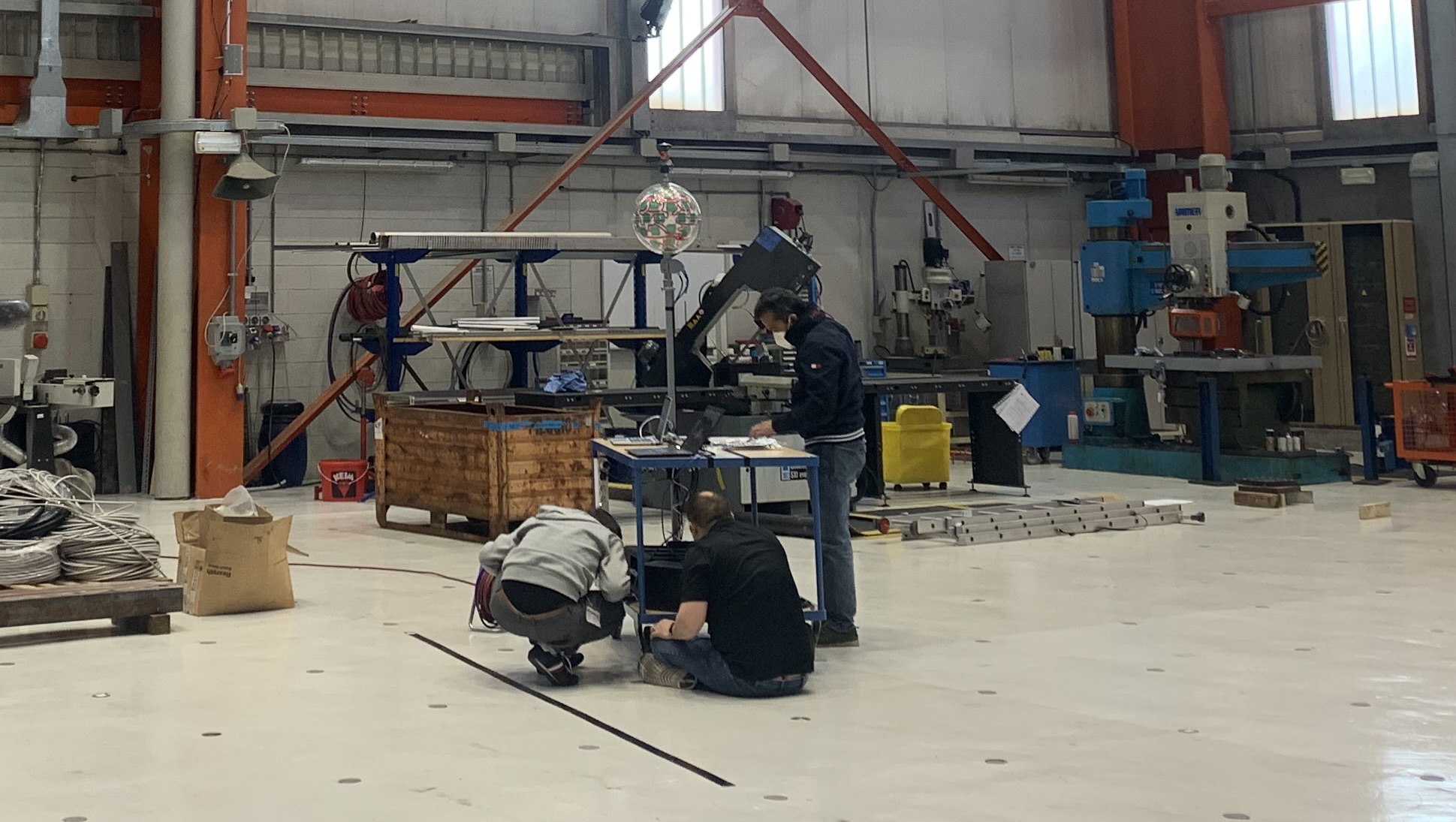
    Locata engineers set up the distinctive VRay Orb antenna for an indoor cm-level positioning demo in the Joint Research Centre’s all-metal Workshop Building. (Image: Locata)
    Locata engineers set up the distinctive VRay Orb antenna for an indoor cm-level positioning demo in the Joint Research Centre’s all-metal Workshop Building. (Image: Locata)

    Yes, and the markets we are in today are delineated by the current form-factor of our devices. Today, our devices are similar to the GNSS receivers that you would have seen back in the 90s. Because we’re FPGA-based and not chip-based our devices tend to be relatively large, power-hungry and relatively expensive. That’s why we’re working into markets where that is not a roadblock. Our main partners today have massive problems that they need to solve, specifically for industrial automation applications. We’re working with some extremely large global businesses in some of the most complex and demanding automation applications in the world. It frustrates me enormously that we cannot publicize those yet because we’re under commercial non-disclosures. Therefore, we remain tight lipped about our current installations.

    However, those in Locata’s inner circle know that we’re working with some of the most advanced automation capabilities in the world. I am very eager to show the world what we’re doing. And we soon will.
    Obviously, the U.S. Air Force work that we’ve been doing for eight years is publicly visible. Our team right now is working with them on an extension of that contract. As I said, we’re also in discussions with some other nations and we look forward to being able to publicly disclose some of our applications in the future. For now, unfortunately, I need to remain tight lipped and just keep working on the installations that we have underway. Hopefully, soon, when these things become visible in public, I’ll finally be able to promote them.

    Is sensor fusion relevant to Locata for certain applications or will it always be a standalone system?

    Locata does not necessarily need to be standalone. Our partners, who are the experts in their machines and applications, are responsible for integrating Locata with other sensors, such as inertial units or cameras or lidar-based systems that may already be on their machines, just like they would with any GNSS system.

    Our business model is working with partners. So, it’s a business-to-business model, whereby we partner with companies that have a problem they need to solve in their products. We work with their engineers to integrate our system — just like GNSS engineers work with their engineering partners to integrate receivers into systems of systems. That is generally what is required in many of the applications in which we’re used for autonomy.

    One of the great features of our technology is that we can guarantee our partners, without fail, exactly how many Locata transmitters will be in view for their application in any area or environment. We can over-determine the solution on a site so that if, say, you get lightning strikes or power outages, the system can continue to function at the level that you require. That’s never possible with satellites, because you never know where your receivers will be relative to obstructions and the DOPs of the satellites. So, our system can be standalone. But in 90% of the applications in which we are working it is integrated into a system of systems, just like GNSS is.

    What, if any, is the role of simulation with respect to your system?

    We are currently in discussions with a major simulation company for integration into their software suite. They see enough demand now from enough players to be working with our integration. I can’t name them because it’s not a commercial system yet. However, they have our data and ICD, and they are working with our engineers to incorporate Locata simulations into their product offering.

    Is there anything else that you would like to add?

    Unlike GNSS or LEO-based systems, which take a long time to change, we can customize and modify our systems very quickly. Our next generation systems are frequency-flexible: we can put our systems into any radio band from 70 MHz, up through all the phone bands, the radio navigation bands for aviation, emergency services bands, right up to the 6 GHz WiFi bands. Those devices are in prototype right now. We can very quickly modify, update and upgrade our system, which allows us to have a very rapid development cycle that satellite-based systems will never have.

    For instance, the U.S. Air Force’s NTS-3 Vanguard satellite that has been coming for several years will soon demonstrate new capabilities. Yet it will still take decades to deploy them. LEO satellites, which are getting an enormous amount of attention today, still have major constraints in terms of upgrades, modification, and or the deployment of new capabilities. Very few people in the industry talk about the replenishment of satellites which these massive constellations will need because in LEO orbits they will naturally deorbit every four to six years or so.

    That means that there’s a huge requirement to continually replace LEO satellites in space, which will obviously require an enormous cost, and complex engineering effort. When you have several thousand satellites, in different planar orbits, deciding where you’re going to place replacement satellites for the many that are failing, is going to be an enormous headache for all these companies that are trying to put LEOs in space. Locata doesn’t have any of these issues. As we move forward, we will miniaturize, go to chipsets and software-defined radio capabilities. We can evolve at a rate that space-based systems can’t even begin to approach. Given that we live in an age of rapidly evolving threats and vulnerabilities, our ability to rapidly react to these challenges is, we believe, a valuable addition to the tool-box of PNT capabilities the world requires.

    Thanks for allowing us this opportunity, Matteo, to speak to your large and expert audience.

  • PNT by Other Means: Satelles

    PNT by Other Means: Satelles

    An exclusive interview with Dr. Michael O’Connor, CEO, Satelles. For more exclusive interviews from this cover story, click here.


    How many Iridium satellites carry your system?

    Mike O'Connor
    Mike O’Connor

    Iridium has 66 active satellites. There are also several spares on orbit. The satellites were all launched between 2016 and 2018, so they are all relatively new. They cover the entire globe, 24 hours a day, seven days a week, so they have universal coverage.

    How will your constellation grow?

    Today, our Satellite Time and Location (STL) service is offered only over the Iridium satellites. There’s nothing else that we’re discussing publicly. It could expand over time to other satellites. The signal and the capability are flexible. In terms of how Iridium could change, that’s more for Iridium to discuss than us.

    Who makes chipsets that can use your system? And how does that work?

    We work with partners. For example, with Adtran (through their Oscilloquartz product line), Jackson Labs (now VIAVI Solutions), Orolia (now Safran Trusted 4D). Companies like that provide the solutions that are favored by critical infrastructure providers today. We provide them either reference designs or effectively referenced designs. They ultimately integrate our STL capability into their solutions. We help them to do that. They can use our reference designs or create their own custom designs based on our reference designs. So, that’s the model that we use.

    Is the STL receiver on top of a traditional GNSS receiver and passing certain data to it?

    STL is used in two ways. In some cases, users are trying to do positioning or timing in an environment where GNSS signals will not reach, such as indoors, or are otherwise unavailable. In those cases, it wouldn’t be overlaid with GNSS, it would just be a standalone solution.

    In many other cases, the goal is having a solution that is resilient to an outage, interference, jamming, spoofing, those sorts of things. In that case, the receiver card that might be provided by one of our partner companies would have both GNSS and STL capabilities and would take the best of both worlds. If GPS is jammed or there’s interference, then the STL signal alone would be sufficient to do PNT. However, whenever both signals are available and can be authenticated, then it would use both and leverage the benefits of having two systems.

    Does the location calculation take place in a GNSS chip or separately in the STL?

    The chain to take measurements of the STL satellite signals is different. It’s not a single chip that’s measuring both satellites, it’s ultimately two chips that are making those measurements. Then how the position calculation and the integration of those signals is done is left to our partners. In some cases, it is proprietary to the partners that are doing that integration work. It can be integrated loosely or tightly.

    When it’s just the STL chip, is that usually for timing purposes, or both timing and location?

    Generally, an STL-only solution is best suited for timing. It’ll do timing at about 100 ns, depending on what kind of oscillator is being used and the exact configuration of the product.

    What positional accuracies can you achieve?

    Generally, in the 10 m to 20 m range, depending on the product configuration.

    Most of the correction services refer to variables that are not relevant to your system.

    That’s right. There are other techniques, such as integrating with other sensors, that can improve the accuracy. The primary uses for STL today are in delivering timing in environments where GNSS is not able to do so today, such as for national critical infrastructure. That’s been our commercial focus as a company.

    Who currently uses the STL receivers? Which markets are you targeting first?

    Most of our users are in the data center space. Stock exchanges around the world are also using our service as a source of resiliency, and now wireless infrastructure. So, think 5G infrastructure. As 5G networks are rolling out, they need about five to ten times more nodes to cover a geographic area than 4G networks. GNSS has been used for years to time 4G networks, but most 5G network sites — such as femtocells and picocells — are indoors or in places where GNSS is challenged. We deliver that timing service indoors, outdoors, everywhere. So, those are the three commercial markets where we have the highest adoption rates.

    You still have plenty of room for expansion in that market before you must start thinking about expanding into other areas.

    Yes, there’s plenty of room for expansion into those markets, so I wouldn’t say that they’re fully saturated. We are also looking into other opportunities. We’ve seen interest in the energy area. I think the industry is a little bit slower moving, but the need is ubiquitous, right? We all recognize that a black swan event in our society would really represent a bad day and we want to avoid that.

    There are several companies across the industry that are trying to solve that important problem. Everyone involved in critical infrastructure that requires a timing reference — which is anything that is associated with a network activity — should have an alternative or augmentation to GNSS as a timing source. It’s great that we’re seeing tailwinds from the U.S. Government, from the European Union, and from others to try to encourage that adoption. However, there’s still a long way to go before we really feel that that’s been sufficiently covered.

    What, if any, have been the major developments in the past year or so?

    One of the most interesting things that has happened over the last year and a half has to do with our capability regarding STL. We’ve been demonstrating more publicly, and with more independent authorities, the capabilities, resiliency, and operational characteristics of our service.

    For example, the JRC study.

    It started with the U.S. Department of Transportation (DOT) a couple years ago, but there’s also been some work done by the Department of Homeland Security and with the National Institute of Standards and Technology (NIST). We’ve been working directly with NIST to do some validations, as well as with UK and European organizations. They have subjected STL to rigorous third-party, hands-off technology evaluations. They confirmed the timing accuracy specifications to UTC and validated the operational characteristics of STL, such as the resilience in the absence of GNSS, the ability to receive the signal indoors, and having global availability.

    We’re delighted to see the third-party operational evaluation of things that we’ve known all along but are now being evaluated and confirmed by these government sources. Beyond that, of course, there are always going to be technology advancements, both with our company and with other companies.

    The real focus of industry right now is on adoption. All the providers of these capabilities ultimately need adoption in industry to remain active and viable. These are good people trying to do the right thing to protect our society. There are many great technology solutions out there to do it. Hopefully, many of these solutions are adopted in the near term. That’s what our focus has been. Our focus has not been on squeezing an extra five nanoseconds out of performance, although, of course, we’re always doing that. I think the important focus of industry should be driving adoption. There are solutions available today, including ours, that are ready to go and are being proven operationally in use.

    Can you say more about the study by the European Commission’s Joint Research Centre (JRC)?

    If you look at the summary, all these technologies that were demonstrated worked. Both the DOT report and the JRC report effectively summarize that there are multiple technologies out there today that are ready to go.

  • PNT by Other Means: Xona Space Systems

    PNT by Other Means: Xona Space Systems

    An exclusive interview with Jaime Jaramillo, Director of Commercial Services, Xona Space Systems. For more exclusive interviews from this cover story, click here


    Image: Xona Space Systems
    Space X Launch. (Image: Xona Space Systems)

    It has been said that “the only alternative to a GNSS is another GNSS”. Your website’s homepage claims that Xona will be “the next generation of GNSS.” Will it provide all the positioning navigation and timing services that the four existing GNSS provide?

    JJ: The answer at a high level is “Yes, it will provide all the services that legacy GNSS provides and more.” Xona is developing a dedicated constellation of PNT satellites in Low Earth Orbit — this allows us to provide PNT signals and service with significant improvements to precision, protection, and power compared to what’s available today. Xona’s service, called PULSAR, is designed to meet a variety of commercial and modern applications that have been seeking performance improvements.

    So, the short answer to my question is, “Yes. All of that, and then some.”

    JJ: Yes, absolutely. Traditional GNSS constellations provide tremendous value to the world today, though we’ve seen market demand signals for even higher performance PNT and that we intend to deliver on.

    How many satellites and orbital planes will the full constellation have?

    JJ: The target is approximately 300 satellites. That will include several spares. There will be a diverse set of orbital planes and a combination of polar and inclined orbits.

    When all the satellites are up, their locations and broadcast frequencies will be public, right? They will have to be disclosed to various regulatory bodies.

    JJ: You hit it on the head. Because we’re in the process of going through regulatory approvals for the full constellation, we can’t talk a lot about our frequencies and a lot of the specifics publicly though this will change over time.

    Roughly, when do you expect to achieve initial operational capability (IOC)? And when you expect to achieve full operational capability (FOC)?

    Image: Xona Space Systems
    Image: Xona Space Systems

    JJ: As you can imagine, it is expensive to put up all 300 satellites — we’ll have a three-phase roll-out approach. Our target is to launch our next satellites at the end of 2024. In our first phase, we’re going to offer services beginning in North America and Europe that only require one satellite in view — for timing services and GNSS enhancements. IOC will be achieved in 2025. Then, as we roll out to phase two with more satellites in view, we’ll be able to start to offer positioning services in mid-latitudes. As we move to phase three, the service will provide even higher-performance PNT globally, and the services’ ability to operate independently from GNSS. We also designed the constellation with polar orbits to provide much better coverage in the polar regions which will be an improvement over what GNSS provides today.

    With climate change and more traffic through the Arctic, that’s going to become more important.

    JJ: Exactly. When we talk to potential customers today, that question comes up.

    When do you expect to complete your constellation?

    JJ: Our target for full operational capability is 2027.

    So, two or three years to fill out the constellation.

    JJ: We have basically locked down our signal and system architecture. Now, it’s a matter of building out the ground segment and launching satellites on schedule. There are several factors at play here, but those are the targets that we have today.

    Speaking of launch, who will launch your satellites?

    JJ: That decision will depend on the satellite manufacturers with which we proceed. But the demo satellite that we have in space was launched last year in May on a SpaceX Falcon 9 rocket.

    What is your business model? Will you have different tiers of service? Will your rate structure enable mass adoption?

    JJ: We are targeting both mass market applications and high-performance ones. LEO brings many benefits in comparison to MEO in just about every industry to which it can be applied. Our business model supports industries that prefer a lifetime fee, as well as ones that prefer recurring subscriptions. We’ve also designed PULSAR with different performance tiers to support a wide variety of customer needs.

    What would be the differentiators between the different tiers?

    JJ: The PULSAR base service will include timing and positioning from Xona satellites. We have some in-band capabilities to broadcast additional services, such as GNSS enhancements, enhanced security features, and signal/service integrity. The integrity service will verify that the signal has a certain level of performance thresholds. Critical applications that need certain levels of performance will be able to receive the signal. If it drops below certain performance thresholds, we will flag that to the device so that it knows that, even though it is receiving a signal, it should not continue to use it due to signal degradation.

    With legacy GNSS, satellites in MEO broadcast signals to receivers. There’s no need for two-way communication and, anyway, transmitting to the satellites would require too much power. With LEO satellites, however, you need a lot less power from the ground to talk to the satellites. Would two-way communication benefit certain applications?

    JJ: The initial service will not have two-way capabilities. However, we are leaving room in the signal and hardware designs to potentially offer that in the future.

    Image: Xona Space Systems
    Image: Xona Space Systems

    Your business model is the exact opposite of the gift from U.S. taxpayers to the world that is GPS.

    JJ: Agreed that GPS is one of the greatest gifts US taxpayers have given to the world. While similar in function, GPS and Xona have different mission sets. As a commercial company, we have a mandate to listen to the commercial world’s needs and address them in a cost-effective manner. The world is evolving much faster than current GNSS can improve. This forces commercial industries to design around satnav limitations and use other navigation technologies that may not be as scalable or cost-effective.

    Who will build the receivers? Do you expect that “if you build it, they will come”?

    JJ: Xona has established relationships with many of the receiver manufacturers out there. What’s publicly announced is that we have a strong relationship with Hexagon | NovAtel. They have been supportive of us for a long time now and are very advanced in their development and support for our signals. Some interesting announcements were made at JNC, with additional simulator and receiver manufacturer partners, with more to come. It’s going to be very exciting.

    I assume that, at least for a transitional period of several years, we’re talking about adding Xona to the traditional GNSS on the receivers — just like, many years ago, we went from GPS-only to GPS and GLONASS, and then, more recently, to multifrequency receivers that use all the satellites in view. Would there be any reason, at some point, to have Xona-only receivers?

    Image: Xona Space Systems
    Image: Xona Space Systems

    JJ: We have designed our signals to make it as easy as possible for receiver manufacturers to support them. We designed the signal so that most receivers can support them with just with a firmware upgrade. Many receiver manufacturers ask the same question that you just asked. For certain applications, maybe Xona PULSAR-only makes sense or maybe it’s just GPS and Xona or GPS and some other constellation and Xona. There are initiatives looking at all these scenarios but most of them today are GNSS plus Xona as a complement.

    It’s interesting what you said about firmware as opposed to needing new hardware.

    JJ: Correct. Given that we’re a startup we want to facilitate that as much as possible. For some of the advanced features — for example, enhanced signal security — the receiver needs more horsepower. So, it depends on the receiver. Some very optimized ASIC types of receivers may not have the horsepower for this.

    Of course, that horsepower is increasing anyway…

    JJ: Exactly. And there are other techniques, right? For example, some IoT receiver manufacturers are offloading a lot of the processing power to the cloud. So, the device is designed to have some sort of network connection. Then, if it needs to do heavy processing, it can do that in the cloud. That can be done in different ways. For future applications, some receiver manufacturers are looking to potentially add this capability to next generation receivers.

    Of course, the cloud introduces some lag…

    JJ: Right. It depends on the application. If it’s an IoT device or an asset tracker, maybe it’s not mission-critical. It just depends on the application.

    What markets or applications are you targeting first?

    JJ: Timing is a big area of focus for us for initial applications. The precision agriculture, construction, and surveying markets are on the cutting edge of GNSS technology and are seeking improvements to their existing capabilities as well. We’re in discussions with players in high-volume markets that see a lot of potential even in the initial PULSAR phases as well.

    Will the timing you provide be good enough for cell phone base stations? For television broadcasts? For financial transactions?

    Image: Xona Space Systems
    Image: Xona Space Systems

    JJ: Our patented system architecture will provide better timing accuracy than what GNSS provides today. One of its key pieces is that our satellites are designed to use GNSS signals, inputs from ground stations, and from other Xona satellites via cross-links for timing reference. Satellite clock and ephemeris will be updated very frequently which enables much higher accuracies.

    That raises a critical question, especially in the context of complementary PNT: will your satellites have their own atomic clocks or will they rely entirely on GNSS? If the latter, any problem with GNSS would also affect your system.
    JJ: This was one of the key points that we kept in mind when we architected the constellation. Each Xona satellite uses timing inputs from a variety of sources (GNSS, ground, and other Xona satellites). If GNSS degrades or is removed entirely, the PULSAR service can continue to operate in this GNSS-independent mode indefinitely. In this scenario, the PULSAR service performance will degrade a bit since the number of quality timing inputs are reduced but can still meet about the same level of performance that GPS provides today.

    The devil’s in the details. What kind of frequency standard will be on the satellites? How fast will their time degrade? How long will it remain sufficiently accurate for certain applications?

    JJ: I know where you’re going because I come from the timing industry. Since we’re a commercial company, one of the goals of the constellation design was to keep the cost of the satellites themselves as low as possible, so that we can deploy them at a low cost. We will leverage the very high-quality atomic clocks in GNSS satellites and ground stations in which governments have already invested. The type of clock that we use costs much less to keep the satellite cost down. The way to discipline these clocks properly is by updating them on a more frequent basis than traditional atomic clocks. This is done through the many inputs from GNSS, adjacent satellites, and the ground.

    If GPS goes down entirely, we’ll have bigger problems. Your system would continue to work and, even if degraded, will be a lot better than nothing. Your architecture, however, leaves room for people to say that we also need ground-based systems.

    JJ: That’s a really good point. The idea of having another LEO-based constellation is to take advantage of what can be done in LEO for GNSS. It’s not intended to replace ground-based systems or alternative systems. If you want the most resilient time and position, you need to use a combination of everything. GNSS alone will not give you the best combination. We always like to say that we’re complementing GNSS.

  • PNT by Other Means: Oxford Technical Solutions

    PNT by Other Means: Oxford Technical Solutions

    An exclusive interview with Paris Austin, Head of Product – New Technology, Oxford Technical Solutions. For more exclusive interviews from this cover story, click here.


    What are your title and role?

    I’m the head of product for core technology at OxTS. My role now is focused on R&D innovation. So, the research side, developing prototypes and taking new technology to market effectively. One of the key things we’re examining is GNSS-denied navigation: how we can improve our inertial navigation system via other aiding sources and what other aiding sensors can complement the IMU or inertial measurement unit to give you good navigation in all environments. Use GNSS when it’s good, don’t rely on it when it’s bad or completely absent.

    We rely increasingly on GNSS but are also increasingly aware of its weaknesses and vulnerabilities. What do you see as the main challenges?

    Excessive reliance on anything leads to people exploiting it, which is where the spoofing, the jamming, and the intentional denial come in. We all rely on technology nowadays to do all our menial tasks; then, if we lose the technology, we don’t have the skills to do the task ourselves and we’re in trouble. Reliance on a mass global scale on GNSS is a good and a bad thing. It is good for technology because costs come down. Access to GNSS data is increasingly easy and devices that use it are increasingly cost-effective. But if your commercial, industrial, or military operations rely too much on that one sensor, they can fall over. That’s where complementary PNT comes in: if you can put your eggs in other baskets, so that you have that resilience or redundancy, then you can continue your operation — be it survey, automotive or industrial — even if GNSS falls or is intermittently unavailable or unavailable for a long period of time.

    However, you can fully replace a GNSS only with another GNSS.

    You cannot replace GNSS with anything that has all the pros and none of the cons. You could use something like lidar or an IMU to navigate relative to where you started. However, you would not know where you are in the world without reference to a map, which would have been made with respect to GNSS global coordinates. The best thing you can do is use things with GNSS to plug the gaps or rely less on it periodically in the sense of having multiple updates per second and be able to at least start with a global reference, then navigate relative to that for a period of time and then get another global update. Then you can navigate in between either via dead reckoning or local infrastructure that is being referenced with respect to the global frame. That way, you can transition between GNSS and localized aiding without any dropouts in your operation or your functionality without relying on completely clean GNSS data all the time.

    As you say, you can’t replace it. If you do claim to be breaking free from GNSS you’re really playing a different game and just describing it in a way that sounds as good as GNSS, but in reality you’re saying, “I can navigate in this building but I don’t know where this building is” until you start saying, “Well, I’ve referenced it with respect to a survey point that used a GNSS survey pole.” At that point, you’re not breaking free from GNSS, you’re just using it differently.

    INS-GNSS integration has been around for a long time and the two technologies are natural partners because each one compensates for the other’s weaknesses. What have been some of the key recent developments in that integration?

    The addition of new GNSS constellations has helped a lot because you need four satellites for a position or time lock and six satellites to get RTK. What previously were 12 to 14 satellites from GPS and GLONASS visible at any one time have doubled with the addition of Galileo and BeiDou. So, your requirement for six satellites at any one time has become a much more reasonable proposition in terms of maintaining that position lock in the first place. Meanwhile, IMU sensors have been coming down in price. So, you can make a more cost-effective IMU than ever, or you can spend the same and get a much better sensor than you ever could before. Your period between the GNSS updates is also less noisy and you have less random walk and more stability.

    With less drift you can also go for longer periods without re-initializing your IMU.

    Yeah, exactly. Your dead reckoning period can go longer, while still taking advantage of tight coupling wherein you use the ambiguity area of the IMU to reduce the search area for the satellites. So, a better IMU means that you can use GNSS more readily when you go under a bridge or go through a tunnel. You can lock on to satellites quicker again because of the advancements that have been made with the IMU technology.

    What have been some of the key advances in IMU technology in the last five or ten years?

    With GNSS receivers, the market has become more competitive, there are now more options than ever before. People being disruptive in the space has allowed us to use lower cost sensors for the same performance or mix and match gyroscopes and accelerometers to get the best IMU complementary level. Previously, you may have had an accelerometer that far outweighed the performance level of the gyroscope. So, you would have very good velocity drift over time. But if you’re heading drifts, you still end up in the wrong place when you haven’t had GNSS for a while.

    So, that’s allowed us to pick a much more complementary combination of sensors and producing an IMU that we manufacture and calibrate ourselves, while using off-the-shelf gyroscopes and accelerometers. That allows us to make an IMU that is effectively not bottlenecked in any one major area. I think previously, with IMUs, you took what you could get and some of that technology was further ahead than other. So, it’s a good thing for us because the sensors that we’re getting do not cause single-source bottlenecks and we can achieve higher level of performance than we ever could, without having to significantly increase our prices.

    The way we’ve always seen it, either you add features or performance level and maintain the price, because the technology is maturing over time, or you disruptively lower your price with the same technology. On occasion, we have done that in the survey space. That’s where the performance level requirements are far tighter because people are moving from static survey using GNSS, where they’re used to millimeter-level surveys, into the mobile mapping space, where they still rely entirely on RTK GNSS.

    However, they also rely on high accuracy heading, pitch, and roll to georeference points from a lidar scan at a distance instead of only exactly where they are. Where new IMU technology has helped us is to get the better heading, pitch, and roll performance for georeferencing as well as reducing the drift while we dead reckon in a GNSS outage.

    What is the typical performance of IMU accelerometers and gyros these days?

    It boils down to what it gives us in terms of position drift or heading, pitch, and roll drift over 60 seconds. Real-time heading, pitch, and roll is heavily affected by gyroscope performance.

    How much more do you have to pay to get that increase in performance?

    There are definitely diminishing returns. When you look at some of the Applanix systems that have very good post-processing performance in terms of drift, you’re talking about something like $80,000 for a mobile mapping survey system that is maybe 50% better on roll and pitch in normal conditions, let alone an outage, vs. $30,000 to $40,000 for our top system, which is 0.03 roll and pitch, for example. If you go down to 0.015, you can pay double for the INS. Similarly, if you go the other way, and you go cheaper, you can probably get a .1 degree roll and pitch system for $1,000.

    So, it’s a very steep curve. The entry level systems are very disruptively low priced now but given the requirements for certain applications —particularly survey — that .1 degree means that you can never achieve centimeter-level point cloud georeferencing. And that’s where people are still justifying spending $80,000 or more on the INS. They also spend similar levels on their RIEGL lidar scanners and other profilers. So, it’s complementary to the quality of the other sensors. However, it really doesn’t make sense to spend $1,000s on your INS and then $80,000 on your lidar, because you’re going to be bottlenecking the point cloud that you get out of it at the end anyway.

    The same goes for autonomous vehicles, where people are now spending sub-$1,000 on their lidar or their camera, and they don’t want to spend $30,000 to $40,000 on their INS for a production level, autonomous vehicle. So, there needs to be that similar complementary pricing for sensors in that space, where you can offer an INS for hundreds of dollars, for example, that performs maybe only a percentage less than INSs do today.

    For an autonomous vehicle to stay in lane, it still needs these building blocks to be high accuracy, because they’ve only got 10s of centimeters with which to play. However, they are doing it from the point of view that they don’t care where they are in the global frame at that moment in time to stay in their lane, only where the lane markings are. However, they will care where they are in the global frame when they come to navigate off of a map that someone else has made and they’re looking for features within the map, for such things as traffic signs, stoplights, and things that are out of sight or occluded by traffic, so that they know if they’re approaching them and the camera is just blocked at that time. That’s where the global georeferencing comes in and where GNSS remains critical effectively. Right?

    It ranges price-wise. The top-end systems — Applanix and NovAtel — in the open road navigation sense, are not orders of magnitude better but you do end up paying double very quickly. If you look at the datasheet, positioning in open sky conditions is identical between a £1,000 power system and an £80,000 pound system. The differences all come in those drifts specs, or the heading, pitch, and roll specs that are being achieved, because the value really comes from the IMU being used at that point.

    Is most of the quality difference between these devices due to better machining, smarter electronics, or improved post-processing?

    Any one of them on their own will not get you a good navigation solution. Fundamentally, you can have a good real-time GNSS-only system that will work at a centimeter level if you just use, say, a u-blox receiver, which is less than $100. Adding a low-cost IMU can fill some gaps, but not particularly intelligently and you’ll get jumps and drop-outs or unrecoverable navigation. That’s when the algorithms come in to play in terms of intelligent filtering of bad data and when to fall back on one solution versus the other and when to blend the two.

    I was asking specifically within INS. When you’re talking about a $1,000 INS versus an $80,000 INS, how much of the improvement in performance is due to manufacturing, how much of it is due to smart electronics, and how much of it is due to algorithms or post processing?

    Most of it is probably down to the raw sensor quality and then the calibration of the sensors. An IMU calibration is important, in terms of compensating for bias and scale factor errors, but also for the misaligned angle of the sensors. So, you need to make sure that your accelerometers and your gyros are all mounted exactly orthogonal to each other. A $1,000 sensor is very unlikely to be calibrated to the same level as an $80,000 one. That’s probably because you’d get 10% more out of calibrating the $1,000 one but you might get three times the performance out of calibrating the $80,000 one. So, you have a lot more to get out of a high-end system in terms of unlocking the potential whereas the low-end sensors are probably already giving 80% to 90% of their potential out of the box, with no calibration at all.

    You affect such things as warmup time. A well-calibrated system will already be modeled accurately almost as soon as you power it on. If you don’t calibrate the system, you can still have a Kalman filter or something running in real time that can model the errors live. But it will mean that you won’t be at spec level performance as soon as you power up. When does it matter to you that you get the best data? Is it the instant you power up because you’re navigating an autonomous vehicle out of the parking garage? Or do you have 10 minutes before you need to take the data and use it for anything, and therefore you can take those 10 minutes to model the sensors live?

    You might save money on the electronics budget but spend it to pay the driver to do the warm-up procedure. You can reallocate where you spend your money. If you’re rolling out a fleet of 100 vehicles, though, you probably don’t want to have to have 100 drivers that are trained to do a warm-up procedure. So, you would spend the money on the electronics to have an INS that does not require a warm-up. That is an option that you can go with now. If you spend the extra you can get away from the warm-up procedure requirements, because things have been modeled during calibration instead of in real time.

    Your website focuses on three areas: automotive, autonomy, and surveying and mapping. Why those and what might be next in terms of markets or end user applications?

    Automotive is probably the bread-and-butter part of OxTS. For a long time, automotive users were looking for a test and validation device that could give them their ground truth data to validate onboard vehicle sensors. We were very much the golden truth sensor, making sure that the sensors they were putting into the production vehicles were fit for purpose and safe. So, if they claimed it had autonomous emergency braking, they used our sensor to say how far away it was from the target — for example, a pedestrian — when it made the vehicle stop. Did it break with the appropriate distance between them? They had a unit in each vehicle and got centimeter accuracy between them. That was very easy to do with GNSS. Because on a proving ground for automotive users, they always have RTK.

    Now the automotive world is moving into the urban environments and doing more open-road testing. So, the need for complementary PNT is more on their mind than ever. They are looking for a technology from us and our competitors that allows them to keep doing those tests that they did on the proving ground, but in real world scenarios. They may collect 1,000 hours of raw data and then only have an autonomous emergency breaking (AEB) event kick in three times in those 1,000 hours. They will then look at the OxTS data at that time and say something like, “Did the dashboard light come on and then did the brake kick in at the required time to avoid the collision?”

    So, they rely on the INS data to be accurate all the time. It cannot be that in 1,000 hours, if you get those three events, two of them do not meet the accuracy requirements to be your ground truth sensor. Because then they would basically say, well, we don’t know whether the AV kicks in at the right time on the open road. They would have to fall back to the proving ground testing to have any confidence. So, that’s where the automotive world is looking to use an INS to reference its onboard sensors.

    In autonomy and survey, on the other hand, the INS is used actively to feed another sensor to either georeference or, in the case of autonomy, actively navigate the vehicle. So, that data being accurate is critical because an autonomous vehicle without accurate navigation cannot move effectively and would have to revert to manual operation. There’s a lot to do with localization and perception and avoidance of obstructions and things like that.

    Timing synchronization is critical. People haven’t solved a way to synchronize multiple vehicles without using GNSS and PPS. Some people are using PTP to synchronize, but they’ll often have a GNSS receiver at the heart of it with the nanosecond-accurate time to be the actual synchronization time. And then everything else is a slave PTP device that operates off of that. So, if we did not give accurate timing, position and orientation, there is basically nothing that that vehicle could do to navigate other than navigating relative to where it was when it last had accurate INS time.

    Often, these vehicles will enter a kind of limp mode or stop completely and require user operation to get it to the next stage. It’s where you see the street drone-type small robots now, which will stop if a pedestrian walks in front of it, obviously, because it is a safety requirement. But also, if it doesn’t know where it is, like a Roomba operating inside, it cannot localize with respect to landmarks that it has in its map, it will just effectively try to re-localize off of random movements until it can orient itself. In that scenario, an INS or an IMU can help you reduce the number of times that you’re losing absolute localization. Where the autonomy side of things comes in for us is if we can offer the navigation quality, more of the time and to a high accuracy but for acceptable cost, then the sensor is a viable one to be put into the autonomous vehicle.

    In autonomy, our active and potential customers are looking to do everything for a very, very low cost base, because they know that they’re trying to reach consumers with these products rather than businesses. So, their value box is entirely within the algorithms that they’re selling. They’re trying to offer scalable solutions that could roll out to thousands or millions of vehicles around the world, with their algorithms at the center of them. That localization and perception stuff is where you see companies such as Nvidia getting involved, because they want to be at the heart of it. Then they say that they can support any sensor while not being tied to any one of them. However, their algorithm is always going to be there at the heart of it. They will have GNSS receivers they support, they will have IMUs, they will have cameras, lidar, and radar and all the other kinds of possible aiding sensors. But they will say that their algorithm will still function if you have any number of those being fed in at any time.

    So, autonomy relates to automotive in a sense, because you have autonomous passenger vehicles, but you also have autonomous heavy industry and autonomous survey, where people are flying drones autonomously or operating Spot autonomous dog robots, things like that, which can still be a survey application where you don’t want to have a human in the loop but you still need to navigate precisely. Someone may be sending a Spot dog robot into a deactivated nuclear reactor where they don’t want to send a human, but they still need to get to a very specific point within that power station and report back. They need to avoid obstructions, they need to georeference data they collect, and then take a reading from a specific object or sensor that’s inside and come back out safely. So, accurate navigation throughout the whole process is very important.

    I understand the role of OxTS in testing and development. However, are any of your systems going to be in any production vehicles?

    Many of the companies that are working on autonomous passenger vehicles are realizing that they are still a long, long way away.

    What about your presence in the auto market more broadly?

    They are used, but as separate components. You will have GNSS, IMU, radar, cameras, and lidar but the localization and perception will all be done by the OEM or by a tier one supplier to the OEM. So, they don’t want a third-party solution that is giving them a guarantee of their position because it’s a black box. They need to have traceability and complete insight as to what each sensor is saying so that they can build in redundancy and bring the vehicle safely to a stop if one of those systems is reporting poor data. For production vehicles, we are very much used as a validation tool in the development stage, but in terms of producing the production vehicle, they need to have that visibility of the inner workings of the system. Most INSs will not give you that insight as to how they arrived at their navigation output, because that is proprietary information. As a result, many automotive customers are looking to do that themselves. However, as I said, they’re realizing that it’s very difficult, and they’re quite a long way from navigating anywhere.

    Therefore, currently no OxTS products are in production vehicles.

    Not for passenger autonomy. However, they are used in some of the other autonomous spaces, such as heavy industry, that take place in private, fixed spaces such as mines, quarries, and ports where there is little interaction with the public. That is not only because the vehicle price point is much higher for some of these mining vehicles and heavy industry vehicles, but also because you don’t have to have your algorithm and perception capability deal with vehicles that are not autonomous or are driven by drivers that are not trained on health and safety in the area.

    In these private spaces, you can tune your systems to work with each other without having to worry about the pedestrians and the random vehicles for which you’ve not accounted in your perception algorithms. That’s where the divide comes at the moment. If there are untrained people in the area, then there’s a lot more to accommodate and that makes the proposition much more difficult.

    Are you at liberty to discuss any recent end user success story with your products?

    The Ordnance Survey in the UK has been using our INS to create 3D maps on which they can then use semantic segmentation to classify features within the environment and pull out all the relevant features within a survey of a city, for example. They’re blending the raw data from OxTS lidar and map data that they have to create high accuracy 3D maps that can be used to add that third dimension to the high accuracy 2D maps that have been their value proposition for the past few decades. They can say, “here are all the trees in the environment” or all the traffic signs or buildings or that kind of thing that you’re going to see in Google Earth imagery. They start to reach the realms of high accuracy map data. They’re looking to sell that map data to commercial entities to monetize it and use it on a nationwide level and then on a global level.

    If you have that map data, there’s a lot that you can do with it, in terms of intelligent decision making about routing a vehicle, or many other things, such as monitoring the heat output of buildings. In the EU, there are many directives around such things as carbon emissions. If you’re being more efficient with the heat output of your buildings, you can effectively say that you’re hitting your CO2 emissions reduction goals, by running whatever initiative to insulate buildings better and things like that. It always starts with, “Where was I when I saw this object or this building?” Therefore, I can georeference that building, I can color it by thermal imaging and things like that.

    They can start to produce 3D imagery that is colored by thermal output, they can do it by any other number of sensors as well, that can give them meta data that can allow them to sell the data to someone else. It makes what was previously a very big job very efficient. So, they can drive hundreds of kilometers in a day where previously it was a static survey that was done over the course of weeks on foot. It’s also changing the efficiency metric that they can deliver to their end users.

    Thank you very much!
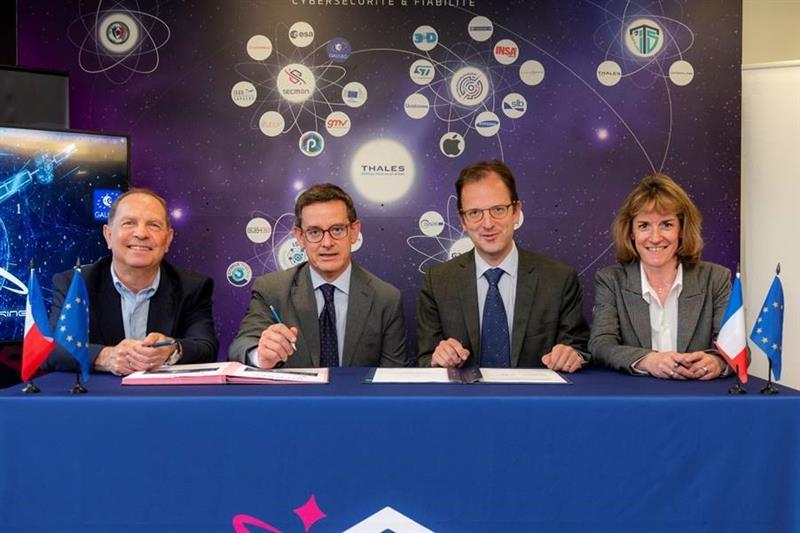
  • PNT by Other Means: Safran Federal Systems

    PNT by Other Means: Safran Federal Systems

    An exclusive interview with Garrett Payne, Navigation Engineer, Safran Federal Systems (formerly Orolia Defense & Security). For more exclusive interviews from this cover story, click here.


    What led to the Versa PNT?

    Payne.
    Garrett Payne

    It is an all-in-one PNT solution that provides positioning, navigation, and very accurate timing. We can take in GNSS signals, as well as the satellite signals, and integrates that with an IMU for a fused solution. I work on the navigation filter and software inside it. So, I’ve been able to get deep into developing and fine tuning the filter inside for an assured and robust navigation solution. I’ve been able to integrate some other new kinds of PNT technology into that as well. So, I’ve been working on projects with integrating odometry for speed and measurements from a vision-based sensor for position fixing. Those are all complementary PNT sources that help the Versa. You always have a good fused solution, even if you’re in a GNSS-degraded/denied environment.

    It sounds like a sort of extreme sensor fusion, integrating every possible PNT source.

    Correct. GNSS has global coverage, of course, while some positioning sources, such as UWB, are very local.

    Can a Versa on a mobile platform transition seamlessly from one to the other?

    It’s all very configurable. You can plug-and-play the sensors that you have. Then, you can check the integrity of each measurement source. For example, if you’re in a GNSS-degraded environment, the Versa has some software that can alert you to that and will automatically filter out those measurements, and then navigate based on the other sensors.

    With UWB, if there’s nothing local and already mapped out, could you set up some transmitters very quickly, as needed?

    Versa PNT. (Image: Safran Federal Systems (formerly Orolia Defense & Security))
    Versa PNT. (Image: Safran Federal Systems (formerly Orolia Defense & Security))

    Our goal with this project of integrating UWB technology is to identify the exact sensors that we would need. Then it would just be plug-and-play: you would take a Versa unit and plug in a UWB sensor, and it would be able to automatically detect that and talk to other Versa systems that have UWB transceivers. Once we get all the software figured out, it will be simple in GNSS-denied environments for these UWB transceivers to start talking to each other.

    If you have units within a building that all have Versa PNTs with UWB, they can see each other’s relative position, but not their absolute position. However, if one of them is located at a known point, such as the entrance or a corner, that would serve as a reference for the other ones to know where they are within the building.

    Right. The technology is proven. There are already sensors that do that in warehouses and other large buildings. We want to take that idea and expand it to other GNSS-denied/degraded locations. It would be the same concept: one Versa unit goes on the edge of an area and knows its location, then broadcasts it to other Versa units with UWB technology, enabling them to determine their absolute location as well.

    If 50 meters is not enough to get outside the GNSS-denied/degraded area, you might set up a chain or a mash of as many units as needed.

    Correct.

    What’s your rough timeline to go live?

    Currently, we’re evaluating UWB computer technology from different vendors and integrating it in the software portion. We will probably begin performing full field tests in the first quarter of 2024.

    Are there any non-defense applications, such as with first responders?
    We also provide very accurate beaconing signals that are used for location purposes. So, this is an additional technology that can be used in GNSS-degraded locations — such as deep urban canyons, jungles, or inside buildings — as long as long as you’re within range of the UWB transceiver.

    You could accurately survey a point inside a structure ahead of time. Then you could place your UWB transmitter in that surveyed spot and provide the coordinates to other units for use in positioning.

    Right, right. If you’re thinking of a very large building in a city, on every floor you could have a beacon in a very accurately surveyed location. So, if you’re in a rush, you can automatically determine your range from different beacons and use that data to determine your position.

    How long has Versa PNT been available? Did it evolve from a previous solution you had?

    Our company has been founded on timing. We have VersaSync, which provides very accurate timing signals. We’ve extended on that by adding a navigation solution. Many of our customers are using the timing portion of our platforms to generate very accurate frequency reference signals. It also provides an assured navigation solution by fusing GNSS and inertial data.

    What markets and applications are you targeting?

    Versa PNT. (Image: Safran Federal Systems (formerly Orolia Defense & Security))
    Versa PNT. (Image: Safran Federal Systems (formerly Orolia Defense & Security))

    We’re providing precise position, timing, and situational awareness for different applications. Our systems can be used for ground, air, and sea-based applications. We specifically at Orolia Defense and Security [now Safran Federal Systems] market towards the U.S. government, defense organizations, and contractors. Our systems have applications beyond defense and security, as they can be used anywhere accurate position and/or timing is needed.

    How does the Versa fit into the larger debate about developing complementary PNT capabilities to compensate for the vulnerabilities of GNSS?

    It is an expensive, high-end solution that fits a few niches. Every type of sensor that you’re using for PNT has its strengths and weaknesses. That’s why we have a very accurate navigation filter solution that dynamically evaluates the sensor inputs. GNSS is great but not always accurate or available. Other sensors are also not always reliable. That’s why we try to make the unit and the software inside it as customizable and flexible as possible.

    Can you give me a couple of use cases?

    If a ground vehicle application is entering a GNSS denied/degraded environment, the Versa PNT’s software will detect any kind of GNSS threat. So, it’s going to cut off the GNSS speed and continue to provide a PNP solution based on inputs from the other sensors — such as an IMU, a speedometer, an odometer, or a camera. They’re all providing you different position feeds, so that you can still have an insured position.
    The VersaPNT also contains internal oscillators that can provide very accurate timing signals.

    An IMU-derived position drifts, of course, so it needs to be periodically re-initialized.

    That’s why it’s important to use a navigation filter that’s initialized with a good position from GNSS or other sources, so that you can estimate and dynamically correct the IMU drift using bias terms and offsets.

  • PNT by Other Means: Spirent

    An exclusive interview with Paul Crampton, Senior Solutions Architect, Spirent Federal and Jan Ackermann, Director, Product Line Management, Spirent Communications. For more exclusive interviews from this cover story, click here.


    Jan, what is the role of simulation in building a new GNSS with a very different constellation and very different orbits than existing ones?

    J.A.: Before the Xona constellation or any other emerging constellation has deployed any satellites, simulation is the only way for any potential end-user or receiver OEM to assess its benefits. Before you can do live sky testing, a key part of enabling investment decisions — both for the end users as well as the receiver manufacturers, and everybody else — is to establish the benefits of an additional signal through simulation. Once it’s all up there and running, there are still benefits to simulation, but then there’s an alternative. Right now, there really isn’t an alternative to simulation.

    With existing GNSS, you can record the live sky signals and compare them with the simulated ones. It’s a different challenge when it’s all in the lab or on paper.

    JA: Yes, but it is not an entirely novel one, at least to us at Spirent. We went through it with other constellations and signals -for example with the early days of Galileo. It’s often the case that ICDs or services are published before there is a live-sky signal with which to compare them. So, we do have mechanisms in terms of first generating it from first principle, putting out the RF, running tests with that RF, and then seeing that what we put out is actually what we expect based on our inputs and the ICD. Obviously, we always work off the ICD, which is essentially our master. Then, a lot of work needs to happen to turn what’s written in the ICD into an actual full RF signal, overlay motion, and all those things. So, we have a well-established qualification mechanism to make sure that whole chain works for signals when we don’t have a real-world constellation.

    Another very important check is when you work with some of the leading receiver manufacturers who have done their own implementation and you bring the two things together and see if they marry up. Then there’s always a bit of interesting conversation happening when things don’t line up, but we have a lot of experience in resolving that. So, there’s the internal (mathematical) validation of things — which we do internally, before we bring something to market — and then there is validation with partners, be they the constellation developer or a receiver manufacturer – or both.

    JJ: Then, one step further from the receiver manufacturers, what we call the OEMs, want to validate that the receiver is doing what it’s supposed to do. The best way to do that is with a simulator. You can try to get a live sky signal, but it can be difficult. You must get on a roof. It may not have an optimal environment for that. The best way to prove that in a controlled environment is with a simulator. Spirent works with two levels of customers: first, the receiver manufacturers, then all the application vendors or OEMs that use those receivers.

    JA: What we’ve done with the SimXona product recently follows very closely along those lines. First, we did validation ourselves. Then, we worked in a close partnership with Xona for them to certify that against some of their own developments. So, we follow that same proven development approach. It’s just that, in this case, the signal comes out of a LEO.

    What is the division of labor here between Spirent Communications and Spirent Federal? In particular, which device comes into play with Xona?

    PC: Spirent Federal has provided support to Xona but the equipment is the COTS equipment provided from the UK by Spirent Communications.

    JA: This Xona product does not currently implement any restricted technology only accessible through Spirent Federal. That is very much the case, especially for the aspects of secure GPS, for which we have the proxy company, Spirent Federal. However, the SimXona product is a development through Spirent Communications, albeit heavily aided by Spirent Federal, from a technical perspective and others, but there are no Spirent-Federal-specific restricted elements to SimXona or the current Xona offering.

    PC: If we ever had to go into a U.S. government facility to demonstrate SimXona or to sell it to them, that would be Spirent Federal that would be involved.